Get Full Government Meeting Transcripts, Videos, & Alerts Forever!
Get email alerts on the Opioid Abatement topic
No spam. Unsubscribe anytime.
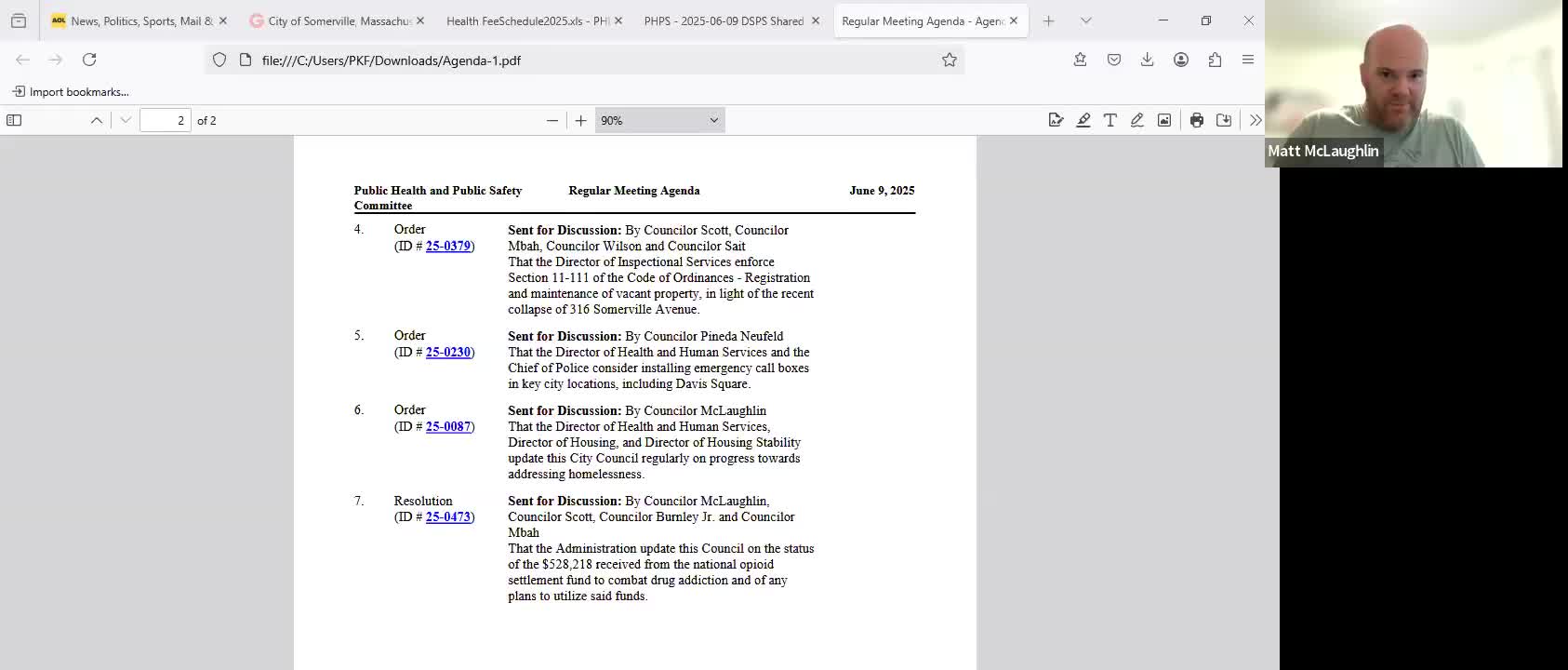
Somerville outlines use of $528,218 in opioid settlement funds for kiosks, vending machines and care‑coordination software
Summary
City staff told the Somerville Public Health and Safety Committee that $528,218 from the National Opioid Settlement Fund will fund public‑health vending machines, sharps‑disposal kiosks and care‑coordination software.
City staff told the Somerville City Public Health and Safety Committee that the city will allocate $528,218 from the National Opioid Settlement Fund toward three main categories: public‑health vending machines (and ongoing maintenance), sharps‑disposal kiosks, and a care‑coordination software system for referrals among city and regional providers.
Liaison staff explained that one sharps kiosk is installed in the Davis Square area and an indoor sharps kiosk is located at the Somerville Homeless Coalition site; two additional kiosks have been purchased for installation next year. The vending machines discussed are public‑health vending machines intended to provide harm‑reduction supplies; the city will pay for maintenance and upkeep from the settlement funds. Staff said maintenance and ongoing operating costs are included in the fiscal‑year plans.
The committee also heard that care‑coordination software will be used to allow multiple service providers — city staff, regional partners and nonprofit providers — to use a single database to track referrals, avoid duplication, and reduce loss to follow‑up. Staff said this should improve continuity of care among Somerville and neighboring cities with shared agreements.
Committee members asked about restrictions on settlement funds and direct‑service spending. Director Karen Carroll, Health and Human Services, and staff said the funds must be linked to activities responding to opioid impacts and to people and families affected by opioid misuse; examples given in the meeting include harm‑reduction equipment, sharps disposal, and services identified in an opioid abatement needs assessment. Staff agreed to provide more detailed guidance on specific allowable uses and to share information about other municipalities’ use of similar software upon request.
Committee members emphasized priorities for direct services that keep people alive and facilitate access to treatment. Staff said existing uses (kiosks, vending machines, software) reflect needs identified in the needs assessment and in focus groups with people directly affected by the opioid crisis.
Next steps: staff will continue to implement the stated purchases and maintenance and provide the committee with more detailed information on restrictions and longer‑term plans as requested.