Get Full Government Meeting Transcripts, Videos, & Alerts Forever!
Get email alerts on the Land Use Regulations topic
No spam. Unsubscribe anytime.
Commission tables extensive code amendments on congregate living and short‑term rentals for one month
Summary
The Planning and Zoning Commission tabled COD25‑0001, a broad code amendment on congregate living facilities and short‑term rentals, after staff presentations and requests from commissioners for more review time.
The Planning and Zoning Commission voted to table COD25‑0001, a comprehensive ordinance updating the City of Ocala Code of Ordinances on congregate living facilities and short‑term rental residences, after an extended staff presentation and discussion.
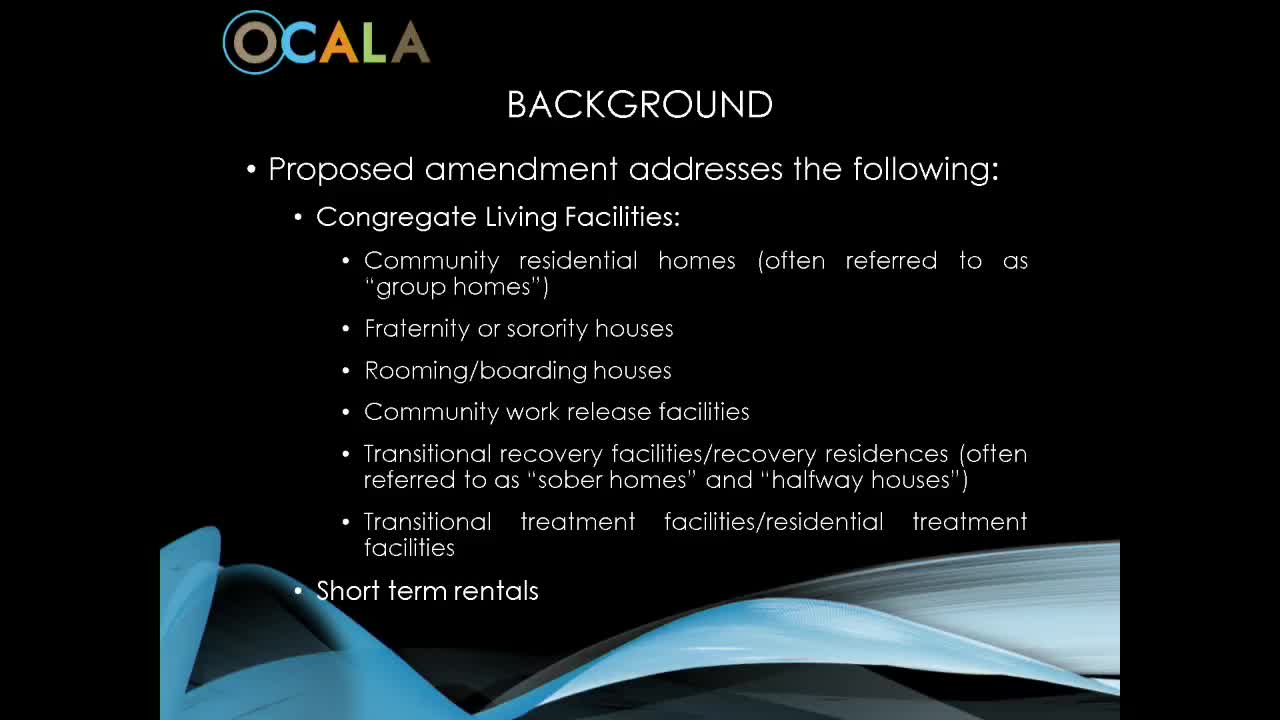
Planner Emily Johnson summarized the proposal as aligning local definitions and permitted‑use tables with state statutes and creating a standardized set of supplemental regulations for uses such as community residential homes (group homes), recovery residences (sober homes), residential treatment facilities and similar uses. The ordinance would also formalize that certain recovery residences and residential treatment facilities require a special exception in specific zoning districts and move special‑exception hearings for congregate living facilities to city council rather than the Board of Adjustment. Johnson noted the ordinance would require a business tax receipt when appropriate and referenced pending state legislation (noted in the staff presentation as Senate Bill 954) that affects short‑term rental regulation.
Growth management director Jeff Schrum said the text amendment responds to council direction after public concerns, noting much of the local code was older and inconsistent with statute. Schrum explained the proposal allows the city manager or designee to administratively grant waivers for recovery residences that receive voluntary certification under Fla. Stat. 397.487 (the Florida Association of Recovery Residences certification process) — a measure reflecting pending state guidance. He also said staff and police/code‑enforcement will discuss possible enforcement tweaks outside this amendment.
Commissioners expressed the item was lengthy and requested more time to review the changes and potential implications of pending state law. One commissioner suggested the board should consider a workshop for the text amendment. After discussion, a motion to table COD25‑0001 to the next meeting carried on a roll call vote. The tabling motion recorded aye votes from Branson, Boudreaux, Carlock, Martin, McDonald, London and Lopez.
Why it matters: The amendment would change how the city treats congregate living facilities and short‑term rentals by standardizing definitions, requiring special exceptions in some districts and enabling administrative waivers tied to state certification for recovery residences. Staff cautioned that state preemption limits local regulatory authority for certain short‑term rental regulations and that the package may be refined depending on state action.