Get Full Government Meeting Transcripts, Videos, & Alerts Forever!
Get email alerts on the Reasonable Assurance Plan topic
No spam. Unsubscribe anytime.
Advisory board hears technical progress on Biscayne Bay reasonable assurance plan; $20 million in state Bay grants sustained
Summary
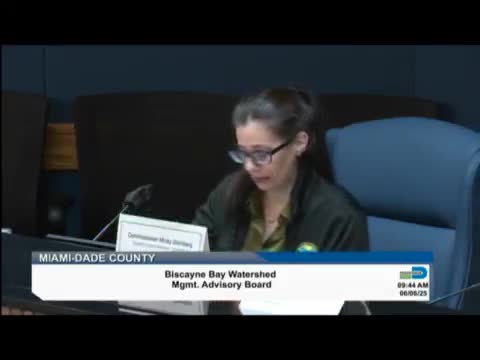
Commissioner Mickey Steinberg presided over a Miami-Dade advisory board meeting where county staff presented a technical progress update on the Reasonable Assurance Plan (RAP) and confirmed continued state funding for Biscayne Bay grant programs.
Commissioner Mickey Steinberg on Tuesday presided over a Miami-Dade Biscayne Bay Watershed Management Advisory Board meeting where county staff delivered a technical progress update on the Reasonable Assurance Plan (RAP) intended to reduce nutrient pollution in Biscayne Bay.
The RAP update presented by Pamela (staff member) described the completed hydrological-biological model, the project verification tool for stormwater and wastewater projects, and a proposed timeline to submit a draft RAP to the Florida Department of Environmental Protection next summer with a final submission by the end of 2026. Jess McCarty, executive assistant county attorney (participating from Tallahassee), also briefed the board on the 2025 Florida legislative session and confirmed that the state's annual Biscayne Bay grant line remains funded at $20,000,000.
The RAP outlines three steps: identify pollutants of concern (total nitrogen, total phosphorus and chlorophyll a), set water-quality targets and allocate required load reductions to sources and projects. Pamela told the board the county's technical team has constructed an integrated groundwater-surface-water model and will run calibration and validation in the coming months to compare historical data with modeled results. "The hydrological model has been constructed," she said, adding that model outputs will allow the team to estimate how proposed projects reduce nutrient loads.
Why this matters: the RAP becomes a formal implementation tool under DEP and EPA processes and will determine how reductions are measured and allocated among municipalities, utilities and other dischargers. The board and public speakers repeatedly pressed for clarity about enforcement, monitoring recognition and funding.
Key details and next steps
- Model and technical work: County consultants (GHD with ESA participating) have built an integrated hydrological-ecological model meant to capture groundwater-surface-water interactions and pollutant transport; calibration and validation runs are underway. A dashboard was shown to board members to visualize historical conditions and candidate target years.
- Project verification and stakeholder engagement: Tetra Tech and county staff have launched a project verification tool and asked municipalities and other stakeholders to submit project lists (including projects back to 2017 and planning for the next 5-10 years). The county is collecting this information so projects that meet state guidance can be credited in the RAP.
- Timeline: Pamela reported the county is on track to submit a draft RAP to the state in summer 2026 (internal milestone described in presentation), with a final submission to DEP by the end of 2026; the state and EPA will review thereafter.
- Monitoring and credits: Public comments and board members emphasized that monitoring, data collection and adaptive management should be recognized in implementation. Adriana Gonzalez Fernandez (science and research director, Miami Waterkeeper) and Francesca De Julio (Everglades Law Center) urged DEP and stakeholders to find ways to formally recognize monitoring and upgraded MS4 activities (catch-basin maintenance, street sweeping, inspections) through conditional credits or bonus scoring because such work helps detect unintended outcomes and guide adaptive management.
- Funding and grants: Jess McCarty said the Legislature sustained the Biscayne Bay allocation at $20,000,000. He also listed budget items still in conference as of his briefing: $100,000 for boating safety, $1,375,000 (reported for Goulds Canal earlier), $250,000 for bay monitoring and telemetry, and a separate $2,750,000 referenced for the C-9 Canal. McCarty told the board, "There were some misreadings of some of the spreadsheets," while clarifying that both House and Senate conference documents funded the $20,000,000 line for Biscayne Bay.
Discussion vs. decision
The presentation was informational; no regulatory allocations or new county rules were adopted at the meeting. Board members repeatedly requested clearer enforcement and reporting thresholds, more frequent stormwater maintenance, and a mechanism for regular municipal accountability. Pamela and staff said the RAP will be an order of the DEP secretary once adopted and that the county is assessing how allocations might integrate into stormwater permits and other regulatory hooks.
Public comments and separate initiatives
Speakers at public comment urged practical steps that the RAP could support: Miami Waterkeeper recommended municipalities consider asset management systems to locate pollution hot spots and prioritize inspections; Friends of Biscayne Bay urged the mayor's Boater Safety and Bay Education Task Force to include a specialized bay environmental expert and promoted a derelict-trap cleanup event on July 12 at Matheson Hammock Park. Speakers also urged municipalities to use the current budget season to increase funding for stormwater maintenance and marine patrols.
Board follow-up and reporting
Staff said they will return with more technical detail from consultants at a future meeting (the chair indicated a deeper technical session will be scheduled), will convene periodic stormwater roundtables for municipal coordination, and will post RAP materials and progress on the county's Biscayne Bay landing page (miami.gov/biscaynebay). The county also plans further meetings with DEP and the South Florida Water Management District as the model is finalized.
Ending
Board members flagged the need for clearer, routine performance thresholds so that municipalities and stakeholders can track incremental improvements and identify which projects are on schedule or delayed. Staff said the RAP and related monitoring will create the data streams needed to show incremental change once projects begin to come online.