Get Full Government Meeting Transcripts, Videos, & Alerts Forever!
Get email alerts on the Economic Development topic
No spam. Unsubscribe anytime.
Land use committee advances three citywide use changes tied to Summer Nova; master-plan overlay and mobility controls remain under review
Summary
A joint hearing of the Somerville City Land Use Committee and the Planning Board on June 11 recommended approval of three zoning-use changes related to the proposed Summer Nova redevelopment, while leaving the project—s arts-and-innovation master-plan overlay for further review.
A joint hearing of the Somerville City Land Use Committee and the Planning Board on June 11 recommended approval of three zoning-use changes related to the proposed Summer Nova redevelopment, while leaving the project—s arts-and-innovation master-plan overlay for further review.
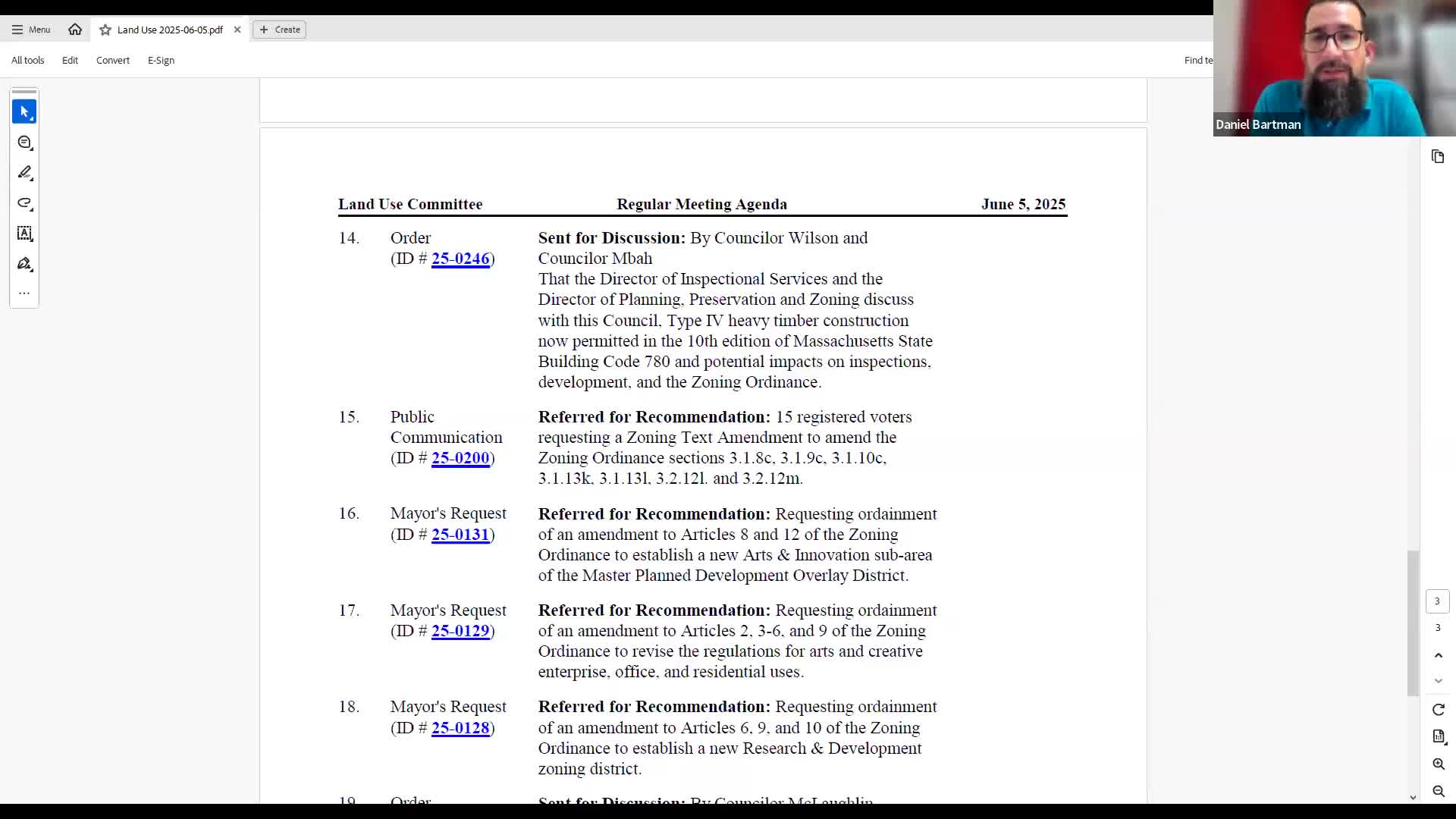
The committee voted, by roll call, to recommend approval of: (1) a citywide amendment to arts and creative enterprise (ACE) categories; (2) a new Research & Development (R&D) base zoning district meant to replace or supplement the existing Fabrication district for certain parcels; and (3) revised laboratory-use definitions and regulations. Votes on each item were recorded as unanimous (5-0) in committee and will be considered by the full council as part of the broader process.
Why it matters: Those three use-level changes would alter what kinds of businesses and activities are allowed by right (or by permit) across parts of Somerville, and are linked to larger master-plan proposals for the Summer Nova campus in Union Square. Committee discussion focused heavily on transportation and parking safeguards built into the overlay proposal and the community benefits agreement (CBA) negotiated with local neighborhood groups.
Planning staff and mobility experts told the committee the R&D zoning was drafted in part to respond to risk assessments about laboratory uses and to preserve a path for existing tech / lab tenants while keeping some manufacturing- and arts-related uses in place. Director-level staff noted the R&D district keeps the same scale limits as the Fabrication district (four stories, 60 feet) but changes the permitted uses and increases the required ACE space from 5% to 10% on redevelopment.
Mobility and monitoring: The proposal for the Arts & Innovation subarea that remains under discussion would allow taller buildings and a different site plan than the base R&D/Fabrication districts. As presented to the committee, the overlay includes a city-negotiated package of mobility controls and reporting requirements the proponent agreed to in the CBA. Key elements described to the committee include: - A parking cap inside the overlay (7 50 total spaces across the master plan) and a requirement that planning board approval use a staff-prepared parking demand model to determine how much parking should actually be built; - Mobility management and monitoring tied to permitting: initial mode-share targets would allow up to 40% of site trips to be by automobile at opening, but require a drop to a 25% automobile mode share for residents and employees by two years of occupancy; monthly commercial-parking utilization reporting, monthly pickup/drop-off and delivery reporting, and quarterly resident/employee travel surveys were described as part of the enforcement package; - Permit controls that allow the planning board to impose conditions, reprogram or limit use of parking facilities, and deny or refuse master-plan approval if consistency and required findings are not met.
Representatives for the Summer Nova development told the committee the parking number reflects tenant needs and lender expectations but said the proponent will work with city staff on demand-modeling and that the ultimate number built can be reduced through project-phasing and later permitting. Russell Preston (Summer Nova) described the mobility package as "a very rigorous and comprehensive mobility set of mobility requirements" and said the team plans to use shuttles, transit passes, bike programs, childcare on site and other measures to reduce drive-alone trips.
The committee also received notice that the Union Square Neighborhood Council provisionally reported a CBA vote tally of 2,208 ballots cast with 71% supporting the agreement. The committee did not take a vote on the overlay master-plan special permit or on the Summer Nova subarea itself; those are expected to return for further review and would require additional planning-board and council actions.
What comes next: Because the R&D district and the ACE and lab-use amendments are citywide code changes, the committee forwarded all three to the full council with a recommendation for approval. The overlay and master-plan level approvals (the site-specific items that allow taller buildings and the block-by-block plan) remain in active discussion; the planning board has a central gatekeeping role for master-plan special permits and can deny a master plan if the board finds it is not consistent with required findings. Mobility staff told the committee changes to signal timing, parking pricing, or other city-level capital improvements could be part of mitigation if monitoring identifies problems.
Ending: Committee members said they planned additional community outreach and follow-up on mobility details before the council acts on the overlay. The use changes approved in committee will move on to the full council agenda, while the overlay master-plan and several related site-specific zoning questions remain to be resolved in subsequent hearings.