Get Full Government Meeting Transcripts, Videos, & Alerts Forever!
House subcommittee hears clash over open-banking rule, GLBA modernization and small‑bank impacts
Summary
Members of the House Financial Services Subcommittee on Financial Institutions and five witnesses debated whether to modernize the Gramm‑Leach‑Bliley Act, preserve the CFPB’s open‑banking rule under Dodd‑Frank section 1033, and how a patchwork of state privacy laws, API costs and liability rules affect consumers, fintechs and small banks.
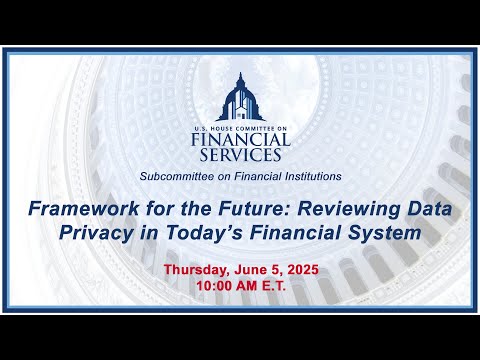
The House Financial Services Subcommittee on Financial Institutions convened a hearing to review data privacy in the financial system, focusing on whether to modernize the Gramm‑Leach‑Bliley Act (GLBA) and how the Consumer Financial Protection Bureau’s (CFPB) recently finalized personal financial data rights rule under Dodd‑Frank section 1033 should be treated.
The hearing matters because technological change has multiplied the volume and sensitivity of consumer financial data, raising tradeoffs between consumer privacy protections, fraud prevention and continued innovation in payments and fintech services.
Chairman Andy Barr, chair of the subcommittee, opened the hearing by framing the policy tradeoffs: lawmakers must “balance robust privacy protections with innovation, access, and reduced regulatory burden,” and asked whether GLBA remains fit for purpose in a data‑driven era. Ranking Member Bill Foster urged preserving the CFPB rule implementing section 1033, calling it “significant because it gives consumers greater rights, privacy, and the security over their personal financial data.”
Five witnesses gave five‑minute statements and answered members’ questions. Scott Talbot, executive vice president of the Electronic Transactions Association, emphasized the scale of modern payments and the industry’s reliance on existing GLBA and state rules. “In fact, during the minute the 5 minutes I will speak today, this morning, roughly 1,500,000 transactions will be processed in The US,” Talbot said, arguing that payments firms need clarity and a uniform national standard to…
Already have an account? Log in
Subscribe to keep reading
Unlock the rest of this article — and every article on Citizen Portal.
- Unlimited articles
- AI-powered breakdowns of topics, speakers, decisions, and budgets
- Instant alerts when your location has a new meeting
- Follow topics and more locations
- 1,000 AI Insights / month, plus AI Chat