Get Full Government Meeting Transcripts, Videos, & Alerts Forever!
Get email alerts on the Land Use Cluster Development topic
No spam. Unsubscribe anytime.
Wellington advisory committee proposes returning to 2018 "cluster development" rules, limits on commercial uses
Summary
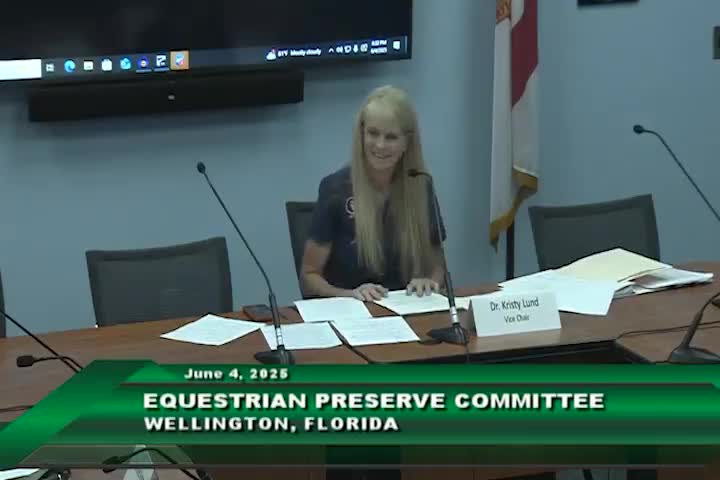
Christy, committee member, opened the Equestrian Preservation Committee meeting to discuss section 6.8.8 of the Village of Wellington Land Development Regulations after receiving a legal opinion; the committee agreed to draft advisory language restoring the 2018 cluster-development approach, defining equestrian open space, and limiting commercial uses in cluster projects.
Christy, committee member, opened the committee’s workshop by urging the group to draft clear guidance for council on section 6.8.8 of the Village of Wellington Land Development Regulations (LDRs), which governs “cluster development” in the Equestrian Overlay District. She said she had received a legal opinion and that the committee’s task was to advise council on land-development language that would best protect equestrian uses.
The committee agreed on a set of baseline recommendations to present as advisory guidance to council rather than as binding law. Committee members said the practical goal is to restore the intent of the equestrian preserve and to remove ambiguity introduced by the 2019 LDR rewrite. “I think the guardrails are how much do we want to appear to be working within the context of this bill seeing the light of day versus not,” said Tim, staff member, during the legal overview. Tim also explained the committee’s options if a pending state bill were to become law and summarized timing: bills sent to the governor often have an effective date of July 1, and the governor may sign, veto or take no action.
Why it matters: members said the 2019 insertion of 6.8.8 removed specific definitions and expanded where cluster development could be applied; the committee cited the recent Ala/Isla Carroll application as an example of unintended consequences from vague language. Committee members identified several policy risks that, they said, have not been resolved in the current LDR text: inconsistent definitions of “open space,” the elimination of an earlier definition of “equestrian cluster development,” and the ability for planned development (PUD) rules to allow commercial amenities that the advisory committee wishes to exclude from equestrian cluster projects.
Specific advisory recommendations the committee agreed to draft and forward to council include: - Revert the 6.8.8 text toward the 2018 language and restore a clear definition for “equestrian cluster development” in the LDR definitions section; - Define “open green space” as land reserved for exclusive equestrian use (examples discussed: grass polo fields, paddocks, derby fields; exclusion: revenue-generating commercial businesses); - Limit the availability of cluster development to Subarea D of the Equestrian Overlay District (the committee’s stated baseline); - Set a minimum project acreage threshold to qualify for a cluster development (committee discussion centered on illustrative thresholds of 60–100 acres; members suggested 60 acres as a working proposal); - Require that a substantial share of the project be preserved as open space (committee members proposed 50% of total acreage as the open-space baseline) and that a minimum portion of the project be dedicated to equestrian amenities (committee discussion suggested a 20% minimum of the project acreage for equestrian amenities); - Specify what counts as equestrian amenities and what does not: allowed items the committee identified included barns (with feed/storage and wash stalls), covered and uncovered arenas (lighting limited to arena interior, not stadium-style exterior lighting), paddocks and dressage walls; items expressly excluded or to be tightly controlled included general commercial membership clubs and revenue-generating outside memberships; manure management and feed storage were discussed as necessary support facilities but not to be treated as public commercial operations; - Require that the communal equestrian amenities intended to serve the cluster be constructed or guaranteed (deed restriction/HOA mechanism) prior to issuance of certificates of occupancy for the residential units; - Restrict use of cluster amenities to property owners, residents and their invited guests (no outside membership or commercial customers); and - Ask village staff to run scenario tests (example parcels and acreage simulations) before the committee finalizes a proposed text to present to planning and zoning and council.
Committee members emphasized the advisory — not decisionmaking — role. “Our job is to advise council on what’s best for the community,” one member said; another added, “We should not self-censor.” Tim warned that pending state legislation could reduce local flexibility: he summarized that a proposal discussed at the meeting would carve out exceptions for privately initiated applications and include a moratorium-like restriction tied to a federal disaster declaration (members discussed SB180 language and a July 1 effective date as context). Committee members asked staff to forward the village attorney’s letter and to prepare a written draft for the next work session.
Other items discussed briefly: the committee reviewed ongoing county and state policy signals that could affect local rules — including recent bills addressing agricultural products, manure processing and agricultural worker housing — and an unrelated application (a manure/processing operation along Flying Cow Ranch/Owsley Road) that committee members said will proceed under existing land-use designations. Tim and staff noted that agricultural uses and certain manure-processing activities have been treated by state agencies as agricultural products in previous Department of Environmental Protection (DEP) and Solid Waste Authority determinations, and that new state bills could change the legal landscape.
Next steps: committee members asked staff to prepare a draft LDR amendment that incorporates the definitions and regulatory guardrails identified above, plus scenario testing on sample parcels. The committee agreed to review staff’s draft in a followup work session (members discussed an August meeting window) and to share their advisory text with council members informally while staff prepares the formal draft for planning-board and council review.
Ending: The session closed with procedural items and a motion to adjourn; committee members said they would circulate the staff draft and reconvene to finalize the advisory recommendation for planning and zoning and council.