Get Full Government Meeting Transcripts, Videos, & Alerts Forever!
Get email alerts on the Short Term Rentals topic
No spam. Unsubscribe anytime.
Oakland Park amends restrictive covenants to allow limited short-term rentals at two mixed-use buildings
Summary
The City Commission voted unanimously June 4 to amend a voluntary restrictive covenant on the Oakland and Park buildings, allowing up to 25 units per property to be used for short-term rentals on a rotating (non‑dedicated) basis while preserving a six‑month minimum lease requirement for the remaining units.
The Oakland Park City Commission on June 4 voted to amend a voluntary declaration of restrictive covenants on two mixed‑use properties at 3333 and 3363 North Federal Highway to allow up to 25 units in each building to be used for short‑term rentals on a rotating basis, while keeping a six‑month minimum lease requirement on the remaining units.
The change stems from a request by the property owners to remove a voluntary covenant they recorded in 2018 (amended in 2019) that had required longer minimum leases. Sierra Marrero, director of engineering and community development, told the commission staff’s recommendation was to consider the applicant’s request to terminate the declaration, noting that hotels and any dedicated hotel‑style use would remain a conditional use under the city’s land development code and would require a separate commission approval.
Applicant Dan Deitchman, a property representative, told the commission the voluntary restriction put the project at a competitive disadvantage and that the buildings already operate with on‑site management, security cameras and 24/7 maintenance. “Our request really is to bring our property even with every other property in Oakland Park,” Deitchman said. He said demand includes traveling nurses and other short‑term essential workers who need flexible stays and that some prospective guests are currently moving into single‑family rentals in nearby neighborhoods because of the covenant.
Commissioners probed enforcement and precedent. Several members sought assurance the amendment would not allow the buildings to convert into hotels without returning to the commission. Marrero and city staff explained the city’s land development code and state law differ: under city code a dedicated set of 25 or more units would classify a property as a hotel; under state statute a change of use that converts 25% of a property to short‑term rentals would trigger hotel classification and licensing. City staff also said the nuisance/code enforcement ordinance can lead to sanctions if repeated violations occur.
Mayor Tim Lonergan expressed concern about neighborhood impacts, saying he is “anti short‑term vacation rentals” because of issues he has seen in the city. Several other commissioners said they were persuaded by the applicants’ assurances about on‑site management and the potential to house short‑term workers in a controlled environment rather than in single‑family neighborhoods.
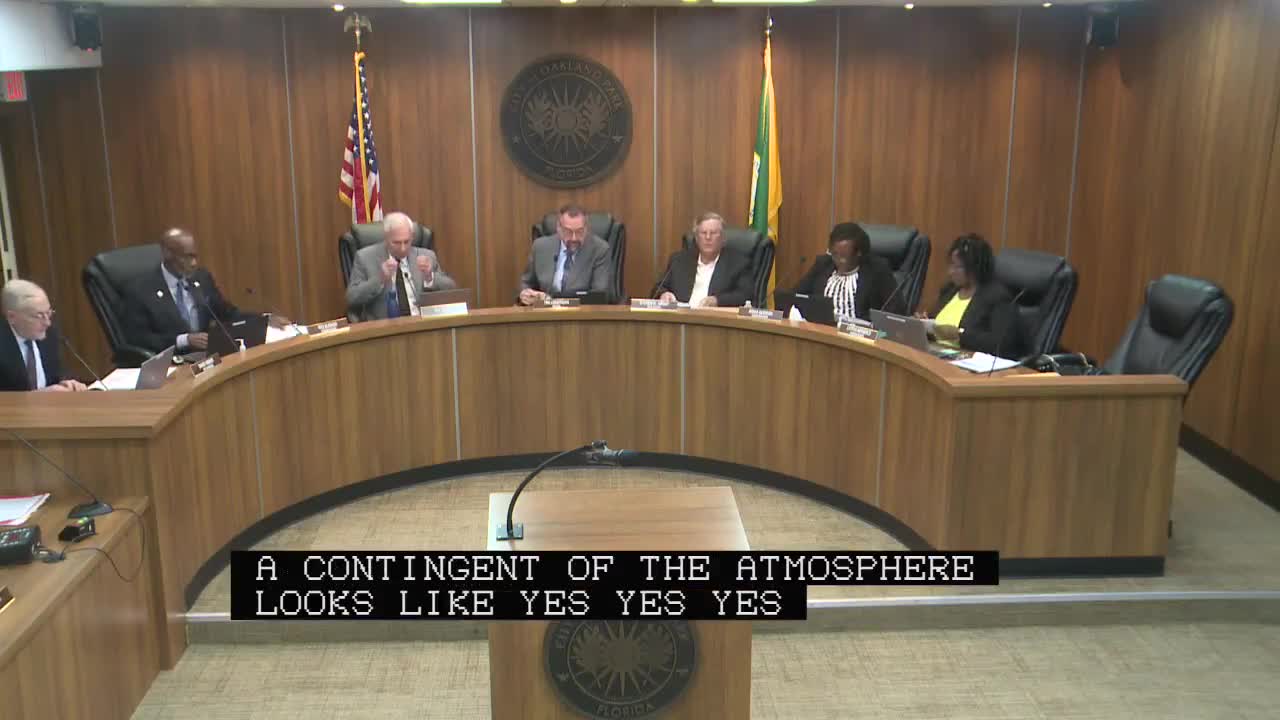
The commission adopted an amended resolution that (1) keeps a restrictive covenant in place for the remaining units with the six‑month minimum lease requirement and (2) expressly allows up to 25 units in each of the Oakland and Park buildings to be used for short‑term rentals in a non‑dedicated, rotating manner. The applicant confirmed on the record that the 25‑unit limit applied to each building. The motion passed on a roll call vote: Commissioner Newbold — yes; Commissioner Budhoo — yes; Vice Mayor Arndt — yes; Commissioner Gordon — yes; Mayor Lonergan — yes.
Why it matters: commissioners framed the vote as a balance between preserving neighborhood quality of life and letting mixed‑use, managed properties serve short‑term workforce demand. The amendment places a numerical cap and keeps the covenant on title for the remainder of units, and staff said any future conversion that met the city or state thresholds for a hotel would require new approvals.
Next steps: the commission directed the city attorney to draft the amended restrictive covenant language and return documents for execution. Staff flagged enforcement mechanisms (code/nuisance proceedings and short‑term registration rules) as the means to address any future problems.
Votes and specific items discussed: the resolution to amend the restrictive covenant (applicant request to terminate/revise covenants for Oakland And Park Buildings), staff recommendation to approve the applicant’s request with modification, and direction to the city attorney to prepare the amended restrictive covenant for execution.