Get Full Government Meeting Transcripts, Videos, & Alerts Forever!
Get email alerts on the Homelessness topic
No spam. Unsubscribe anytime.
Encinitas council updates homeless action plan, directs staff to add enforcement goal and seek local data
Summary
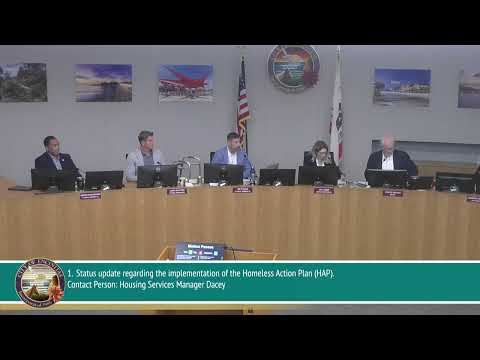
At a special meeting, the Encinitas City Council received a status update on the Homeless Action Plan, asked staff to restore a housing navigator role, to run a city-only homeless count, and unanimously approved new direction that adds an enforcement goal focused on people who refuse services.
The Encinitas City Council on Tuesday received a staff status report on the city's Homeless Action Plan (HAP) and unanimously directed staff to amend the plan to add an explicit enforcement goal, restore housing navigation capacity, run a city-only count and pursue measurable, time-bound metrics.
The action came after a staff presentation from Melinda Dacey, the city's housing services manager, and a nearly three-hour public comment period in which residents, business owners and service providers urged both more services and stronger enforcement. "On May 14, city council received an update on the homeless action plan," Dacey said during the staff report, summarizing recent council direction and budget carryovers.
The council's directive asks staff to continue HAP programs already in place, add a fourth goal focused on enforcement and the service-resistant population, develop SMART (specific, measurable, achievable, relevant, time-bound) metrics for plan goals, and return with recommended changes. The council also directed staff to re-establish a housing navigator role (either in-house or contracted), to create or operate a citywide by-name list in coordination with HMIS, and to run a separate Encinitas-only homeless count to corroborate regional statistics.
The meeting recapped recent local developments: staff said the regional 2025 point-in-time data showed a net regional decrease and noted a reduction in the city's counts described in staff materials as a drop of 32 unsheltered individuals and 19 other unhoused individuals. Staff reported the city had received notice of an intent to award $236,000 from the Permanent Local Housing Allocation program; the award acceptance was scheduled for the June 25 city council meeting and the funds were included in the proposed budget entry tied to the Buena Creek Navigation Center.
Community Resource Center representative John Van Cleef told councilors the HAP "provides a framework grounded in data, coordination, accountability, and care," and cited coordination that now enables CRC to refer clients to 12 Buena Creek navigation center beds. Participants from business and downtown communities emphasized safety and enforcement in public comment; several business owners recounted incidents that they said made employees and customers feel unsafe.
Sheriff's Captain Shane Watts described recent enforcement focus, saying the department had stepped up enforcement efforts: "We have already transitioned, as you know, into a 0 tolerance." Watts told council the sheriff's office supports combining enforcement with outreach, and the city attorney confirmed the municipal-code prosecutions initiated in recent months would proceed through city court.
Council discussion emphasized measuring results and avoiding vague language. Councilmember Schafer proposed a sign-up program for Encinitas residents who would offer housing (for example rooms or ADUs) to people experiencing homelessness; staff were directed to develop a sign-up approach, publicize it and report back after Labor Day. Councilmember O'Hara pressed for stronger mapping of how municipal code enforcement, county prosecution and any state-level tools (including recent ballot measures) could be coordinated to compel treatment or housing for people who repeatedly break the law.
Councilors also asked staff to identify barriers to creating more affordable housing targeted to the needs of people experiencing homelessness (described in the meeting as "acutely" or "critically" affordable tiers), and to return with concrete, measurable updates rather than broad narrative guidance. Several speakers and council members requested clearer reporting on program outcomes such as exits to permanent housing and recidivism.
The council made two formal, recorded decisions during the meeting: (1) to direct staff to create a resident sign-up process to offer housing to unhoused individuals and evaluate the response after Labor Day, and (2) to direct staff to update the HAP with the amendments described above, including adding an enforcement goal and restoring housing navigation capacity. Both measures passed unanimously.
Staff said next steps include drafting the HAP changes, identifying any municipal-code updates recommended by the city attorney and sheriff for enforcement, returning to council with proposed SMART metrics, and reporting back on the sign-up program after Labor Day. Several council members also requested that staff coordinate outreach to the county supervisor's office and other regional partners to pursue collaborative options for temporary and longer-term housing outside city limits when appropriate.