Get Full Government Meeting Transcripts, Videos, & Alerts Forever!
Get email alerts on the Special Education topic
No spam. Unsubscribe anytime.
Norwood hears 500‑page program review calling for centralized IEP monitoring, targeted PD and nursing resources
Summary
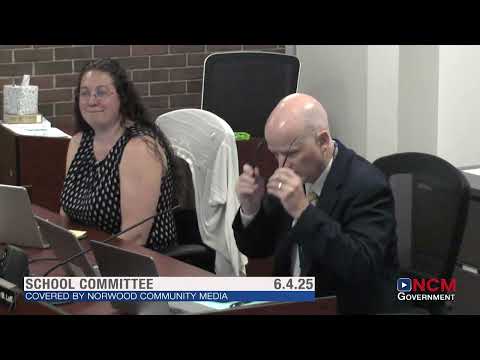
Academic Discoveries, the vendor hired by the Town of Norwood to audit student services, presented a final program review at the June 4 Norwood School Committee meeting that credited the district for "many wonderful great strengths" while recommending a set of systemwide changes to special education, multilingual learner services, counseling and school health.
Academic Discoveries, the vendor hired by the Town of Norwood to audit student services, presented a final program review at the June 4 Norwood School Committee meeting that credited the district for “many wonderful great strengths” while recommending a set of systemwide changes to special education, multilingual learner services, counseling and school health.
The consultant, Dr. Ekstrom of Academic Discoveries, told the committee the review was extensive: 274 survey responses, 270 interviews and focus‑group questions, 84 people in focus groups, 46 classroom observations and review of roughly 196 documents. "Norwood has so many wonderful great strengths," she said, but added the team identified consistent areas for improvement.
Why it matters: the report ties classroom practices to staffing, budget and district processes. The consultants flagged a higher-than‑average share of students on Individualized Education Programs (IEPs) — 24.3% compared with a state average the report cited of 20.6% — and recommended that the district prioritize strengthening universal instruction (MTSS/tier 1) and set a centralized, district‑wide approach to monitor IEP compliance and data collection.
Key findings and recommendations
- Specialized services and classroom practice: Observers saw strong engagement and promising co‑teaching in elementary classrooms, plus effective substantially separate settings. At the same time, the review found inconsistent differentiated instruction and a lack of visible learning targets, agendas and visual aids in many classrooms, especially at the secondary level. Recommendation: targeted professional development on co‑teaching and differentiation and a schoolwide push for visible learning targets.
- IEP monitoring and data systems: The review found no consistent, centralized system to monitor IEP compliance districtwide and recommended implementing such a system, along with standardized data collection tied to professional development impact.
- Multilingual learners (MLs/SEI): Strengths included SEI‑endorsed staff in many buildings, newcomer programming and solid family communication. Areas for growth: ESL teachers serving multiple grades and schools limiting collaboration time, and an intake process for MLs that is slowed by staffing and scheduling. Recommendation: pilot co‑teaching models at selected sites, flexible scheduling for ESL collaboration and an improved intake process.
- Counseling and social‑emotional services: Buildings with multiple school adjustment counselors or behavioral interventionists reported shared responsibilities and reduced caseload pressures. The report noted inconsistent referral systems, limited protected planning time and professional isolation for adjustment counselors. Recommendation: systematize referrals, include related services in student support teams and provide clinical PD; the consultants suggested McLean Hospital as a possible PD partner.
- School nursing and health services: All district nurses were described as RNs with basic life support certification and praised for handling complex medical needs and allergy precautions. Problems identified: insufficient substitute nurses, unclear collaboration between nursing and special education departments, and inconsistent allergy‑safe eating spaces. Recommendation: develop a recruitment strategy for substitute and float nurses, review interactions between health services and special education, and consider partnerships (colleges, urgent care) to build a substitute pool.
- Financial analysis and staffing: The review documented a growth in Medicaid claims and circuit‑breaker reimbursements and noted the district’s relatively high staff ratios for special education (7.3 special education teachers per 100 students; 14.2 paraprofessionals per 100 students in the consultant’s comparative set). The consultants advised removing professional staff from certain grants over time to avoid double retirement contributions and examining scheduling to reduce one‑to‑one pullouts in favor of push‑in services.
Examples the report highlighted: 34 out‑of‑district placements for students with autism or emotional disabilities were concentrated at secondary levels (consultant cited 28 secondary placements for autism, six elementary), which the team recommended as an early focus for developing in‑district options.
Next steps discussed at the meeting
Superintendent (name not specified in the record) said the administration will disseminate the full report to building leaders, start a deep dive with the student‑services leadership team, and share highlights with the public and town meeting members. The committee and administration discussed prioritizing MTSS, targeted PD and budgeting for nursing and related service needs in coming years. Dr. Ekstrom offered to remain available for follow‑up questions.
Voices in the meeting
Committee members pressed for clearer timelines and ongoing public discussion. Chair Ann Marie Mazzola and other committee members emphasized that many recommendations will require town‑level budget conversations. Several members welcomed the report as a starting point for multi‑year planning rather than a single‑step fix.
Ending
The committee accepted the presentation and said it would review priorities and an implementation plan in the coming months. No formal vote on the report was taken that night; the school administration said it will return with prioritized action items and resource requests if needed.