Get Full Government Meeting Transcripts, Videos, & Alerts Forever!
Get email alerts on the Housing topic
No spam. Unsubscribe anytime.
Scotts Valley council adopts housing-element zoning changes, CEQA addendum and SB 9 standards
Summary
After a public hearing with extensive public comment, the council adopted a CEQA addendum and a package of zoning and code changes to implement the city's 2023 housing element, including rezones, new development standards and updates to SB 9 procedures.
The Scotts Valley City Council voted unanimously to adopt an addendum to the General Plan environmental impact report and approve a package of zoning and code amendments intended to implement the city's 2023 housing element.
The changes, presented by Planning Director Taylor Bateman, update land-use designations and development standards for selected residential and mixed-use sites, revise citywide rules on building coverage and multifamily parking, and amend local SB 9 standards and safety/environmental criteria. Bateman told the council the package implements state-mandated requirements and the city's negotiated settlement with the California Department of Housing and Community Development (HCD).
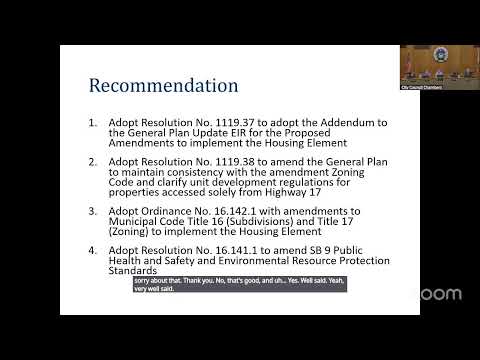
The council adopted the CEQA addendum first, then approved amendments to the General Plan and introduced ordinance changes to the municipal code (Titles 16 and 17) that will allow higher residential density on specified sites, change building-coverage limits in commercial zones, and update multifamily parking ratios. The council also adopted a resolution updating the city's SB 9 public-health, safety and environmental protection standards.
Bateman said the rezones are targeted to the sites identified in the housing element and are not citywide: "These changes apply only to the housing-identified sites and not to all commercial or residential property across the city," he said. He described several categories of changes: residential rezones that allow 20'40 dwelling units per acre on specific properties; mixed-use rezones that permit a larger proportion of residential use (up to 70 percent residential on some sites); and modest adjustments to height and roof allowances to permit three stories while accommodating architectural roof forms.
Why it matters: The package is intended to keep the city in compliance with state housing law and its certified housing element. Bateman warned that failure to implement required changes could put the city at risk of HCD decertification and the loss of local land-use discretion. Council members and staff said that, while they prefer local control, the city has negotiated many of the specifics with HCD and sought to limit broad impacts.
Public comment at the hearing included concerns about traffic, creek-side erosion risk, neighborhood character and notice. Resident Patrick Carroll urged additional environmental and geotechnical study for parcels that abut Carbonera Creek and asked for more time for neighbors to respond: "We have significant concerns about the ecological and geotechnical risks of building significant developments on these parcels," Carroll said. Other speakers asked for careful attention to building heights near existing housing, and asked that any future project proposals include traffic and safety studies.
Council response: Council members acknowledged the public concerns and said the actions adopted now are largely the policy and zoning framework; any individual development proposal would return for separate project-level review with its own environmental analysis, design review and public hearings. Several council members said they had traveled to Sacramento to press the city's case with state officials and described limited options to resist certain state laws.
What the council approved - A resolution adopting an addendum to the General Plan EIR (no new significant impacts found). - Amendments to the General Plan to remain consistent with the rezoning package. - Introduction and first reading waiver for zoning and subdivision ordinance amendments (Title 16/Title 17) to implement the housing element. - A resolution updating SB 9 development standards, including public-health, safety and environmental protections.
Next steps: The ordinance and code amendments introduced will return for final adoption as required by law. The planning staff will continue to track applications and report back as project-level proposals arrive.