Get Full Government Meeting Transcripts, Videos, & Alerts Forever!
Get email alerts on the Mass Graves Investigation topic
No spam. Unsubscribe anytime.
Speakers urge Tulsa council to fund $1 million to continue mass-graves investigation during budget hearing
Summary
During a public hearing on the proposed FY2026 city budget, more than a dozen speakers — descendants, historians and community leaders — urged the Tulsa City Council to allocate $1,000,000 to continue the investigation of mass graves tied to the 1921 Tulsa Race Massacre. No formal budget vote was taken at the hearing.
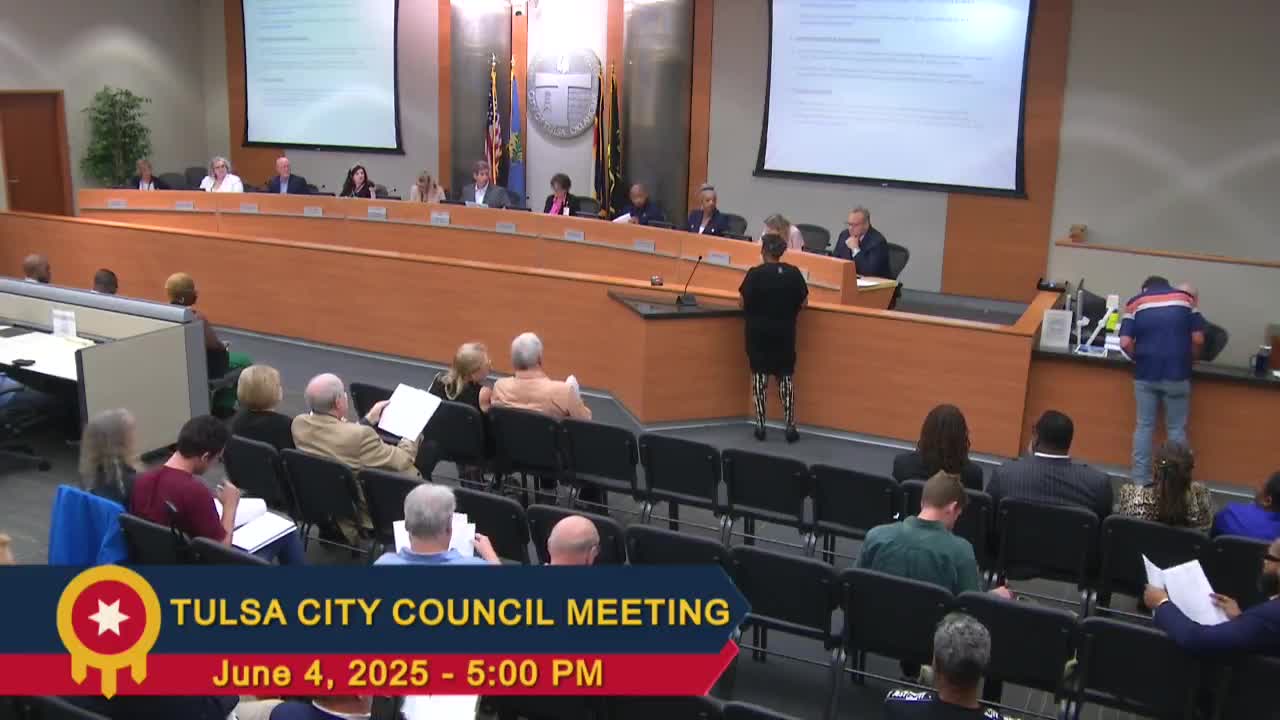
More than a dozen residents, descendants and community leaders addressed the Tulsa City Council during a public hearing on the proposed City of Tulsa Fiscal Year 2026 budget, urging the council to include $1,000,000 to continue an investigation of mass graves tied to the 1921 Tulsa Race Massacre.
Donald Rose Jr., director of operations for the Black Wall Street Chamber of Commerce and a commissioner on the Greater Tulsa African American Affairs Commission, told the council the city has a moral obligation to “identify every victim, notify every family, and to restore the dignity that was denied for over a century.” He singled out the documented case of C.L. Daniel, a World War I veteran whose remains were identified in recent work, as evidence the effort has produced results.
The push for funding drew speakers from community organizations and institutions tied to Greenwood history. Kuma Roberts, president of the Black Wall Street Chamber, called the Greenwood Trust reparations plan a “down payment on justice” and urged the council to back continued investigation and related healing efforts. Cody Ransom, a Greenwood historian and tour guide, said visitors come to Tulsa seeking a complete account of the massacre and warned that stopping the investigation would leave the city’s story incomplete: “We can’t just benefit from the story and not actually finish the story,” he said.
Taylor Ray West, a member of the Tulsa Beyond Apology Commission and a Langston University student, told the council that two survivors remain alive and urged an ongoing investment in the work to identify victims and connect families. Reverend Keith R. Mays Sr., pastor of Vernon AME Church and a Beyond Apology commissioner, praised Mayor Monroe Nichols’ decision to recommend funding and urged the council to view the effort as a bipartisan moral obligation.
Christy Williams, a descendant of massacre victims and chair of the Beyond Apology Commission, described her service on earlier oversight structures and cited the U.S. Department of Justice’s 2025 report addressing the massacre and confirming the existence of mass graves. She said the work must continue until “we bring every ancestor” home and families receive closure.
Dr. Alicia Odewale (archaeologist and descendant), who has served on the oversight and investigation teams, asked the council to both fund the work and restore the original oversight committee’s authority, saying transparency and cross‑committee communication are needed for the physical investigation. Odewale also said her research and that of colleagues has identified many potential sites and that earlier public statements understating the number of sites underestimated the scale; she said her team has accounted for at least 36 potential locations of interest.
Speakers referenced allied funding and work already under way. Several speakers noted private and federal grants that have supported identification and genealogical research, including an Emmett Till genealogy grant that trains investigators and helps solve cold cases; Phil Armstrong, president and CEO of the Oklahoma Center for Community and Justice and a Beyond Apology commissioner, referenced approximately $100 million in private contributions raised in prior phases of the work.
Council members did not take a final vote on the FY2026 budget at this meeting; the session was a public hearing to receive comments. The mayor was not present to report. The council entered and later exited public hearings as part of the evening’s agenda, and the hearing drew at least 13 public speakers recorded by staff. No formal appropriation was adopted during the hearing.
The issue remains scheduled for subsequent budget deliberations; council members will consider the mayor’s proposed allocations, including the $1,000,000 recommendation, during the formal budget process that follows public comment.