Get Full Government Meeting Transcripts, Videos, & Alerts Forever!
Get email alerts on the Economic Development topic
No spam. Unsubscribe anytime.
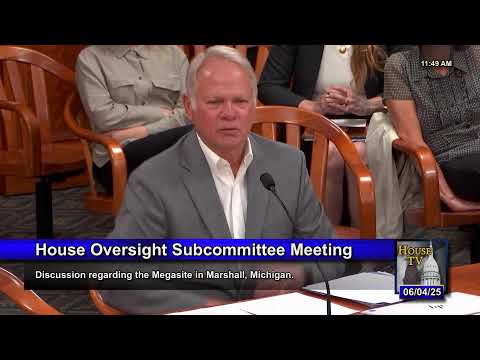
Marshall residents, township treasurer tell House panel they were sidelined in mega site planning
Summary
LANSING — Residents of Marshall and officials from Marshall Township told the Michigan House Oversight Subcommittee on Corporate Subsidies and State Investments that planning for the Marshall "mega site," a large proposed electric‑vehicle battery campus, proceeded with secrecy and heavy state involvement and has harmed local property, environment and civic processes.
LANSING — Residents of Marshall and officials from Marshall Township told the Michigan House Oversight Subcommittee on Corporate Subsidies and State Investments that planning for the Marshall "mega site," a large proposed electric‑vehicle battery campus, proceeded with secrecy and heavy state involvement and has harmed local property, environment and civic processes.
"It wasn't disclosed to us that our new home would be less than a half a mile from a proposed EV battery plant connected to the CCP," said Julianne Bryant, a Marshall resident, during testimony to the committee. She and other residents described nondisclosure agreements, a dark‑money campaign and the demolition of homes and farmland near the Kalamazoo River.
The testimony matters because it raises questions about the use of state tax dollars, local land‑use authority under a Public Act 425 land‑transfer agreement (PA 425), and whether residents were given a meaningful opportunity to weigh in as property was rezoned and cleared. Petition drives and lawsuits seeking a referendum on the rezoning are now before state courts, testimony and documents show.
In testimony, Glenn Kowalski, Marshall Township treasurer, described a multi‑year process in which local land use and infrastructure planning shifted from hundreds of acres to more than 2,000 acres and, as described by some residents, into a footprint of roughly 3,000 acres. Kowalski said the Marshall Area Economic Development Alliance (MEDA) and the Michigan Economic Development Corporation (MEDC) applied for state grants beginning in 2019 to prepare water and site infrastructure and that members involved with planning were asked to sign nondisclosure agreements (NDAs).
Kowalski said the Joint Planning Commission (JPC) voted 4–2 on April 25, 2023, against rezoning the site for heavy industrial use, but the Marshall City Council approved the rezoning in a May 1, 2023, meeting that ran into the early morning hours and passed the measure unanimously. "The next council meeting, which was May 1, the city council completely neglected that vote of the joint planning commission, and without discussion, approve[d] the rezoning with appropriation," Kowalski said.
Both witnesses described efforts by a group calling itself Marshall Citizens for Jobs and Opportunities (MCJO) to oppose the petition drive and influence public opinion. Bryant and Kowalski said MCJO received about $100,000 in outside funding reported in news coverage; the group used robocalls, postcards and advertisements opposing the petition, the witnesses said. Bryant said the postcards included photos of local residents who opposed the project with red X marks and that the material appeared intended to intimidate petition circulators.
Kowalski told the committee that local residents collected 810 petition signatures in support of a referendum — above the 570 required — but that the city clerk found a majority of signatures invalid and rejected the petition. "The petition drive collected 810 signatures in less than 30 days. Only 570 were needed. After this huge petition effort brought by its citizens, the city of Marshall rejected the petition outright," Kowalski said. The petition committee then sued the city; Kowalski said the case is now pending at the Michigan Supreme Court and that the petition committee raised roughly $155,000 from local donors and pro bono legal support.
Witnesses raised environmental, public‑health and infrastructure concerns. Bryant said the site borders about three miles of the Kalamazoo River and that some neighborhood wells could be affected by industrial activity. Kowalski told the committee that the Michigan Department of Environment, Great Lakes, and Energy (EGLE) has documented soil‑erosion violations at the site and that fines have been issued. "Soil erosion violations have already been documented by EGLE. Fines have been issued," he said.
The witnesses also described economic terms they said were part of the package: Kowalski said the city of Marshall has a history of approving 50% tax abatements for companies and that the PA 425 agreement includes a four‑mill pass‑through to the township. He warned that local governments could face higher service costs and fewer tax revenues than expected. "Marshall Township will be receiving essentially half of what we would have and less than we would have if the land had stayed in our jurisdiction and under our tax rolls," Kowalski said.
Both witnesses referred to a proposed partnership involving Ford Motor Company and a supplier identified in testimony as Contemporary Amperex Technology Co. Limited (CATL). Bryant and Kowalski said some residents are concerned about CATL's ties to China and cited news reports and federal actions that limit CATL's business with the U.S. Department of Defense. Those are claims they attributed to public reporting and to their review of the project; the witnesses framed those issues as part of national‑security concerns.
Committee members asked whether local opposition would have been as intense if a different company had proposed a large plant; Bryant said the community would prefer other uses of the land, such as a county park, and added, "We would rather have anything over in that area opposed to an EV battery plant with dangerous components." Kowalski said he is skeptical the plant will ultimately open and said Ford has scaled back some commitments as electric vehicle volumes slowed.
The subcommittee chair and members thanked the witnesses. Committee members noted that the Michigan Economic Development Corporation (MEDC) has testified before the panel in other cases and said they have invited MEDA and MEDC representatives to appear; Kowalski and Bryant said MEDA leadership had not agreed to testify before the committee when asked.
The testimony before the oversight subcommittee described ongoing litigation, disputed local votes, and environmental enforcement actions but did not include committee votes or new state actions. Several factual claims made by residents — including the amount of outside funding received by advocacy groups, the precise acreage cleared, and the details of legal filings and appointments of specific attorneys to judicial posts — were presented to the committee as the speakers' account or as reported in media and court filings.
The petition committee's lawsuit is pending at the Michigan Supreme Court; EGLE enforcement and the status of tax‑incentive agreements remain matters for local and state agencies.
For follow up, the subcommittee said it will continue oversight and has asked MEDC and MEDA to respond to invitations to testify at a future hearing.