Get Full Government Meeting Transcripts, Videos, & Alerts Forever!
Get email alerts on the County Budget topic
No spam. Unsubscribe anytime.
Alamance County residents press commissioners to fund schools, libraries and rescue unit as manager presents 1.59¢ tax proposal
Summary
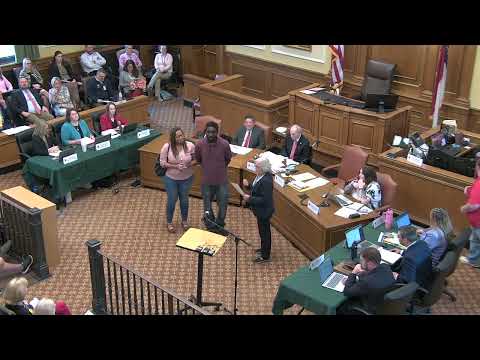
Alamance County’s proposed budget drew more than two hours of public comment as teachers, parents, nonprofit leaders and first‑responder representatives urged the Board of Commissioners to fully fund schools, maintain county libraries and keep support for the Alamance County Rescue Unit.
Alamance County’s proposed budget drew more than two hours of public comment as teachers, parents, nonprofit leaders and first‑responder representatives urged the Board of Commissioners to fully fund schools, maintain county libraries and keep support for the Alamance County Rescue Unit.
County Manager York told the board the document before commissioners was a manager’s recommended budget and that it did not propose closing library branches or eliminating positions in non‑mandated services. “So let me be clear that the recommended budget does not propose to close library branches, does not eliminate positions from non mandated services,” York said while summarizing the plan and tax impacts.
York said the recommended tax rate increase is 1.59¢; she estimated that change would add about $47.86 a year to the tax bill on the county’s then‑median home value and noted each penny of the tax rate produces roughly $2.6 million in revenue. York also said the schools’ formal request exceeded current funding by about $19.8 million — roughly the equivalent of a 7.5¢ tax increase if the board sought to fully meet the request.
Public speakers described concrete consequences of the draft cuts. Sandy Ellington Graves, chair of the Alamance Burlington School System (ABSS) Board, told commissioners the district is already strained after a major mold remediation effort and warned that an additional operating cut would endanger school operations, student safety and staff recruitment. “Our young people deserve safe schools with SRO partners and well‑maintained buildings with healthy classrooms led by teachers and staff rewarded with competitive wages,” she said.
Teachers, school staff and parents cited lost positions and services that would follow smaller operating budgets: fewer school nurses, social workers, counselors, bus drivers and teacher assistants. Several speakers — including classroom teachers and teacher‑scholar students who said they intend to return as teachers — urged the board to view school funding as an investment that attracts businesses and keeps the county competitive.
Residents and library advocates pressed the board to preserve the county’s unified library system rather than shift branches to municipal control. Deborah Scott, president of the Alamance Friends of the Library, described mobile library service, summer reading and countywide programs that she said would be at risk if branches lost county support. “Their summer reading program kicks off next weekend,” she said. “How would your changes affect all of that?”
Representatives of the Alamance County Rescue Unit and allied statewide rescue organizations warned that proposed cuts to county support would reduce on‑duty coverage during peak hours and weaken response capacity for technical rescues. Chris Moline, identified as chief of the Alamance County Rescue Unit, and Josh Shumate, commander with the North Carolina Association of Rescue and EMS, described specialized capabilities — rope and trench rescue, water rescue, K‑9 searches and heavy‑rescue extrication — that they said are scarce regionally and costly to replace.
Sheriff Terry Johnson urged the commission to consider public safety and staffing pressures countywide, saying the county’s low tax rate has contributed to growth but also to demands on services. “Each of you holds the future of our elderly people, our children, and our entire county,” he told commissioners.
Several speakers supported the manager’s recommendation for a limited tax increase. County manager York and other presenters said the recommended 1.59¢ increase was intended to reduce the need for the most severe program cuts that were analyzed during budget development. York also explained that the recommended budget shifts $10 million toward school capital projects while altering the payment mechanism for some school resource officers so that the sheriff’s office would directly fund SROs provided by the sheriff rather than routing the positions through ABSS.
Board members did not take a final vote on the overall budget at the meeting; York reminded the public that the board will hold budget work sessions on June 9 and June 10 and has scheduled adoption for the regular meeting on June 16. Commissioners and multiple speakers urged continued public input.
Votes at the meeting covered unrelated agenda items (see separate article on the 9‑1‑1 interlocal agreement). The public comment period drew dozens of speakers and closed after roughly two hours and 40 minutes of testimony; many speakers described the proposed cuts as immediate threats to people who depend on school, library and emergency services.
What’s next: the board’s work sessions will re‑examine the recommended budget’s assumptions, tax‑rate options, and possible reallocations; final adoption is scheduled for the board’s June 16 meeting.