
Salem High School building team reviews MSBA comments, advances schematic design; welding-location debate continues
Get AI-powered insights, summaries, and transcripts
Subscribe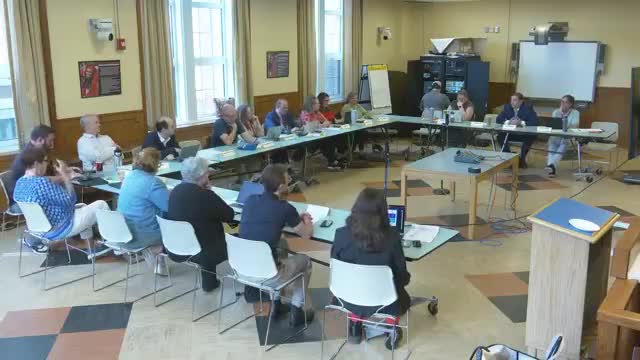
Summary
The Salem High School Building Committee heard a schematic-design update, discussed MSBA comments and site circulation, weighed whether the welding CTE program should be on the first or second floor, and reviewed next procurement steps. Committee members scheduled further reviews and noted a June 5 deadline to return MSBA comments.
The Salem High School Building Committee on May 29 reviewed progress on schematic design, discussed site circulation and accessibility, and heard competing staff views about locating the school’s welding career-and-technical-education (CTE) shop on the ground floor or an upper floor. The committee also discussed next steps for the Mass. School Building Authority (MSBA) submission and the procurement timeline for a construction manager under the OIG-approved (Office of the Inspector General) CM at-risk method.
The update centered on the committee’s forthcoming MSBA submission and a set of detailed MSBA comments the design team received after the March submission. Committee members were told the design team must return responses to MSBA by June 5. The team is planning a June 12 meeting to present an updated cost estimate and a June 18 vote to authorize the MSBA submission; MSBA staff review is expected to continue through the summer, with the MSBA board’s next milestone vote anticipated in July.
Why it matters: Salem’s MSBA process determines whether and how much state support the district receives for a major high-school project. The schematic-design work shapes traffic, emergency access, athletic fields and the placement of CTE programs that affect construction, ventilation and long-term operations.
Most of the meeting focused on schematic elements that affect daily operation and safety: arrival and drop-off circulation, locations for bus, parent and daycare access, emergency vehicle turning radii, accessible parking and routes for students and visitors, and the detailed layout of athletic fields and service/CTE loading areas. The design team presented a preferred “finger” building massing and a central interior circulation spine intended to bring daylight into classrooms and create direct access from the spine to academic neighborhoods and public spaces (auditorium, gym, cafeteria). The plans shown the team described as MIAA-compliant for athletic fields and ADA-accessible for parking and routes.
On program layout, staff said they have shifted medically fragile programs (Stride and Bridge) to the ground floor to provide easier access to nursing and emergency routes. The design team also reported that music, auditorium support spaces and several CTE programs (culinary, carpentry, automotive) are proposed on the ground level for easier loading and public access. The location of welding drew sustained discussion: Mario (staff member) urged the ground-floor location because welding uses heavy equipment, needs reliable ventilation and frequent movement of large student projects in and out of the shop. Mario said welding equipment and material handling “is heavy heavy equipment shop” work and moving large pieces via freight elevator would reduce instructional time and add safety complexity. Others on the design team said welding on an upper level produces architectural efficiencies and could be feasible, but that additional structural, fireproofing and ventilation costs may follow.
Committee members and staff discussed tradeoffs: first-floor placement eases equipment access, outdoor work areas and teacher supervision; an upper-floor placement can reduce building footprint and aid daylighting but may require more expensive structural and fire-protection measures and complicate handling of large projects. The committee asked staff to refine both options and present a recommended plan before the submission.
Traffic, circulation and emergency access were prominent. The design team showed three main vehicular sequences: a north/bus/delivery entry, a south/parent drop-off loop, and a separate service/CTE loading area with gates that can be closed after drop-off to create a pedestrian campus. The team said emergency vehicles will have multiple access points (Highland Avenue and north/south of Wilson) and that turning-radius checks are in progress. The team also flagged a potential future constraint: a state DOT project on Highland Avenue could affect the pedestrian bridge over Highland and may require shifting the building slightly south.
Procurement and schedule: Deborah (staff member) summarized next procurement steps for a CM at-risk approach. The project team will submit an application to the Office of the Inspector General (OIG) to use a CM at-risk method and will issue a Request for Qualifications (RFQ) followed by a Request for Proposal (RFP) and short-listing; the team said it expects to shortlist three to four firms and aims to have a construction manager selected or near selection by August.
Other committee business: the finance working group reported approving April invoices (Anser $29,833.75; Perkins $62,083.20; total $91,916.95). The committee also approved minutes from a prior meeting by voice vote during the session. The committee chair announced several community engagement items, including a public forum scheduled for June 3 focused on younger parents and a presentation to the Salem Partnership on June 20.
Public comment: Dr. Brendan Walsh urged the committee to expand CTE capacity and emphasized workforce demand for trades, saying, “I am just so excited about what the promise of this building.”
Next steps: the design team will finalize responses to MSBA comments for the June 5 deadline, present the estimate at the June 12 meeting and seek authorization for the MSBA submission at the June 18 meeting. The building committee requested a single preferred schematic to move forward prior to the next formal submission and will continue debating the welding location and circulation details.
Ending: The committee scheduled follow-up meetings through the summer, with at least one meeting in July and August planned as virtual sessions to improve attendance and keep the MSBA timeline on track.