Get Full Government Meeting Transcripts, Videos, & Alerts Forever!
Get email alerts on the Water Rates topic
No spam. Unsubscribe anytime.
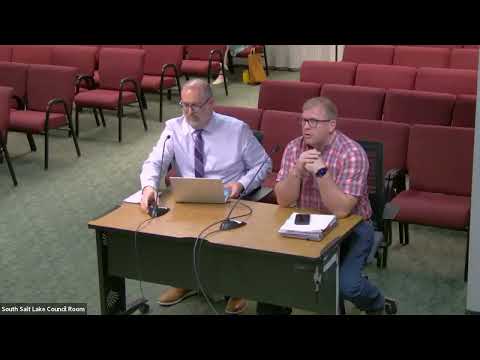
South Salt Lake staff present water rate study proposing roughly 20% revenue boost to fund wells, pipes and reserves
Summary
South Salt Lake City Council members heard a presentation May 28 on a culinary water rate study recommending multiyear rate adjustments to fund operations, capital improvements and minimum reserve targets.
South Salt Lake City Council members heard a presentation May 28 on a culinary water rate study recommending multiyear rate adjustments to fund operations, capital improvements and minimum reserve targets.
Sean, a consultant with HDR, told the council the study begins with a 10‑year financial plan and five years of proposed rates tied to the utility's revenue requirement, cost-of-service and rate design. He said the consultant team modeled annual operating needs, planned capital projects and debt service and concluded that revenues must rise to meet those obligations.
The study proposes funding a portion of annual capital reinvestment from rates (an initial target of $550,000 per year that increases to $975,000 over the study period) and assumes about $26.5 million of new borrowing across the next five fiscal years to pay for larger projects. The presentation also included an additional $3 million in out‑year borrowing projected in fiscal year 2032–33. The study uses a 365‑day operating reserve target as the minimum reserve policy and assumes issuing long‑term debt for several large distribution projects and a new well.
"Annual rate adjustments are necessary to fund the water utility," Sean said, explaining that the increases would fund renewal and replacement, debt service and target reserves. The consultant said the revenue requirement analysis reflects cash‑basis funding of O&M, capital and debt service and that the city's water enterprise is intended to be self‑sustaining from customer revenues.
On timing and scale, the consultant presented a rate transition that would produce approximately a 20% increase in total water revenue in fiscal year 2025–26, followed by additional adjustments over roughly three years and a lower long‑term annual increase thereafter (the presentation cited about 5.5% beyond the initial multi‑year ramp). The consultant emphasized the effect of planned borrowing on rate levels and recommended adopting a multiyear schedule if the council plans to issue debt, because lenders evaluate pledged revenues against adopted rate schedules.
The presentation included three rate design options. The "status quo" would preserve the existing structure but update meter capacity ratios and increase consumption charges. "Alternative 1" would keep the same fixed charge schedule but begin charging for the first tier of consumption (currently embedded in the fixed charge). "Alternative 2," the consultant's preferred option, would move toward a cost-of-service approach with residential tiers designed around winter indoor use and summer peak use (presented as 0–5,000 gallons; 5,000–15,000 gallons; and over 15,000 gallons for residential customers). The consultant recommended keeping larger meters on higher fixed charges to reflect meter capacity.
The consultant showed sample bills under the proposal: a typical residential month of 6,000 gallons would result in a total bill of about $25.70 under the proposed rates (a fixed charge plus consumption). He also displayed a regional comparison chart showing South Salt Lake's proposed bill at several consumption points relative to neighboring systems, and noted regional agencies use different funding mixes (for example, Jordan Valley Water Conservancy District receives property tax revenue that affects its wholesale/retail funding).
Council members asked questions about growth assumptions, which the consultant said included about 1.5%–2% annual customer growth; the interaction of growth, impact fees and future borrowing; the timing of rate adoption (the consultant recommended a multiyear adoption to support debt issuance); and clarifications about customer class definitions (multifamily refers to master‑metered developments, apartments and townhomes; institutional includes schools, churches and city properties). The consultant said commercial rates could be implemented July 1 at the start of fiscal year 2025–26, with residential changes phased in January 1, 2026, if the council approves the schedule.
No formal action or vote occurred during the work meeting; council members directed staff to continue reviewing the study and consider next steps, including public outreach and timing for adoption and potential debt issuance.
The city's fiscal and operational assumptions cited in the study include: a 10‑year capital plan, initial rate‑funded capital of $550,000 rising to $975,000, approximately $26.5 million in borrowing across five years for major projects (plus a forecasted $3 million in FY32–33), a 365‑day operating reserve target, and projected O&M inflation roughly averaging 4.5% per year in the near term. The consultant referenced the American Water Works Association M1 manual as the guiding methodology for cost‑of‑service analysis.