Get AI Briefings, Transcripts & Alerts on Local & National Government Meetings — Forever.
Durham to merge public works, solid waste and impact team; bond spending and rising maintenance needs shape budget
Loading...
Summary
Durham officials proposed merging Public Works, Solid Waste Management and Neighborhood Improvement Services’ impact team into a new Environmental Street Services department, with about 307 staff and a preliminary budget of roughly $57 million, and laid out immediate pavement, paving contract and recycling priorities.
Durham city leaders proposed a major reorganization that would combine Public Works, Solid Waste Management and a portion of Neighborhood Improvement Services into a new Environmental Street Services department, and outlined near‑term maintenance funding needs for streets, stormwater and solid waste operations.
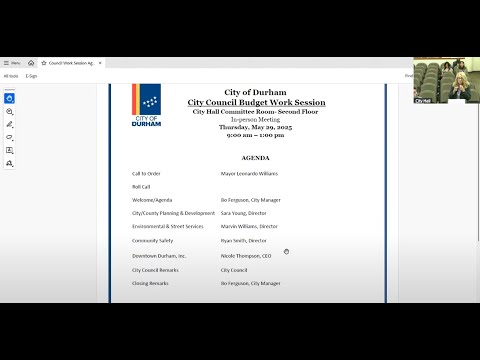
The proposal: Marvin Williams (Public Works) and Wayne Fenton (Solid Waste Management) presented the reorganization and the accompanying budget at the council’s budget retreat. The planned new department would include street maintenance, stormwater, street cleaning, solid waste collection, the impact team from Neighborhood Improvement Services and related functions. Williams said the merged department would total roughly 307 full‑time positions and presented a preliminary annual budget of about $57 million, split approximately $35 million for personnel and $22 million for operating costs.
Why it matters: The city faces ongoing pavement maintenance needs on thousands of lane miles. Staff told council the city’s residential pavement condition index (PCI) remains in the mid‑60s; prior studies and staff testimony showed Durham needs roughly $25 million a year just to maintain that mid‑60 PCI level and $30–35 million a year to improve the network.
Key points from the presentation - Reorganization goals: The merger aims to improve operational efficiency, consolidate equipment and yards, and expand career paths for frontline workers by housing similar work groups under one leadership structure. - Street maintenance funding: Williams said an updated PCI study is under way with results expected later this year. He told council the city would need roughly $25 million a year to maintain the current mid‑60 network PCI and upwards of $30–35 million a year to improve conditions beyond that. - Bond projects and capacity: Williams noted that existing bond funds and recent paving contracts have enabled larger repaving efforts. The city’s recent contract produced lower unit prices ($24 per square yard) but staff said the city is at near‑maximum capacity for what its crews and local contractors can handle in a single year. - Solid waste pressures: Wayne Fenton said recycling contamination rates have risen following a change in the city’s processing contractor. He said contamination is driven by non‑recyclable materials entering the recycling stream and by improperly prepared recyclables, and that the city is responding with education and targeted outreach campaigns such as Recycle Right Durham and “feet on the street” inspections.
Operational and service proposals - Yard waste collection: Solid Waste staff proposed shifting curbside yard‑waste collection from weekly to biweekly service to reduce costs; staff estimated this change could save about $530,000 annually while keeping a similar level of service through two annual bulky brush pickups and allowing up to 10 biodegradable bags on collection weeks. - Bulky pickup schedule: Officials proposed discontinuing holiday makeup days for scheduled bulky pickups; staff estimated narrower schedule changes would reduce service costs by about $52,000 annually while keeping request slots available online and by phone. - Recycling and reuse hub: Solid Waste staff outlined outreach to reduce contamination and proposed exploring a “reuse hub” and possible reuse/wash facility where textiles, mattresses and other non‑curbside materials could be diverted and repurposed locally. An EPA grant application is pending; the current solid‑waste contractor contract runs through 2028.
Council questions and staff context Council members pressed for comparisons with peer communities and asked how PCI targets are set; Public Works staff said PCI targets are policy decisions set by elected leaders and suggested staff would include peer benchmarks and policy options in the upcoming PCI update. On recycling, staff described hands‑on sorting audits by the materials processor and said contamination measurements shifted when the new contractor sampled loads differently than the prior contractor.
Ending: The reorganization and service changes aim to streamline front‑line operations and reduce duplication across street and waste programs, but staff told council the long‑term choices about PCI targets and solid waste pricing remain policy questions requiring elected direction. "When you invest more in roads, the higher scores we end up with," Williams said.