Get Full Government Meeting Transcripts, Videos, & Alerts Forever!
Get email alerts on the Budget Finance topic
No spam. Unsubscribe anytime.
SFPUC reports positive Q3 financial results; billing and stormwater account issues persist
Summary
SFPUC budget director said operating results across enterprises and Clean Power SF are projected positive for the fiscal year, while staff continue to reconcile delayed bills and to match stormwater parcels to customer accounts.
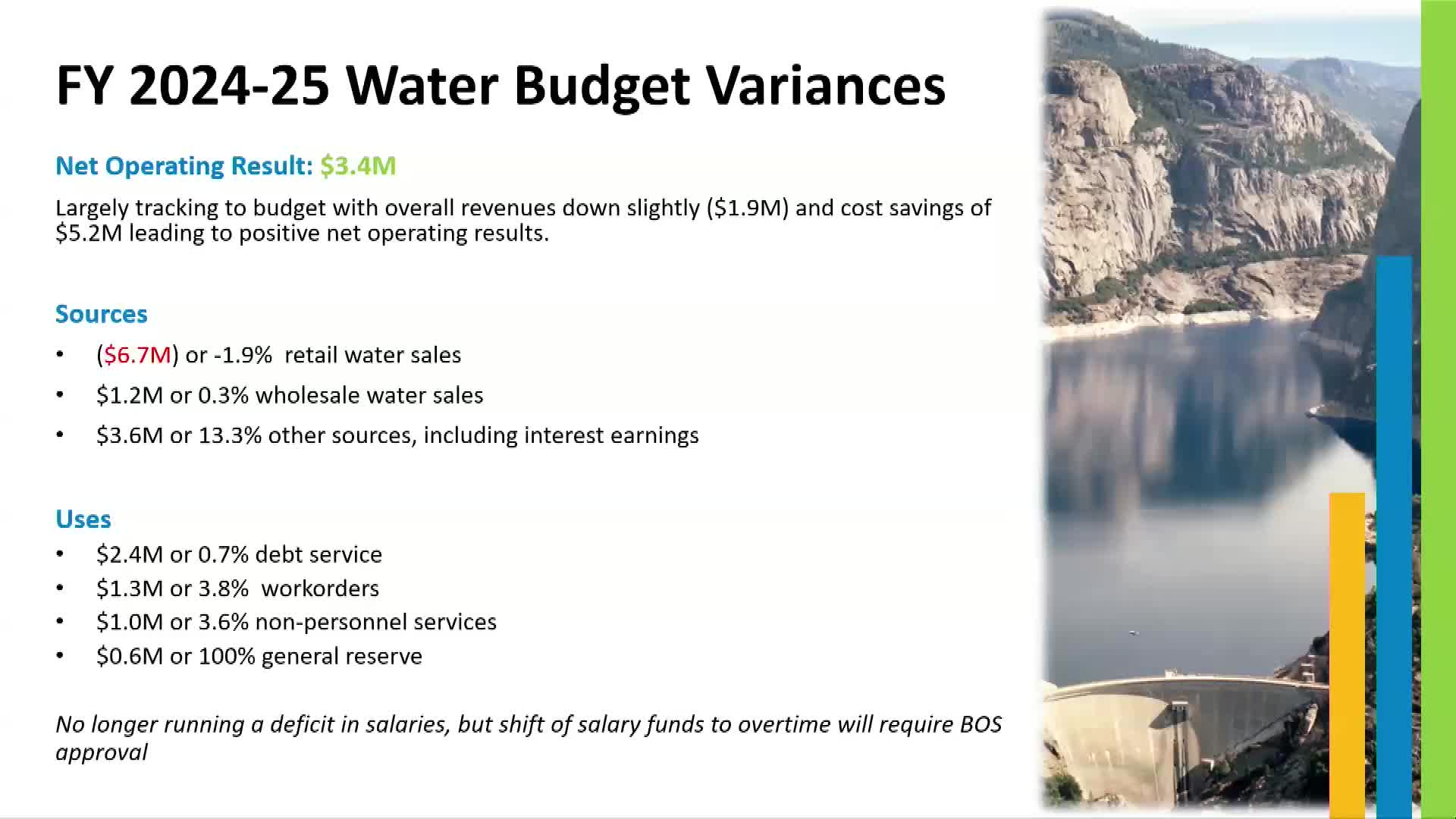
Anna Dunning, the SFPUC’s budget director, told commissioners that third‑quarter financial results project positive operating results across the water, wastewater and power enterprises and for Clean Power SF, and that the utility is meeting or exceeding its financial‑policy targets.
Dunning said retail revenues for the water and wastewater enterprises are slightly below budget because volumes remain lower than forecast, but those shortfalls are offset by higher wholesale sales, interest earnings and personnel and debt‑service savings. She noted Clean Power SF exceeded its fund balance reserve goal for the first time.
Dunning and other staff also addressed two operational account issues raised by commissioners. On delayed billing, staff reported they began with about 8,000 delayed bills in September; the PUC has collected the amounts that were accrued in fiscal‑year 2024–25 (about $6,000,000) and has largely caught up. Dunning said “for all months, there's probably less than a thousand that we're working through right now” as estimated bills are reconciled and field staff replace failed transmission units.
On stormwater surcharges, the customer service bureau estimates about 8,600 parcels must be linked to customer accounts; staff have worked through roughly 2,600 and said about 6,000 remain. Staff explained that some properties are billed through homeowner associations or other account holders, and establishing correct parcel‑to‑account links and resolving appeals is taking longer than anticipated. A staff member said they would confirm whether charges, once established, are billed retroactively; staff promised to return with a clarified answer.
Dunning also noted the PUC required Board of Supervisors approval for a net‑neutral budget transfer that shifts regular salary dollars into overtime, and said that approval was obtained.
No formal commission action was taken on the report; the budget director concluded by offering to answer questions.