Get Full Government Meeting Transcripts, Videos, & Alerts Forever!
Get email alerts on the Public Notice Permits topic
No spam. Unsubscribe anytime.
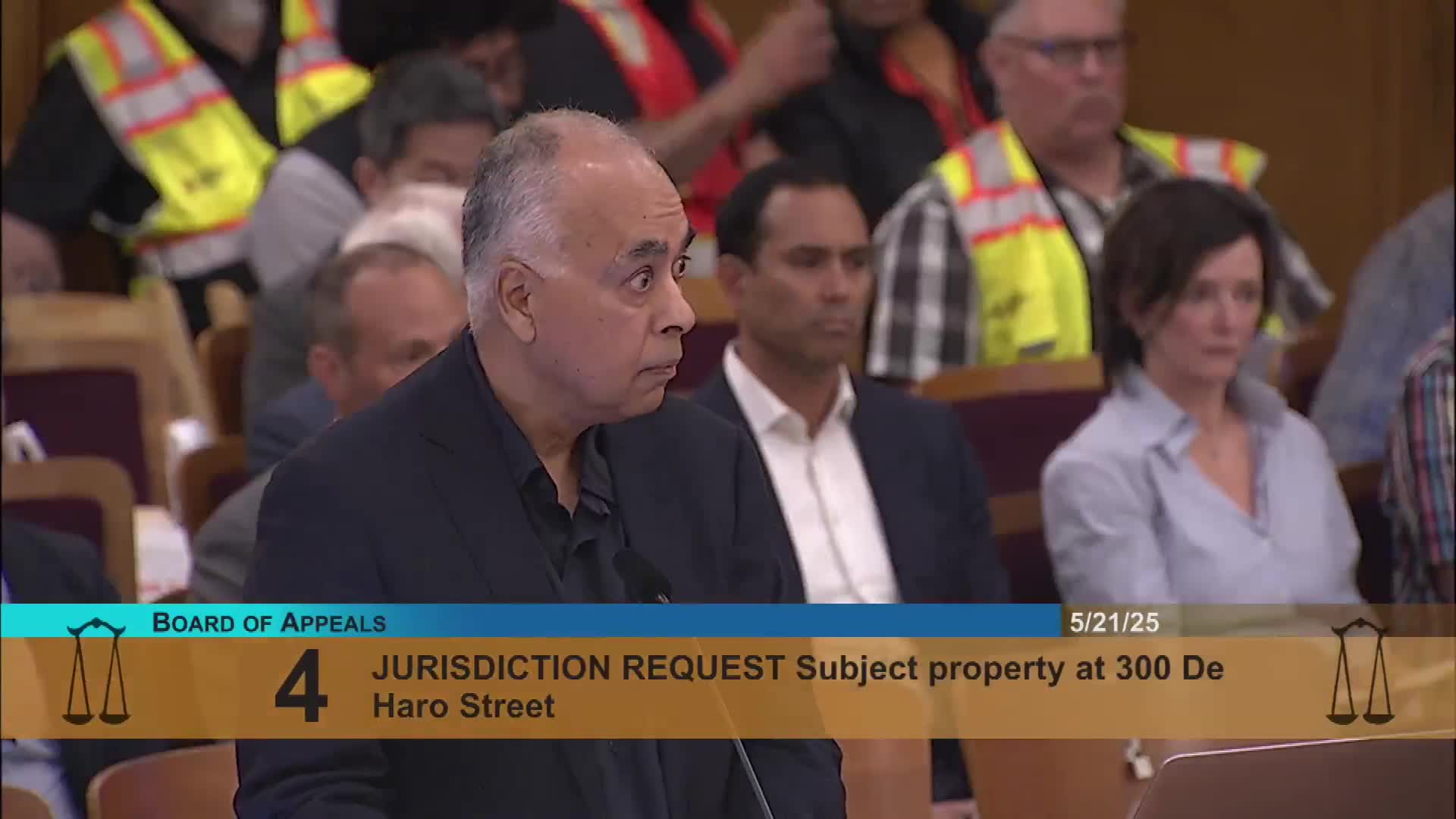
Board of Appeals denies jurisdiction request over 300 De Haro permit after neighbors say notice was not visible
Summary
The San Francisco Board of Appeals voted 3–1 on May 21 to deny a request to reinstate an appeal window for a site permit at 300 De Haro Street, after neighbors said the required posting was not visible; the board had earlier excused Vice President J.R. Epler from the matter.
The San Francisco Board of Appeals on May 21 denied a jurisdiction request from neighbor Sanjay Gupta seeking to reopen the appeal window for a site permit for 300 De Haro Street, saying the board was not persuaded that city actions unintentionally prevented a timely appeal.
Gupta, who identified himself as a nearby resident and a former president of the Potrero Boosters Neighborhood Association, told the board he first learned of activity at the site when he received a demolition-permit notice in the mail on April 15, after the April 14 appeal deadline had passed. Gupta said he found the site permit had been issued on March 28 and that he could not see the required posting from the public right of way because, he said, the notice had been placed ‘‘60 feet from the public right of way’’ and “obscured by vehicles,” asserting that “it is not a notice if it can't be noticed.”
Permit holder DM Development and its counsel argued the permit sequence and posting complied with law and practice. Land-use counsel Peter Ziblatt told the board the site permit is the initial entitlement and that his clients had submitted affidavits showing the sign’s installation dates; developer Mark McDonald said the company had followed permitting rules and secured financing for the project.
City staff from the Planning Department and the Department of Building Inspection (DBI) said their reviews found the permit process and approvals were consistent with code and state law. Corey Teague, Planning Department zoning administrator, said the project’s SB 35 approvals predated SB 423 and that legal rules governing modifications applied; Joseph Ospital (DBI) explained DBI provides the posting board to applicants but does not historically send inspectors to confirm placement and described the required sign dimensions and placement under the San Francisco Building Code (section 106). Ospital read the code language that the sign ‘‘shall be clearly visible to passing motorists and passing pedestrians’’ and described how the code allows the sign to be attached to a building wall in some circumstances.
More than a dozen neighbors testified in person they had not seen a site posting while walking or driving past the property and urged the board to grant jurisdiction so residents could have the opportunity to appeal. Trade-union speakers, the developer, and some others urged the board to deny jurisdiction, warning a grant could delay a 425‑unit, 100% affordable project that developers say will create union construction jobs. The Carpenters Union representative told the board the project would create essential jobs and that the appellant had not demonstrated the city intentionally or inadvertently caused the late filing.
After discussion, the board considered a motion to grant jurisdiction on the basis that city processes had inadvertently caused the requester to be late. The motion failed on a 3–1 vote (one commissioner recorded a nay); earlier in the matter the board had voted 5–0 to excuse Vice President J.R. Epler from participation in the item because of a potential conflict raised by Gupta. As recorded in the hearing, the motion to grant jurisdiction did not receive the four votes the board requires to take that action.
The board made clear in its discussion that it considered signage standards in the building code to be the key issue: whether the posted notice met the code's visibility requirements. President Trezvino said the record indicated the posting did not provide visible notice and concluded any failure appeared inadvertent rather than intentional. The board nonetheless declined to reopen the appeal window for this item.
Next steps: because the jurisdiction request was denied, the permit stands as issued and any further challenge would proceed through the standard appeal window/process if new grounds arise.
Speakers quoted in this article are drawn from the Board of Appeals hearing transcript for May 21, 2025.