Get Full Government Meeting Transcripts, Videos, & Alerts Forever!
Get email alerts on the Urban Forestry topic
No spam. Unsubscribe anytime.
Urban Forestry launches master-plan process; staff cite hiring and contractor limits, ARPA plantings
Summary
Urban Forestry announced a four-year urban-forest master plan kickoff, reported ARPA-funded plantings and described staffing constraints (four arborists, heavy contractor reliance) that lengthen response times for removals and pruning.
Richmond’s urban-forestry staff told the Governmental Operations standing committee they will begin an urban-forest master plan this summer, reported ARPA-funded tree-planting progress and outlined staffing and contractor constraints that limit response speed for pruning and removals.
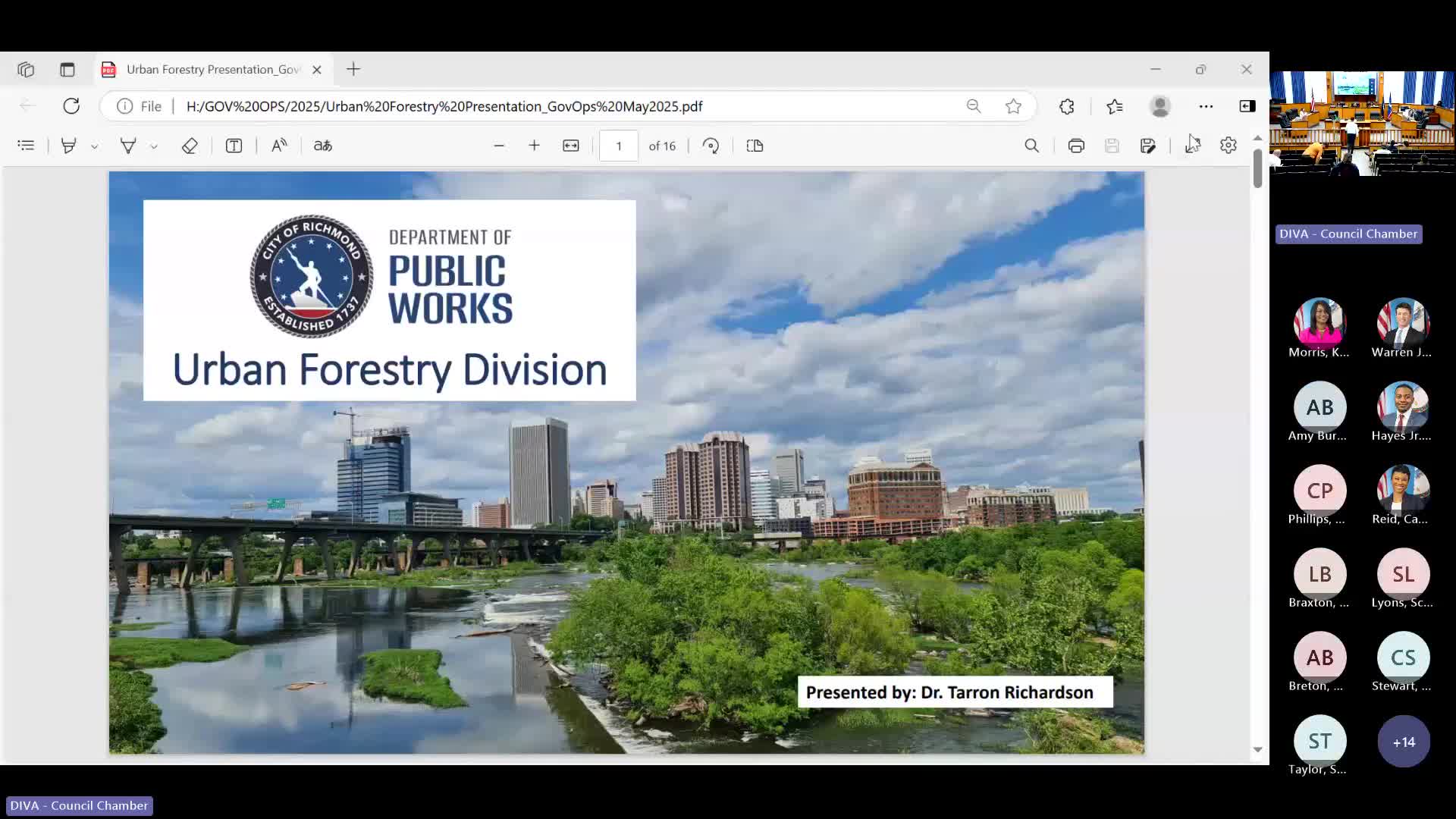
Dr. Terrain Richardson, operations manager for urban forestry, and Michael Webb, urban forester, described a two-track division—operations (inspections, emergency response, debris management and tree care) and planning (master plan, permitting and development review). Webb said the city has contracted an urban-forest master plan that will run roughly four years and produce 10–15-year goals, update the city’s urban tree canopy assessment (last done in 2010 at about 42%) and recommend priorities for heat mitigation and stormwater benefits.
Planting and funding: Webb said Urban Forestry has planted 950 trees to date with ARPA funding and planned another 1,000 trees by the end of calendar 2025. He said the department also secured USDA-related funding that will contribute to the master-plan work. Dr. Richardson and Webb said tree-purchase costs have risen substantially in recent years and that the higher unit cost reduces how many trees the city can plant with the same budget.
Staffing and operations: Urban Forestry currently has four arborists (one position in recruitment) and a larger crew and contractor network to execute removals and plantings. Staff reported average waiting times of roughly 57 days for pruning and 140 days for removals; they said the department prioritizes safety and will accelerate emergency removals. The department manages most large removals through contractors—staff estimated roughly $1.4 million annual contractor spending with about 90% of removals/major work contracted—and said some work (crane lifts, major removals) is more efficient when outsourced.
Policy tools and next steps: Webb noted a new state-authorized tree-canopy bank (available statewide as of March) that lets developers pay into a local canopy bank if they cannot meet canopy requirements on-site; staff said they will explore that option in the master-plan process. Webb said community engagement and a revised ordinance, updated planting methodology and operational staffing recommendations will be core outcomes of the master plan.
Council members praised progress on plantings but questioned canopy-equity and zone assignments, requested SOPs for prioritizing tree tickets, and asked for detailed budget information on contractor spending. Staff committed to provide a FY26 plan and said they welcome further council feedback as master-plan work begins.