Get Full Government Meeting Transcripts, Videos, & Alerts Forever!
Get email alerts on the Affordable Housing topic
No spam. Unsubscribe anytime.
Multiple housing proposals seek county funds to serve students, farmworkers, seniors and families
Summary
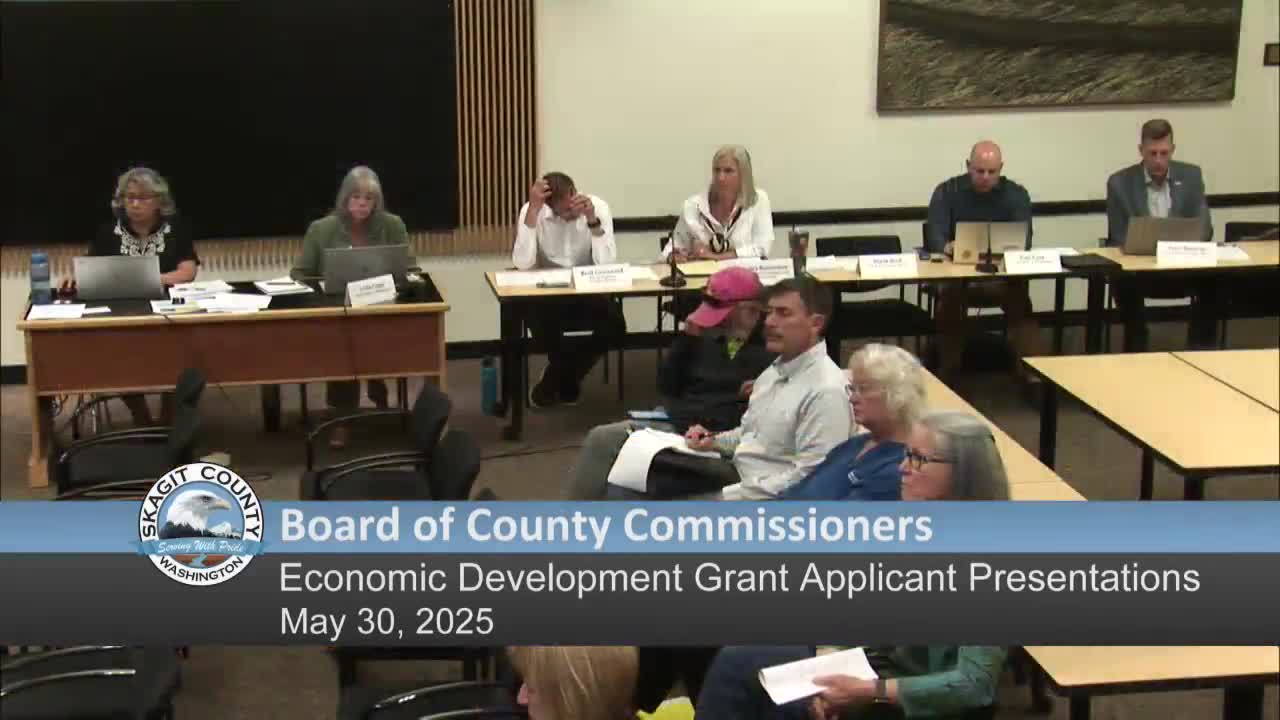
Six housing proposals asked Skagit County for funding on May 30, offering a mix of rental, transitional, farmworker, senior and for-sale workforce housing that proponents said would leverage state and federal funds.
The Skagit County advisory committee heard multiple housing project presentations on May 30 that together sought public funding for affordable rental, permanent farmworker housing, transitional units and for-sale workforce homes. Presenters emphasized vulnerable populations (students experiencing homelessness, farmworkers, seniors and families) and said county funding would leverage substantial state and private financing.
Key projects presented (summaries):
- Colson View Apartments (Community Action of Skagit County, Bill Hinkle and consultant Ginger Siegel): The site in Mount Vernon is purchased and planned in two phases totaling 48 units (phase 1: 24 units). The project will serve families and students experiencing homelessness, reserve six units at 30% AMI, 12 units for farmworker families below 50% AMI and 12 units for families needing supportive services. Presenters said roughly 60% of project funds are currently committed, state funding covers a major share and county funds would leverage more than $9 for every $1 requested. The team hopes to be construction-ready in early 2026.
- College Cottage Village (Family Promise of Skagit Valley, Audrea Woll): Family Promise requested approximately $700,000 for site prep and soft costs for a transitional cottage development in Sedro-Woolley that would provide up to 14 transitional housing units. Presenters noted state code limits transitional housing to a two-year occupancy window and said the site is in active permitting with city staff; Family Promise reported past program success stabilizing families and said the site is within roughly a mile of transit.
- Farmview Family Housing (Housing Authority of Skagit County with Office of Rural & Farmworker Housing): Proposed as a 31-unit permanent farmworker housing development with two- to four-bedroom townhouse-style units for households at or below 50% AMI. Presenters said the financing stack includes awarded Low-Income Housing Tax Credits and a pending USDA Rural Development loan; the Housing Authority requested $1,000,000 from the county to close a remaining gap and optimize the financing stack. The site has some flood-plain considerations but has prior county water/sewer connections and a bus stop nearby.
- Lisonbee Building Reconstruction (Housing Authority, Anacortes): Anacortes officials, represented by Kim Buchanan and Sandy Cox, proposed reconstructing a historic downtown building for affordable housing and ground-floor retail to meet city code. The project has city commitments (including a multi-year $6 million commitment under negotiation) and sought the county—s maximum per-unit award to support construction financing; presenters said the reconstructed project reduces per-unit cost compared with earlier design options.
- Mount Vernon Manor Annex (Skagit Housing Council): The council presented a proposal to add a 45-unit senior (55+) building adjacent to existing campus housing. Board members said the board expects to be debt free on current assets soon, has a refinancing plan for existing buildings and estimates construction costs around $8.2 million; presenters seek design and feasibility funding to advance the project.
- Caledonia Street single-family ownership (Skagit Habitat for Humanity): Habitat presented a three-house homeownership project (phase 1) in La Conner targeted to households at roughly 60% AMI, with homebuyers selected and closing expected in the winter following July construction start. Habitat requested $150,000 to close a final financing shortfall; the organization said it has Department of Commerce and philanthropic support and will convert construction funding to homeowner mortgages at sale.
Why this matters: Together these proposals address multiple housing gaps identified countywide: emergency and transitional housing for students and families, permanent farmworker housing, senior housing and permanently affordable homeownership. Presenters repeatedly said county funds act as —first money in— and are critical to unlocking state and federal dollars.
Next steps: the advisory committee will score and prioritize housing proposals within the county—s $3 million housing retainage for this funding round. Committee members asked detailed questions about AMI tranches, subsidy targeting, site readiness and financing contingencies during the presentations.