Get Full Government Meeting Transcripts, Videos, & Alerts Forever!
Get email alerts on the Port Lease Offsets topic
No spam. Unsubscribe anytime.
Guam Legislature advances bill allowing Port Authority to offset leases for tenant-funded improvements
Summary
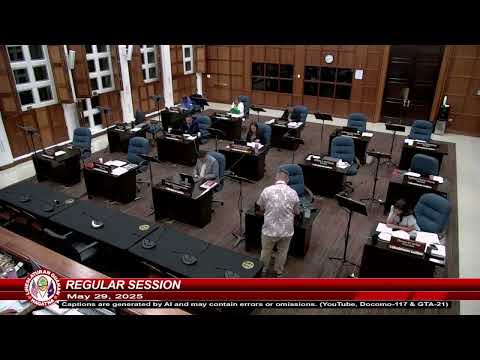
The Guam Legislature on May 29 moved Bill 109-38 COR to the third-reading file, advancing a measure that would authorize the Port Authority of Guam to grant dollar-for-dollar offsets against lease payments for tenants who invest in documented improvements that provide public or operational value.
The Guam Legislature on May 29 moved Bill 109-38 COR to the third-reading file, advancing a measure that would authorize the Port Authority of Guam to grant dollar-for-dollar offsets against lease payments for tenants who invest in documented improvements that provide public benefit or enhance port operations.
The measure’s sponsor, Senator Jesse A. Lujan, told colleagues the offsets are “not a rent waiver. It is not a discount. It is a performance based post-lease offset,” and that credits would be earned only after work is completed, verified and tied to public benefit. He and supporters said the tool is intended to attract private capital for port upgrades without any cash outlay by the Port Authority or the general fund.
Lawmakers who debated the bill pressed several policy issues: whether offsets would reduce port revenue or affect bond covenants, whether retroactive credits would be fair to competitors, how the port would decide which projects qualify, and whether the change would alter procurement fairness for leases already awarded. Several senators urged stronger written standards or outside review to limit subjectivity.
What the bill does: under the proposed language as amended in committee and on the floor, the Port Authority would be authorized to apply a dollar-for-dollar credit against a tenant’s lease obligation for documented capital improvements that provide measurable value to port operations or the public beyond the tenant’s direct use. The sponsor listed examples of qualifying projects: repaving cargo laydown areas, installing high-efficiency lighting in operational and recreational zones, enhancing perimeter security, improving access roads (including the coral-based road from the 76 gas station to Family Beach) and other capital works tied to port operations. The bill excludes purely private cosmetic upgrades and personal office renovations.
Amendments and floor rulings: lawmakers adopted several substantive amendments on the floor before voting to move the bill. The Legislature removed a retroactive-application clause that would have allowed offsets for qualifying improvements completed within the previous five years. Members also amended the bill to require credits to be applied on a strict dollar-for-dollar basis and to prevent offsets from exceeding the tenant’s total lease obligation. A proposed amendment to require bond-counsel approval before any offset program was rejected on the floor.
Support and opposition: supporters, including lawmakers who have toured port facilities and representatives who testified at the public hearing, argued the bill is a pragmatic public–private partnership tool that can accelerate capital projects the Port Authority cannot immediately fund, pointing to the port’s 2023 master plan and other infrastructure needs. Opponents warned that retroactive credits or vague standards could undermine procurement fairness, reduce port revenue available for operations and debt service, and raise questions for future bond investors.
Fiscal and technical details discussed on the record included the Port Authority’s claimed statutory lease rate of $0.56 per square foot and references to the Port Authority’s 2023 master plan (estimated collectively at about $191,000,000) and a reported $517,000,000 contract for breakwater repairs that several senators discussed during debate. Lawmakers repeatedly emphasized that any credit would be documented, inspected and recorded as a capitalized asset of the port rather than an immediate cash payment.
Action taken: after debate and the floor amendments, the body voted to move Bill 109-38 COR as amended to the third-reading file. The floor recorded the motion to move the bill and indicated the motion carried. The bill will return for a third-reading vote at a later date.
Votes at a glance: the final floor action was a voice/hand indication moving the bill as amended to the third-reading file; no roll-call vote tally was recorded in the transcript provided. Several amendments (removal of retroactivity; limit offsets to not exceed lease obligations; require strict dollar-for-dollar application) passed on voice/hand votes; the bond-counsel approval amendment failed on a recorded objection and subsequent hand vote.
Provenance: The bill was introduced on the floor by Senator Jesse A. Lujan during the May 29 session and discussed at length in committee testimony and on the floor; the transcript contains the bill introduction, sponsor exposition, public-witness references, floor amendments and the final motion to move the bill to third reading (see provenance).
What’s next: With the measure now in the third-reading file, the Legislature will schedule a future floor vote on final passage. If enacted as amended, the Port Authority would implement a lease-offset program under the standards in the bill and the Port Authority’s procedures.