Get Full Government Meeting Transcripts, Videos, & Alerts Forever!
Get email alerts on the County Budget topic
No spam. Unsubscribe anytime.
Monterey County unveils $2.3 billion recommended budget; supervisors weigh targeted restorations and new fees
Summary
County staff presented a $2.3 billion recommended budget on May 28 that preserves filled field positions but relies heavily on one-time funds. Supervisors heard detailed department requests for restorations to public safety, parks and elections budgets and directed staff on a set of prioritized restorations and follow-ups.
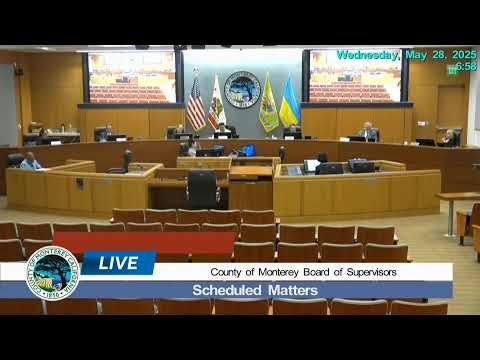
Monterey County officials presented a $2.3 billion recommended spending plan on May 28 as the Board of Supervisors opened a series of budget hearings ahead of adoption. County Administrative Officer Sonia De La Rosa and Assistant CAO Debbie Polinelli said the recommended budget prioritizes preserving filled field positions while using one-time balances and limited discretionary revenue to cover rising salary and benefit costs.
The recommended budget package includes a $2,300,000,000 total appropriation and uses a mix of program revenues, restricted grants and one-time fund balance to carry the plan through the coming fiscal year. Polinelli and De La Rosa told supervisors the largest single driver is salaries and benefits (a projected increase in the tens of millions driven by negotiated increases and base wage adjustments), while constrained discretionary growth forced the CAO’s office to limit augmentations.
Why it matters: the plan protects most frontline staff from cuts but depends on limited one-time sources — including portions of contingency and other restricted assignments — leaving the county exposed if midyear costs rise. Supervisors repeatedly asked staff for clear paths to preserve mandates while limiting the erosion of strategic reserves.
What departments asked for: several departments presented requests for additional funding that exceeded the CAO’s available discretionary resources. Notable requests included: a) Elections: Registrar of Voters Gina Martinez warned that 2026 is a deficit election year in the two‑year cycle and asked for augmentations to meet legal obligations for administration, translation and mailings; b) Sheriff’s Office: Sheriff Tina Nieto presented a large augmentation package focused on adding sworn and professional staff and funding for Axon body‑worn cameras; c) District Attorney: Janine Pacioni and Chief Assistant Berkeley Brannon described a backlog and requested funding for additional deputy district attorneys and support staff; d) Parks and Lakes: Public Works/Facilities & Parks Director Randy Ischi and park staff said reductions would hamper park ranger coverage, water/wastewater compliance and custodial/security at county buildings; e) Civil Rights Office and Elections: small but targeted augmentations were requested for mandated training, investigations, and electionyear costs.
Board direction and votes: early in the meeting the board adopted a routine but required annual resolution setting the county’s Gann appropriation limit (Article XIII B of the California Constitution). Supervisors also used the hearing to give direction on a package of prioritized restorations and follow-up work rather than adopt a long list of augmentations immediately. The board voted to restore multiple items or ask staff to return with options, including partial restorations for targeted parks positions, funded items for civil rights and elections, and requests to explore financing or alternate funding sources for capital needs. Separately the Board of Supervisors and related governing bodies (Water Resources Agency) conducted required public hearings and approved CPI-based (2.7%) increases for multiple water and flood assessment zones.
Public comment: Dozens of speakers addressed the board during public comment and during individual department presentations. Highlights: - Mountain‑bike advocates urged inclusion of bike access at Laguna Seca and referenced potential external funding for trails and associated visitor amenities. - Labor representatives and union leaders — including SEIU and the DA association — warned that vacancies, slow wage study implementation, and multi‑year phase‑ins create acute staffing and public‑safety risks; SEIU asked the board not to “cut” vacant positions but to hold them unfunded instead of eliminating them permanently. - Park rangers from the Monterey County Park Rangers Association described heavy overtime and reduced patrol coverage at Lake Nacimiento and Lake San Antonio, giving weekend incident statistics and urging restoration of ranger positions and a water/wastewater specialist. - The Registrar of Voters emphasized that the 2026 even‑year election costs will exceed billable jurisdiction revenues and will require county support to meet legal obligations if other jurisdictions do not consolidate. - Tourism and business representatives urged the board not to cut support for Sea Monterey and other destination marketing allocations, saying reduced marketing would depress TOT revenue and local business activity.
Board priorities and next steps: supervisors expressed differing priorities but reached quick decisions on a set of restorations and direction to staff. Members asked the CAO and department heads to: - Return with refined funding options (including financing and Measure AA / contingent fund scenarios) for capital items tied to solar and roof projects and to provide clearer revenue sources for any new ongoing commitments. - Provide more detail on the vehicle asset replacement program (VAMP) and options for pausing or redirecting contributions if necessary. - Return in early June with final budget adoption materials and any recommended midyear contingency uses, and to present options for security/custodial service levels at county facilities.
The board kept the budget process open and asked for several follow‑up analyses: public works to present security/custodial options, CAO to model midyear risk scenarios (ERP costs, jail health contract, Medicaid/Medi‑Cal changes), and departments to identify legally mandated costs vs. discretionary asks. The hearings continue; the CAO stressed the recommended plan will be refined before final adoption so the board can balance staff‑funding priorities and reserve policy.
Ending: The hearing included required votes on several Water Resources Agency assessment increases (CPI 2.7%) and closed after the afternoon’s lengthy department presentations and public comments. The board set times for follow-up and directed staff to return with the requested analyses and the final proposed budget for adoption.