Get Full Government Meeting Transcripts, Videos, & Alerts Forever!
Get email alerts on the Housing Affordability topic
No spam. Unsubscribe anytime.
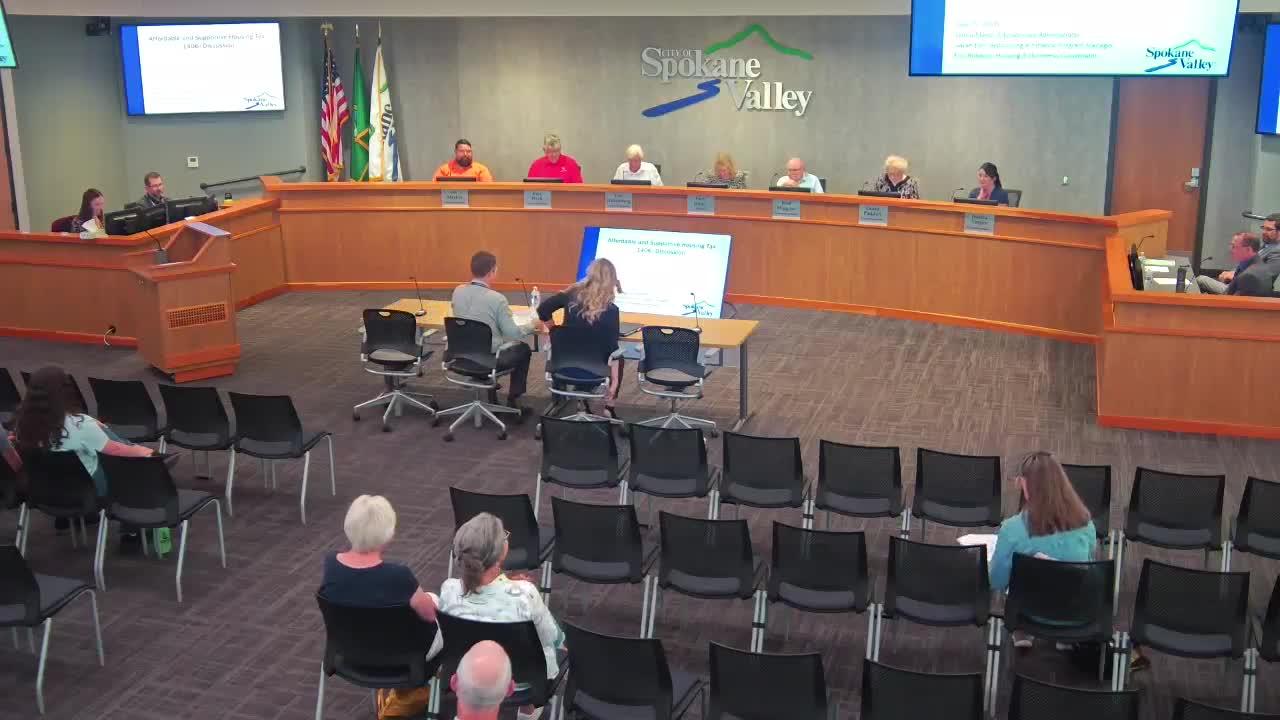
Council discusses use of 14-06 affordable housing sales-tax funds and remaining property-acquisition dollars
Summary
City staff briefed the council on options for spending the city's 14-06 affordable and supportive housing sales-tax revenue and remaining property-acquisition funds; staff presented program rules, current balances and examples of programs that used similar funds.
City staff presented options and examples for using Spokane Valley's 14-06 sales-tax revenues and remaining property-acquisition funds at the council's May 27 meeting, and asked for council guidance on next steps.
Accounting and Finance Program Manager Sarah Farr summarized the city's available resources. Farr said the city's special revenue account (Fund 108) for the 14-06 sales-tax rebate is projected to have a fund balance of about $1,200,000 at the end of 2025 and generates an estimated $200,000 per year; the revenue stream is a state rebate collected for 20 years beginning in 2020. Farr also noted the city received ARPA/CLFR funds and council previously allocated $2,000,000 for property acquisition for affordable and homeless purposes; about $1,300,000 of that property-acquisition allocation remained available following the Habitat for Humanity award in April.
Eric Robeson, Housing and Homeless Coordinator, reviewed allowable uses under Substitute House Bill 14-06: acquisition, rehabilitation or construction of affordable housing (homeownership units can serve households up to 80% AMI), operations and maintenance for new units, rental assistance for households at or below 60% AMI, and up to 10% of the funds for administrative costs. Robeson gave local examples: the council-awarded Habitat for Humanity project (25 affordable homeownership units), the Family Promise "Flash" rapid-rehousing program (previously funded locally and cited by staff as a cost-effective intervention), and Frontier Behavioral Health's outreach program, which used Health Care Authority grants to provide up to $7,200 per household for deposits, arrears, rental assistance and related costs and housed 21 households over the referenced reporting period.
Council discussion explored multiple policy options. Council Member Patton asked about the Flash program's long-term outcomes; staff said Family Promise provided up to two years of case management and that follow-up data would be gathered. Council Member Merkel and others emphasized one-time gap funding to prevent eviction or to help maintain homeownership (small repairs) rather than creating recurring voucher commitments. Council Member Wieck suggested targeting funds to catalyze new types of housing or mixed-use development in locations where the city wants more diversity of housing stock; others suggested targeting existing projects to "complete funding stacks" for projects that are close to construction.
Staff asked whether council preferred a focused request-for-proposals (RFP) for specific activities or a broader application process; council members asked staff to research program examples, return data on outcomes (recidivism/long-term housing stability for prior interventions) and confer with potential partners (Family Promise, Frontier Behavioral Health, Habitat for Humanity and others). No formal action was taken; staff will return with more detail and recommended next steps.
Clarifying details: 14-06 funds are a state-shared sales tax rebate (does not add new tax to citizens); estimated annual revenue ~$200,000; projected 2025 year-end fund balance ~$1,200,000; approx. $1.3M remains from the $2M property-acquisition allocation.