Get Full Government Meeting Transcripts, Videos, & Alerts Forever!
Get email alerts on the Housing Affordability topic
No spam. Unsubscribe anytime.
Columbus officials outline use of prior housing bonds, propose $500 million 2025 bond and new Housing Stability division
Summary
City Development leaders told a Columbus City Council committee the city has used prior bond authority to produce roughly 4,200 income‑restricted units and is preparing a proposed $500 million 2025 affordable‑housing bond alongside a new Division of Housing Stability and ongoing tenant‑protection programs.
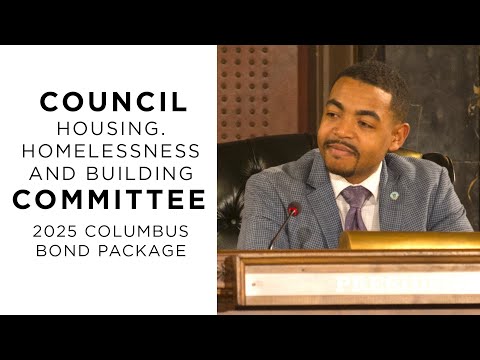
Council President Shannon Harden, chair of the Columbus City Council Housing, Homelessness and Building Committee, convened a public hearing in which Department of Development officials reviewed how prior affordable‑housing bond authority has been used and outlined a proposed $500,000,000 2025 housing bond and a new Division of Housing Stability.
The presentation said prior voter‑approved bond authority (a $50,000,000 allocation in 2019 and continued authorization in 2022 that together created $250,000,000 of bond capacity) has been deployed alongside federal relief dollars and tax credits to support affordable housing production, tenant stabilization services and homeownership programs. Deputy Director Hannah Jones, Department of Development, told the committee the city has supported roughly 4,200 income‑restricted affordable units to date, including about 523 units of permanent supportive housing, and has invested in affordable homeownership and rental assistance programs.
Why it matters: Council and administration officials said a larger bond could be needed to address rising construction and financing costs, further fill gaps in low‑income housing tax credit (LIHTC) deals, and expand support for tenant protections and homelessness prevention. The administration also proposed formally creating a Division of Housing Stability to “hardwire” tenant protections and coordinate services, and signaled the office will present a code change to create that division for council consideration.
Department overview and past bond deployment
Director Prosser (Department of Development) and Deputy Director Hannah Jones described three policy pillars that guide the city’s housing work: build more housing, invest in affordability and preserve existing affordable units. Jones explained the city uses a capital‑stack approach for deeply affordable projects and couples bond dollars with LIHTC (9% or 4%) and other sources to close financing gaps. She said bond proceeds are sold over time (the administration plans roughly $50,000,000 in bond sales a year subject to the auditor’s capacity) and that bond dollars are restricted to capital uses.
Jones said the city has deployed bond and other funds across 39 projects (as presented) and noted about $31,000,000 in city bond support has gone toward affordable homeownership programs with partners such as Central Ohio Community Land Trust and Habitat for Humanity. She said the city has invested in repairing and stabilizing owner‑occupied housing for households at risk of displacement and that bond dollars have reached “more than 600 families” for stabilization work.
Costs and market constraints
Deputy Director Jones and Director Prosser warned the committee that higher interest rates, stricter lending practices, and new federal procurement rules (Build America Buy America) are increasing both capital and project costs for affordable housing. Jones said an increase in borrowing costs can change a project’s budget materially and that additional bond proceeds would help close shortfalls that otherwise would fall to tenants or undermine projects’ feasibility.
Tenant protections, rental assistance and new division
Development staff summarized programmatic investments alongside capital spending. The administration reported more than $98,000,000 invested in rental assistance and housing stability services over recent years and described a Central Ohio Stable Housing Network that includes housing resource specialists and front‑line partner organizations. Staff said implementation of the city’s tenant relocation assistance and access‑to‑counsel codes is underway: 433 notices have been issued under the tenant relocation requirement, and the administration estimates the access‑to‑counsel program yields a $4 return in social service savings for every $1 invested (citing the $1,400,000 council commitment earlier this month as producing an estimated $5,600,000 in savings in social service responses).
On the Division of Housing Stability, the administration said the division will coordinate prevention, enforcement of tenant protections, and upstream interventions to prevent displacement. The presenters said they anticipate hiring an administrator in July and filling remaining positions by the fourth quarter of the year, with work under way before full staffing.
Public testimony and stakeholder views
Four community speakers addressed the committee. Carly Boos, representing the Affordable Housing Alliance of Central Ohio, praised the proposed bond and urged bold local investment, saying the measure “has the power to create the breadth and diversity of housing that our community needs.” Michael Wilkos, of United Way of Central Ohio and chair of the Continuum of Care, said homelessness is fundamentally a housing supply problem and urged voter support; he noted changes in vacancy and household‑unit ratios across the region. Kate Ames of Habitat for Humanity Mid‑Ohio described Habitat’s production and repair work and said funding limitations restrict the number of homes the nonprofit can deliver. Belinda Spinozzi, a disability advocate, urged the city to require greater accessibility in new multifamily projects, requested training for developers and staff on accessible housing standards, and asked the committee to include explicit accessibility targets in new codes (she cited other U.S. cities that have adopted local accessibility requirements).
Council questions and next steps
Council members asked for more transparency and public reporting on how prior bond proceeds were allocated and requested the administration provide a project‑level list of awards, addresses and status. Staff agreed to provide back the project list and said the administration will conduct summer stakeholder engagement to refine program design for a 2025 bond package. The administration told council it will not simply replicate the 2022 framework because market conditions, costs and federal funding availability have changed.
Formal actions and timeline
The administration said it will present a code change to create the Division of Housing Stability at the next council legislative packet (noted in the hearing as coming Monday). The 2025 bond proposal remains a proposed measure; the administration said it will bring a framework to council after summer stakeholder work and public engagement. No committee votes were recorded in the hearing transcript.
Ending
Committee Chair Council President Shannon Harden closed the hearing by urging continued partnership among city staff, council and community stakeholders as officials refine the proposed $500,000,000 bond package, tenant protections and the new division. The committee scheduled additional engagement and a public comment period; staff said they will return with detailed project lists and proposals as the bond design advances.