Get Full Government Meeting Transcripts, Videos, & Alerts Forever!
Get email alerts on the Law Enforcement Use Of Force topic
No spam. Unsubscribe anytime.
Family of Kenneth Grimm urges county to expand less‑lethal tools and crisis response after deputy shooting
Summary
Bridal Callanier Callanin, speaking for the family of Kenneth Grimm, told Guadalupe County commissioners that Grimm — a 77‑year‑old U.S. Navy veteran with dementia — was shot and killed by a county deputy on Aug. 27, 2024, and urged the county to expand less‑lethal tools and crisis‑intervention responses.
Bridal Callanier Callanin, speaking for the family of Kenneth Grimm, told the Guadalupe County Commissioners Court that Grimm — a 77‑year‑old U.S. Navy veteran who suffered from dementia and other health issues — was shot and killed by a Guadalupe County sheriff’s deputy on Aug. 27, 2024. Callanin said Grimm was slow moving, unarmed except for a small knife, and that the officer who responded did not have less‑than‑lethal options at hand.
"We thought that this would have been a great opportunity for the taser," Callanin said, noting the county purchased 25 Axon tasers in a May 13 budget action. "With the advent of the taser, we believe that, in the future, there will be somebody out there who will not be shot with a firearm and pass away, but will be shot with a taser and fall down and be disarmed."
Laurie Grimm, Kenneth Grimm’s wife, described the Aug. 27 incident to the court and emphasized Grimm’s frailties: Alzheimer’s, dementia, Parkinson’s, hearing loss and limited mobility. She said she told the deputy on scene that Grimm had Alzheimer’s and was having a mental‑health episode; she said emergency medical services were called and that Grimm was taking the blood thinner warfarin. "I watched as my father‑in‑law, Kenneth Grimm, hit the ground after 2 shots," she said. "And this is what 8 seconds feels like."
Byron Grimm, the decedent’s son, told the court the deputy had two options that evening — "deadly force or no deadly force" — and urged the sheriff’s office to "immediately provide a plan of action in researching, obtaining and implementing more of these less‑than‑lethal options" and to ensure all deputies receive the necessary training.
Rebecca Gines, identified as Grimm’s first wife, addressed the court about the sheriff’s office response and recent changes. She said Sheriff Joshua Ray assumed command in January 2025 and has since described policy reviews, vendor meetings and formation of a mental‑health unit of five deputies. Gines said the family’s open‑records requests and other follow up show the county approved purchase of tasers in a May budget item; she also said the sheriff established a review team and estimated, based on her calculations, that mid‑May staffing for that team could cost roughly $172,000 (family estimate). Gines told the court that, as of her records review, she did not see evidence that a consistent policy or countywide assignment of less‑than‑lethal equipment and training had been completed.
Family speakers asked commissioners to ensure that: less‑than‑lethal tools are deployed across the sheriff’s office, crisis‑intervention teams are called when appropriate, and policy and training are formalized so similar fatalities can be avoided.
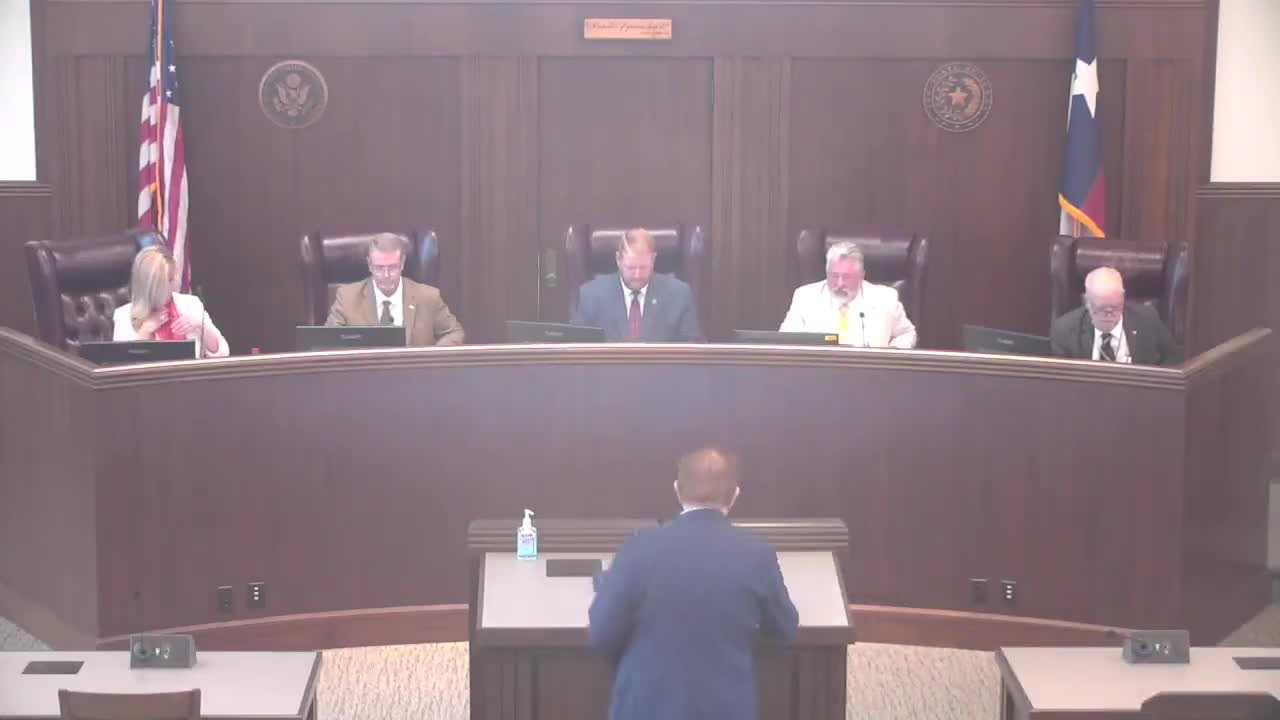
The court received the public comments during the citizens‑to‑be‑heard portion of the May 27 session; commissioners did not take formal action on policy changes during that meeting.
The county previously approved the Axon purchase for 25 tasers in a May 13 budget item, which family members referenced in their remarks. Sheriff Joshua Ray was mentioned repeatedly by speakers as the elected official leading the sheriff’s office response and policy review, but commissioners did not vote on changes to sheriff’s policy at the May 27 court meeting.
Family members and the speakers asked the court to track and report progress on formal policies, training schedules, and countywide deployment of less‑than‑lethal equipment so the community can see whether steps are taken to reduce the likelihood of another fatal outcome in similar circumstances.
The court did not announce additional steps or a formal follow‑up timeline at the conclusion of the comments. Commissioners suggested continued coordination with sheriff’s staff and county administrators as those reviews proceed.