
Senate finance panel advances bill taxing secondary ticket resales to boost transit funding
Get AI-powered insights, summaries, and transcripts
Subscribe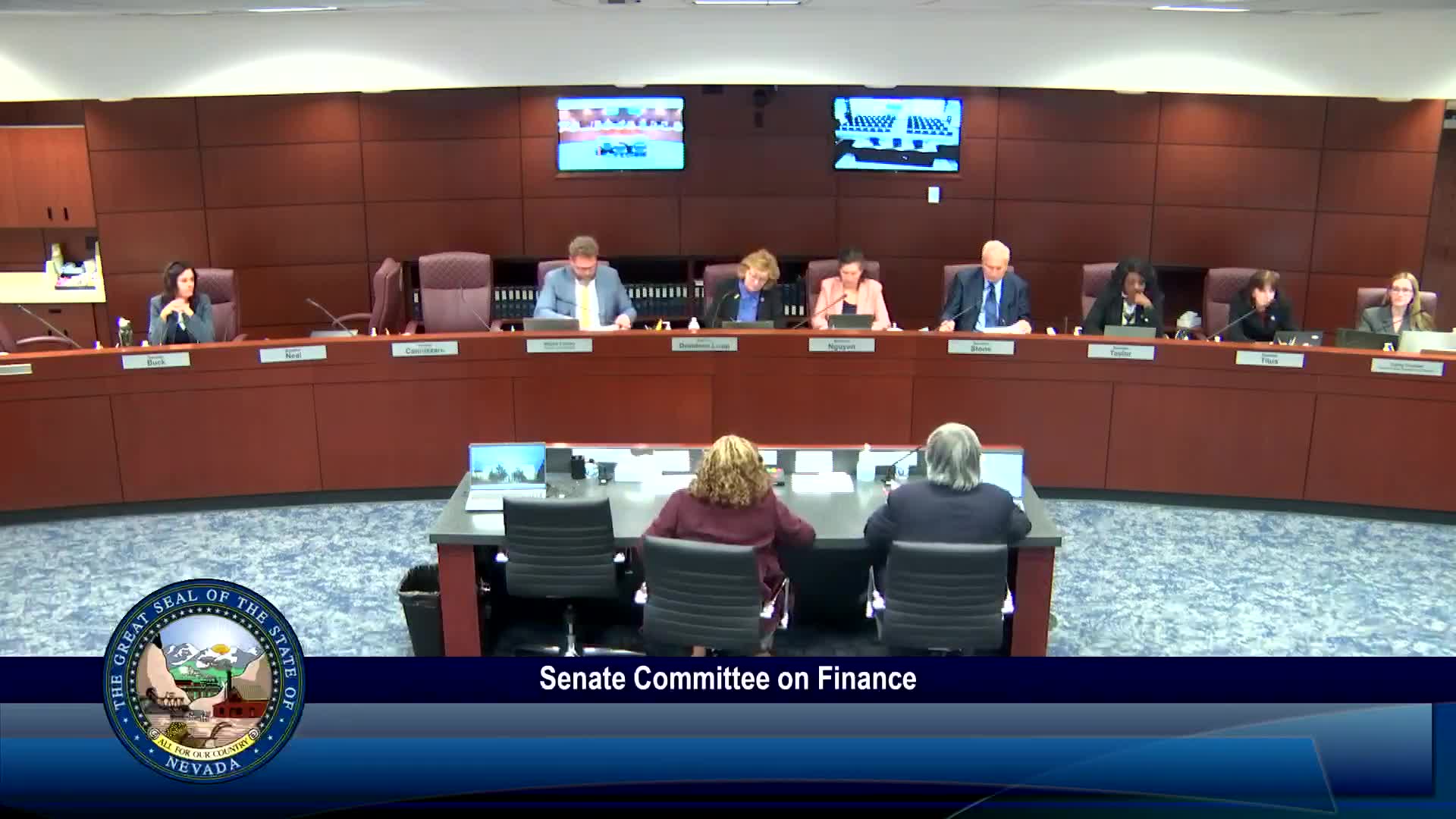
Summary
The Nevada Senate Finance Committee on May 26 advanced SB431, which applies the live entertainment tax to secondary ticket resales on the difference between the original and resale price and directs part of the revenue to regional transit, with implementation language and state tax-office costs added in amendment.
Carson City — The Nevada Senate Finance Committee on May 26 moved forward Senate Bill 431, a measure that applies the state's live entertainment tax (LET) to the secondary ticket market and directs a portion of the revenue to local transit authorities.
Senator Neal presented SB431 and told the committee the tax applies only to the difference between a ticket's original sale price and a later resale — "the delta," he said, giving the example of a $1,000 original ticket resold for $11,000 and noting that the tax would apply to the $10,000 difference.
The bill, as amended in committee, adjusts the share of LET revenue that would be transferred to the Regional Transportation Commission (RTC) of Southern Nevada and includes a provision that would revert a different distribution if a related ballot question (Assembly Bill 28) fails. Michael Nakamoto of the fiscal analysis division said a technical amendment clarifies the bill's effective date so transfers to the RTC apply only to tax periods on or after the effective date of Jan. 1, 2026.
Wayne Thorley of the LCB fiscal analysis division summarized fiscal estimates presented to the committee. The committee's exhibit estimated gross revenue from the taxed resale activity at roughly $49,000,005.04. Under the amendment discussed in committee, the RTC's share was estimated at about $10,000,005.88 and the net change to the state's general fund about $38,954,000.
The Department of Taxation submitted a fiscal note estimating one-time programming and position costs to implement the new tax in the department's systems. Thorley told the committee those implementation costs would need general fund appropriations in the upcoming biennium if the committee approved the bill with the conceptual amendment discussed in the session.
Supporters told the committee the measure would provide a stable, targeted funding source for transit without raising the general sales tax. Olivia Tanager, representing the Sierra Club Toiyabe Chapter, said increased transit funding reduces combined housing and transportation costs and urged support. "Putting more funding into RTC's pockets also means that we are able to allow folks to keep more money in their pockets by bolstering our public transportation system and lowering the cost of living and the cost of housing," she said.
Jackie Spicer of the Nevada Environmental Justice Coalition said reliable public transit connects residents to jobs, education and health care and warned the RTC was at risk of cutting services. Tara Webster, policy manager at the Progressive Leadership Alliance of Nevada, also spoke in support. A caller, who identified himself as Zachisgaegos, said the bill would help address delays and staffing problems in transit technology and service.
Senate Finance later took the bill up in its work session. Senator Wynne moved to "amend and do pass as amended" with the conceptual amendment and additions to cover Department of Taxation implementation costs; the motion was seconded by Senator Cannizzaro and carried after recorded nays from Senators Titus, Stone and Buck.
The bill also includes a trigger tied to AB28, the related ballot measure referenced in committee testimony; the amendment discussed would revert the distribution to a prior share if voters reject that ballot question. The committee record showed the amendment includes both the distribution changes and an implementation/appropriation component for the Department of Taxation.
Votes at the work session were procedural in many cases; the committee approved SB431 to move forward to the next stage with amendments and fiscal adjustments. The Department of Taxation will report programming and position costs in its fiscal note that the committee asked to be funded if the bill advances.