Get Full Government Meeting Transcripts, Videos, & Alerts Forever!
Get email alerts on the Hawaiian Language Archive topic
No spam. Unsubscribe anytime.
Language-archive project asks OHA to join five-year funding drive to train translation fellows
Summary
Two presenters urged the Office of Hawaiian Affairs to partner on a five-year effort to translate and publish large portions of Hawaiian-language archives, seeking multi‑million dollar support and urging OHA to signal a commitment in the coming biennium.
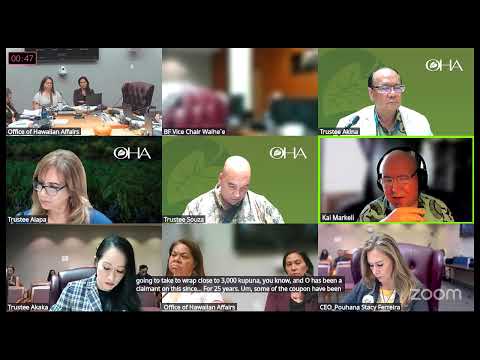
Puakea Nogomayor and Kaui Sai Doudwa told the Office of Hawaiian Affairs Budget and Finance Committee they are seeking OHA collaboration and budget support for an expanded program to translate and publish Hawaiian‑language archives for classrooms and the public.
Nogomayor, who testified as a member of the public, said the effort aims to train a new generation of translation fellows and to bridge a large gap between what fluent speakers know today and the vast Hawaiian‑language archive. “We need $10,000,000 for 5 years,” Nogomayor said, describing a model that combines mentorship, archival work and English‑language translation to make material broadly usable.
The request came with details about scale and timeline: presenters said the initiative has trained roughly 20 fellows over two decades, with about 11 remaining active; they described a target five‑year funding plan that would require roughly $1.8 million per year to operate at “full tilt,” and asked that OHA show a multi‑year commitment, even if the agency can only appropriate money for the next biennium.
Why it matters: presenters described an unusually rich body of Hawaiian‑language material — newspapers, ali‘i letters and other documents — that they say remain largely inaccessible to most Hawaiians and to the public because they are untranslated or use older vocabulary. Testimony framed the project as complementary to language‑revitalization work and as an educational resource for classrooms and community programs.
Presenters asked OHA to consider contributing from the current biennium budget and suggested a range of possible commitments. Nogomayor said a two‑year contribution of $500,000 per year would be an example of a “solid commitment” OHA could make now; presenters also said they will continue to pursue philanthropic funding (Hawaii Community Foundation, Mellon Foundation and others were named as discussion partners).
Trustees and staff responded with preliminary support and questions about how a multi‑year effort would fit OHA’s biennial appropriation process. Trustee Souza said the OHA executive director had discussed the idea of reassigning two personnel positions into the budget to support the work; staff said the agency can appropriate for the coming two fiscal years but cannot directly appropriate a five‑year amount without future renewals. Trustees asked for a follow‑up briefing and staff indicated they would consider options for including a commitment in the agency’s biennium request.
The presenters left printed materials for the trustees and offered to return for a fuller briefing on their pillars and budget breakdowns.