Get Full Government Meeting Transcripts, Videos, & Alerts Forever!
Get email alerts on the Comprehensive Plan topic
No spam. Unsubscribe anytime.
Spokane Valley planning staff outlines public participation plan, schedules policy work this summer
Summary
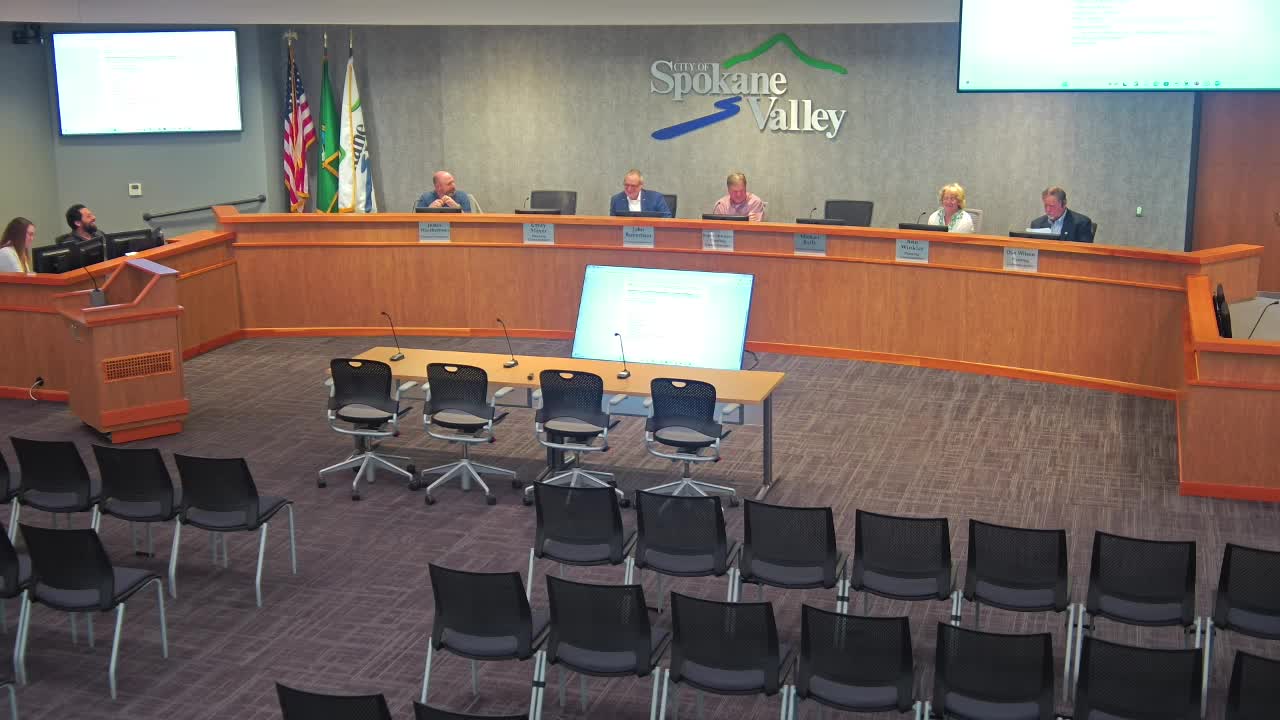
The Spokane Valley Planning Commission on May 22 heard a presentation from planning manager Steve Roberge on a draft public participation plan tied to the city's comprehensive-plan periodic update and agreed to cancel the commission's first June meeting while staff compiles grant deliverables and materials for broader outreach.
The Spokane Valley Planning Commission on May 22 heard a presentation from planning manager Steve Roberge on a draft public participation plan tied to the city's comprehensive-plan periodic update and agreed to cancel the commission's first June meeting while staff compiles grant deliverables and materials for broader outreach.
Roberge told commissioners the work follows the state Growth Management Act (RCW 36.70A) and the city's periodic-update checklist and is structured so public participation will be "early and continuous" through the review and drafting phases. He identified transportation, housing, and a new climate change and resiliency chapter as the heaviest-lift elements for the update.
The presentation laid out three broad phases: an audit and analysis phase running through June 2025; a drafting and policy-development phase that will include extensive commission conversations in July through November; and code updates to follow the policy work. Roberge said the city is operating on a June 30, 2026 target deadline tied to state grant and contract schedules but has an additional six months available to extend the deadline into December 2026 if necessary (exact extended date in the state bill was not specified in the meeting).
Commissioners pressed staff for details about outreach. Roberge said the public participation plan uses a variety of channels: a dedicated project webpage, a presence at community events (including the farmers market), paper materials and kiosks, a survey, possible household mailers, coordination with schools, and multilingual or paper formats as needed. He said staff and the consultant team will staff outreach events; the planning commission may be invited to attend some events so commissioners can hear questions from residents directly.
Roberge identified the consultant team working on the update, including SCJ Alliance and Cascadia, and said consultants will help facilitate community events and compile engagement results. He said staff will deliver interim materials to commissioners in the summer so commissioners can review individual plan sections ahead of policy conversations, and that an engagement-summary report will be provided to the commission in November. Roberge said a full draft of the revised comprehensive plan is expected around January 2026, subject to the timeline adjustments described above.
Commissioners raised concerns about public participation and reach. Commissioner Wilson said, "most people are resistant to change," and urged outreach where residents already go. Several commissioners emphasized reaching a broad cross-section of residents (developers, landowners, students, older homeowners) and suggested QR codes, mailers and event-based booths to capture people who do not typically attend meetings.
The presentation also clarified the content and sequence of work: inventory and state-law checklist review, element updates ("chapters" such as housing and transportation), then development-regulation/code updates. Roberge noted climate change and resilience will be a new chapter for the comp plan that includes both natural-hazard/resiliency measures and greenhouse-gas/emissions elements.
The commission allowed that the chair has administrative authority to cancel meetings when few members will be present; commissioners agreed to cancel the first June meeting and to reassess whether the second June meeting can proceed based on a quorum check. Roberge said staff will email commissioners about quorum checks and will share the outreach-events list and piecemeal draft sections during the summer.
Votes at a glance: motions recorded during the May 22 meeting included approval of the agenda, approval of the prior meeting minutes, a motion to excuse absent commissioners Kelly and Meyer, and the motion to adjourn. Each of those motions was approved by voice vote ("aye") with no opposing votes recorded in the transcript. Specific mover/second names and a numerical roll-call tally were not specified in the meeting record.
Why this matters: the periodic update will guide land-use policy and zoning choices that shape development and neighborhood form in Spokane Valley for the next planning horizon; commissioners and staff emphasized housing, transportation and climate/resilience as the most consequential topics for residents and developers during the update.
What's next: staff will produce outreach materials, post a project webpage, attend community events this summer, and provide commissioners with section drafts and an engagement summary in November, with a full draft anticipated in January 2026. Dates tied to state grant deliverables and the June 30, 2026 target will determine whether the city uses the available six-month extension into December 2026.