Get Full Government Meeting Transcripts, Videos, & Alerts Forever!
Get email alerts on the Harmful Algae Cyanobacteria topic
No spam. Unsubscribe anytime.
Clark County health officials warn of toxic benthic algae mats after dog death on Columbia River
Summary
Clark County Public Health described a recent animal fatality linked to benthic algae mats and outlined new outreach, signage and interagency coordination; officials said routine toxin thresholds for planktonic blooms do not apply to benthic mats and testing capacity is limited.
Clark County Public Health told the Clark County Board of Health on May 21, 2025, that investigators have identified toxic benthic (bottom-attached) algae mats on parts of the Columbia River after a dog died following shoreline contact at a seasonal sandbar near Ackerman Island.
The agency said samples from the incident contained elevated levels of anatoxin‑a and a related animal‑associated toxin (dihydroanatoxin), and that the mat material — not the surrounding river water — is the likeliest exposure route for the animal. "Most importantly, both of these types of algae can produce harmful levels of toxins," said Maggie Palomaki, environmental health specialist with Clark County Public Health's recreational water program.
Why it matters: benthic algae mats are harder to see and to test than the surface scums typically associated with cyanobacterial ("blue‑green algae") harmful algal blooms. County staff warned that: (1) toxins are often bound in mat material so a nearby water sample can test negative; (2) there are currently no state‑defined toxicity thresholds for benthic mats; and (3) local labs do not have routine capacity to analyze mat samples using specialized protocols.
What the health department told the board - Monitoring history and 2024 numbers: Clark County has monitored planktonic (surface) harmful algal blooms since 2007 and conducts weekly site visits in summer (May–October) at lake and pond sites. In 2024 the county recorded more than 66 site visits, collected 38 water samples (two toxin tests per sample, 76 tests total) and found 17 tests with toxin levels above state advisory thresholds that triggered advisories for planktonic blooms.
- The new concern: benthic algae mats, a form of cyanobacteria that attaches to substrate on the bottom of water bodies, were first tested in Clark County in October 2024 after a dog died following shoreline contact at Ackerman Island. County staff, working with the Washington Department of Health and King County Environmental Lab using a California collection protocol, found elevated levels of anatoxin‑a and dihydroanatoxin in mat samples.
- Limits and responses: Palomaki and department leadership said King County's lab provided one‑time testing by special arrangement, but it does not have capacity for routine mat analysis and there are no established state advisory thresholds for benthic mats. As a result, Clark County Public Health is focusing on education and incident investigation rather than setting local numeric cutoff levels. "I think the main focus of this is education," said Dr. Melnick, director of Clark County Public Health, emphasizing outreach to pet owners and recreational users.
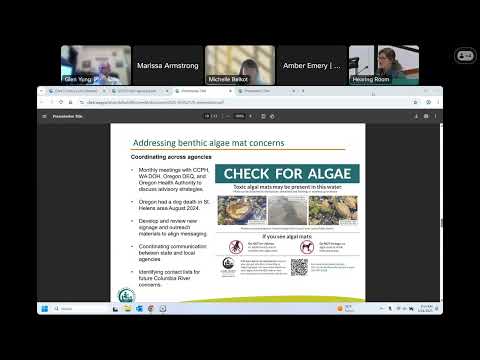
Actions taken and planned - Immediate outreach: the department placed temporary educational signage at all 11 marinas and boat launches it manages on the Clark County side of the Columbia River and produced new handouts and a trifold brochure describing benthic mats, animal and human symptoms, and reporting contacts for Washington and Oregon.
- Interagency coordination: Clark County Public Health now holds monthly coordination calls that include the Washington Department of Health, Oregon Department of Environmental Quality, Oregon Health Authority and Washington Department of Ecology to align advisory strategies and communications across both sides of the Columbia River.
- Surveillance and response approach: the county will continue weekly monitoring and testing for planktonic blooms (no change to that program), will investigate benthic mat reports when illness or animal exposure is suspected, and will notify the community of confirmed incidents. Staff said routine prevention or treatment of benthic mats on the Columbia River is not currently feasible given the river's size and depth.
Board questions and public concerns Board members asked for guidance for pet owners and whether the county has local authority to set numeric thresholds for mats. Palomaki and Dr. Melnick responded that drinking avoidance and carrying alternate water for pets are sensible precautions, but that setting an arbitrary county threshold would be difficult without established science and testing methods: toxins are concentrated within mat material and not reliably indicated by nearby water tests.
Councilor Young praised the multiagency work, saying, "This is, in my opinion, what public health is all about." Palomaki and staff said they are exploring targeted outreach to veterinarians, pet stores and community groups and noted a prior county‑wide veterinary outreach effort for planktonic blooms that could be adapted for benthic mat materials.
Votes at a glance - Motion to approve minutes of April 23, 2025: motion carried (consent agenda). The mover and seconder were not specified in the meeting transcript; board chair called the motion carried following an oral vote.
What is not yet known or resolved - No routine laboratory capacity or standardized testing protocol exists locally for regular benthic‑mat toxin analysis; King County Environmental Lab performed one test by special arrangement using a California protocol. - Washington state does not yet have defined toxicity thresholds for benthic mat advisories; planktonic toxin thresholds continue to govern surface‑bloom advisories. - The full geographic extent of benthic mats on the Columbia River in Clark County is unknown; staff said the county has about 40 miles of Columbia River shoreline to monitor, which limits routine scanning.
The department asked the board to support continued outreach and interagency coordination as staff update educational materials and incident maps; staff said they will report back if testing capacity, thresholds, or new control options become available.