Get Full Government Meeting Transcripts, Videos, & Alerts Forever!
Get email alerts on the Village Revitalization topic
No spam. Unsubscribe anytime.
Hooksett EDAC debates scope of village revitalization, 79‑E incentives and historic protections
Summary
Members of Hooksett’s Economic Development Advisory Committee discussed whether to expand or retarget the town’s 79‑E tax‑incentive area, potential uses for the village, and next steps for historical research and outreach.
Grant (EDAC member) opened a discussion of the village revitalization effort, asking committee members whether they want “additional uses in new buildings, existing buildings being repurposed for new uses or additional uses” and whether to prioritize structural or energy improvements to older properties.
The discussion centered on the town’s existing 79‑E tax‑incentive area — referred to in the meeting as the “79 e program” — and whether to expand that map or instead more narrowly direct incentives toward specific uses such as home businesses. Jim Sullivan, a member of the Heritage Commission, urged caution about stricter historic‑district limits, saying, “Part of their issue felt that if it becomes a Heritage District, if there was restrictions on saying that they can't do X, that they have to have this type of window and that type of column and so forth.”
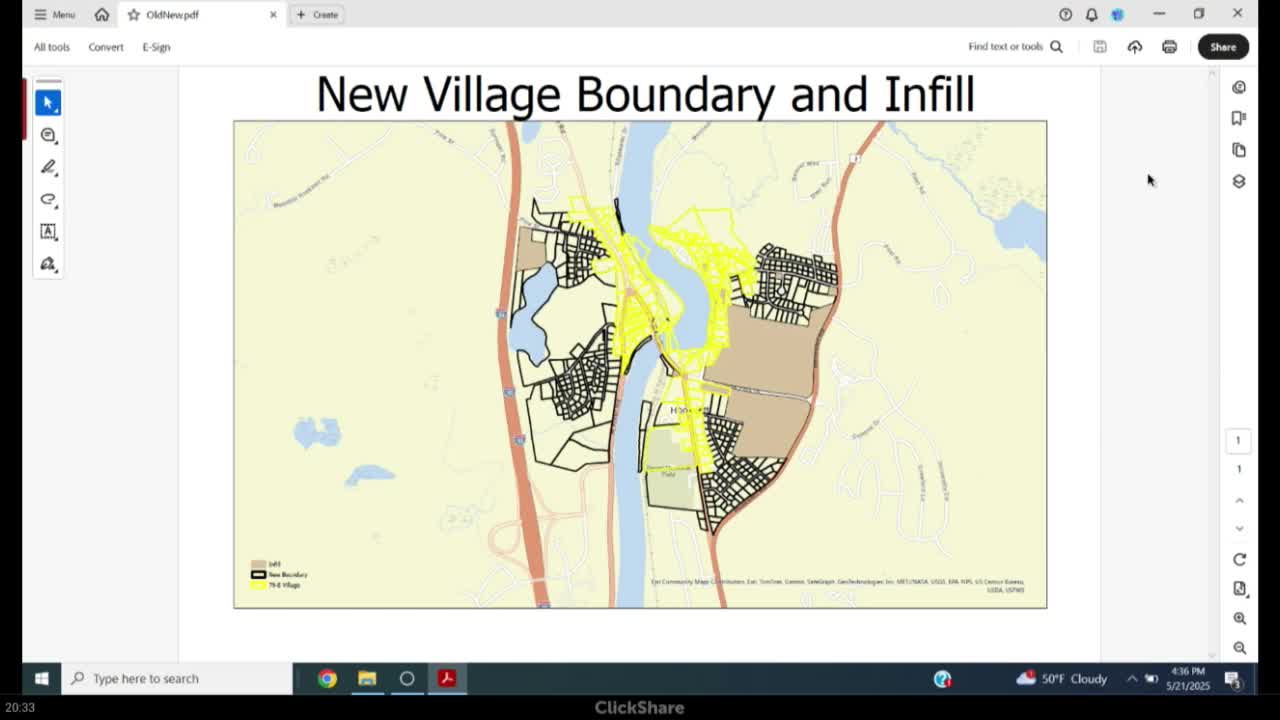
Committee members described two overlapping concepts: the historic village footprint used by the Heritage Commission and the yellow 79‑E map currently used for the tax incentive. Several members said the historic boundaries have not been officially defined and recommended that the committees coordinate to decide whether the tax‑incentive boundary should match the historic definition.
EDAC members discussed the mechanics of the 79‑E program as it currently operates. A staff explanation at the meeting described the incentive as a pre‑improvement tax incentive typically applied for a five‑year window: property owners are taxed on the assessed value prior to a qualifying rehab, and after the term the full assessed value is taxed. The committee also noted that some zoning already allows home businesses and that home‑business activity is currently limited by ordinance to about 500 square feet.
Speakers argued for modest, attainable targets rather than broad commercial redevelopment. Several members suggested focusing on improving walkability — connecting Veterans Park, the lilac crossing bridge and sidewalks along Merrimack Street — and offering financial incentives targeted to property owners who want to rehab older, smaller residential and mixed‑use buildings. The group identified “infill” and a handful of vacant parcels as the only immediate redevelopment opportunities inside the current 79‑E area.
Members agreed on next steps. Grant volunteered to compile historical materials and images, coordinate with the library and Heritage Commission, and return with a short presentation in June. The committee also encouraged outreach to longtime residents for input on historic boundaries and potential signage or a bus tour to highlight village landmarks.
The meeting produced no formal land‑use changes or binding votes; members framed the outcome as direction to research, convene relevant committees and prepare outreach materials.
Ending: The committee scheduled follow‑up work: historic research and a presentation by Grant, coordination with planning and the Heritage Commission on whether to redefine the village footprint for tax‑incentive purposes, and consideration of modest infrastructure and walkability improvements.