Get Full Government Meeting Transcripts, Videos, & Alerts Forever!
Get email alerts on the Downtown Redevelopment topic
No spam. Unsubscribe anytime.
Council committee debates land swap to advance Riverfront Plaza redevelopment, takes no action
Summary
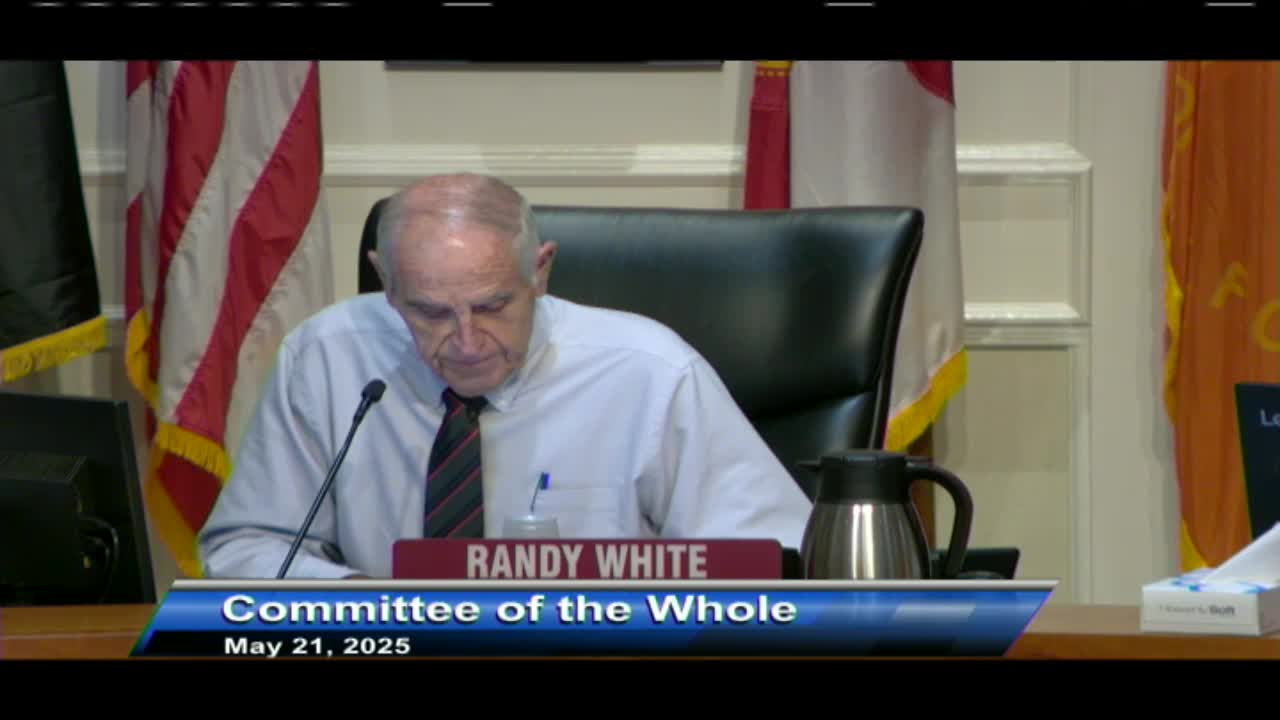
Jacksonville city council members met in a Committee of the Whole on May 21 to review two ordinances (File Nos. 2025-3-19 and 2025-3-39) that would authorize a land exchange and related redevelopment agreement with GatewayJax aimed at advancing construction on Riverfront Plaza Pad B and supporting a proposed University of Florida downtown campus. Council did not take a vote on the measures and no amendments were considered; staff said the item will return for further committee consideration when more councilmembers are present.
Jacksonville city council members met in a Committee of the Whole on May 21 to review two ordinances (File Nos. 2025-3-19 and 2025-3-39) that would authorize a land exchange and related redevelopment agreement with GatewayJax aimed at advancing construction on Riverfront Plaza Pad B and supporting a proposed University of Florida (UF) downtown campus. Council did not take a vote on the measures and no amendments were considered; staff said the item will return for further committee consideration when more councilmembers are present.
The proposed deal would transfer ownership of 801 West Bay (a 2.85-acre, 36,000‑square‑foot office property) to the city and convey Riverfront Plaza Pad B (1.21 acres, undeveloped) to GatewayJax, with an option for the developer to acquire the East Landing parking lot (1.77 acres) later. Lori Boyer, chief executive officer of the Downtown Investment Authority (DIA), said the DIA supports the exchange because it delivers 801 West Bay to the city “with no cash outlay required at this time,” can be completed on a timeline that aligns with UF’s purchase, and creates a recurring revenue source for park maintenance via a proposed 2% hotel surcharge.
“The redevelopment agreement is in standard format, was prepared by OGC, includes many of the normal city protections on performance schedules, rights of reverter, prohibitions against transfer, restrictions on use,” Boyer told the committee. She added the agreement “expressly requires an amendment at a later date, subject to city council approval, to authorize any completion grant” and that the redevelopment agreement includes a cap on that completion grant.
Developer GatewayJax chief executive Brian Moll summarized the company’s experience and the project concept, saying the proposal would include a 17‑story tower above a podium with a 150‑room lifestyle hotel, about 75 condominiums, about 7,500 square feet of food-and-beverage space and a 5,000-square-foot publicly accessible terrace. Moll said GatewayJax has a “committed private equity fund” and emphasized the company’s local investments and proximity to the site.
Council members focused their questions on the deal’s financial mechanics, oversight and timing. Key numeric terms and staff explanations reported at the meeting:
- Appraised values and price points cited: 801 West Bay appraisals ranged from $6,350,000 to $9,500,000; GatewayJax proposed an average purchase price of $6,950,000 if council instead chooses a direct cash purchase of 801 West Bay.
- Repurchase (buyback) mechanism: the redevelopment agreement includes a city option to reacquire Pad B for a reduced price if the developer does not secure required approvals within an agreed period. Moll and DIA staff described a 15‑month period after closing for the developer to obtain design review and incentive approval; if that does not occur, the city could repurchase Pad B at a negotiated lower price (Moll described a reduced repurchase right of $6,350,000 as a potential amendment discussed during the presentation). Council staff and DIA also noted additional time‑based repurchase or clawback provisions tied to commencement of construction and option exercise windows.
- Incentives and funding sources: the redevelopment agreement contemplates a completion grant capped at no more than $20,000,000, which DIA staff said is intended to be funded from Tax Increment Financing (TIF)/CRA resources (DIA indicated an estimated $11–12 million in TIF resources in its proposed FY26 budget and that the grant would be subject to council approval in the budget process). Boyer told the committee the redevelopment agreement language states the intention that the completion grant come from TIF revenues and that any appropriation would require council budget approval.
- Projected fiscal impacts cited by presenters: GatewayJax and DIA estimated the redevelopment would yield a recurring incremental ad valorem increase to the city (presenters cited an example average incremental property tax increase in the order of $1.16 million to $1.86 million per year and estimated hotel surcharge receipts of roughly $400,000–$700,000 annually, depending on assumptions). DIA projected a developer ROI to the city in the 1.5–2.0 range under the assumptions discussed.
- Timing: presenters said closings could occur “as early as July” and no later than Dec. 20, 2025, to align with UF’s timetable. DIA staff said that if council elected to re-run an open RFP and public disposition process instead of approving the swap, that path could add roughly nine months or more to the schedule.
Public commenters who identified themselves as downtown business owners urged council to approve the swap as the quickest path to activation of the riverfront and more foot traffic for existing downtown businesses. Patrick Krichowski, chair of the DIA board, said the board “vigorously debated and questioned this proposal and ultimately determined that it presents an incredible opportunity for our collective downtown.”
Several councilmembers expressed reservations or asked for additional detail. Questions centered on investor disclosure (GatewayJax identified primary investors as DLP Capital and JWB Real Estate Capital but said some limited partners would require permission to be publicly named), the legal limits on loans or grants from public funds, the scope of DIA’s budget authority and whether a future incentive could be limited to TIF dollars rather than general‑fund appropriations. Cindy Trimmer, attorney for GatewayJax, told the committee the developer had disclosed its main investors and that requiring the developer’s fund to publish every limited partner would be a “highly irregular request.”
No formal motions or votes were taken on either ordinance during the meeting; staff and council members agreed to schedule follow-up committee meetings to review a possible amendment package and more detailed underwriting and incentive materials. DIA staff and GatewayJax said additional pro forma and construction underwriting were available to staff and would be finalized before any incentive request was presented to council.
Why it matters: council members and DIA staff framed the choice as one between (a) moving more quickly with a land exchange that transfers an underused office asset to the city and places the riverfront development under private ownership with stated commitments to park funding and activation, or (b) pursuing a direct purchase or a new open RFP that could preserve council discretion but likely delay redevelopment and continuation of the park project. Several downtown business owners and DIA board members said quicker activation could materially benefit small downtown businesses and park programming; other council members urged caution, fuller disclosure and more time for analysis before a final decision.
Next steps noted at the meeting: DIA and legislative services will coordinate scheduling for follow-up Committee of the Whole meetings; DIA said it would present any proposed purchase-and-sale agreement language and technical amendments and that any incentive appropriation would return to council for budgetary action. No council action was taken on either ordinance at the May 21 meeting.