Get Full Government Meeting Transcripts, Videos, & Alerts Forever!
Get email alerts on the Elections Districting topic
No spam. Unsubscribe anytime.
Gilroy council adopts district map F, sets sequencing and 30‑day residency rule
Summary
After eight public meetings, the Gilroy City Council selected draft map F for district-based elections, set three districts to hold elections in 2026, and adopted a 30-day residency requirement for candidates. The ordinance implementing the changes was introduced by unanimous vote.
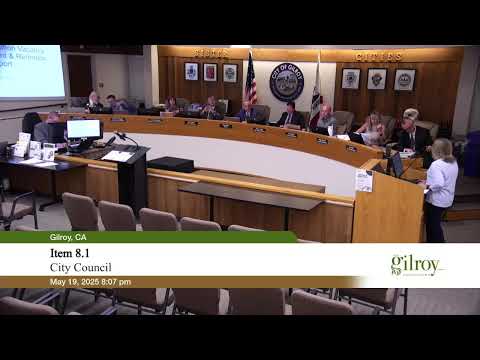
The Gilroy City Council voted unanimously May 19 to adopt draft map F as the city’s district-based election map, set the first round of district elections for 2026, and approved an ordinance implementing the changes.
City demographer and staff presented two final draft maps — D and F — and summarized public input gathered since March. Liz (staff) told the council, “This is the last hearing. We've come a long way,” before explaining that the two maps both produced four majority‑Latino districts but used different dividing lines on the city’s east side and along Monterey Road.
Why it matters: councilors and dozens of members of the public described the choice as central to how the East Side of Gilroy will be represented after the transition from at‑large elections. Supporters of draft D said it kept East Side neighborhoods intact; supporters of draft F argued it would create two districts with stronger direct representation and more electoral competition.
At the vote to choose a final map, Council member Klein moved to select map F; Council member Fugazi seconded. The roll call vote was 7–0 in favor of F. Council members then voted 7–0 to have districts 4, 5 and 6 hold the first staggered elections in 2026 (the council’s sequencing choice for initial elections). On the issue of whether candidates must have lived in their district for a period before filing nominating papers, the council adopted a 30‑day residency requirement by a 5–2 vote.
The council subsequently authorized reading the implementing ordinance by title and waived further reading and then voted 7–0 to introduce the ordinance that (1) establishes six council districts, (2) identifies boundaries and election order, and (3) implements the 30‑day residency requirement. The ordinance will return at a future meeting for second reading and final adoption following standard timelines.
Public testimony at the hearing was lengthy. Proponents of map D included East Side residents and community groups who argued the East Side has been historically marginalized and should remain whole to ensure effective representation. Kathy Chavez Napoli told the council, “I strongly urge you to support d,” citing the East Side as a distinct community of interest. Supporters of map F — including other East Side residents and some downtown stakeholders — argued that F would create multiple majority‑minority districts and provide more direct representation in more than one seat.
Council members repeatedly said they had reviewed dozens of public maps and emails; staff reported receiving about 20 emails favoring map D and 44 favoring map F. Several council members described the process as thorough and noted the council will revisit district lines after the 2030 census as required by law.
The council’s actions finalize which map will be used for future elections and the order in which the first districts will hold elections, but do not immediately change current council membership. Incumbents who wish to run under the new system must meet the residency rule and follow normal nomination filings. The city clerk and city attorney outlined that residency claims may be subject to challenge and potential review if contested.
What’s next: the city will return the ordinance for final adoption at the required hearing/reading and will publish candidate filing deadlines, election sequencing, and administrative details ahead of the 2026 filing period.