Get Full Government Meeting Transcripts, Videos, & Alerts Forever!
Get email alerts on the Higher Education topic
No spam. Unsubscribe anytime.
UC, CSU cuts trimmed in May Revision; students and tribal college seek additional aid and emergency funding
Summary
The governor’s May Revision reduced proposed cuts to the University of California and California State University systems but students and advocates asked the Legislature to eliminate a remaining cut, fund emergency financial‑aid backfills for students with federal data‑privacy concerns, and include one‑time support for California Indian Nations
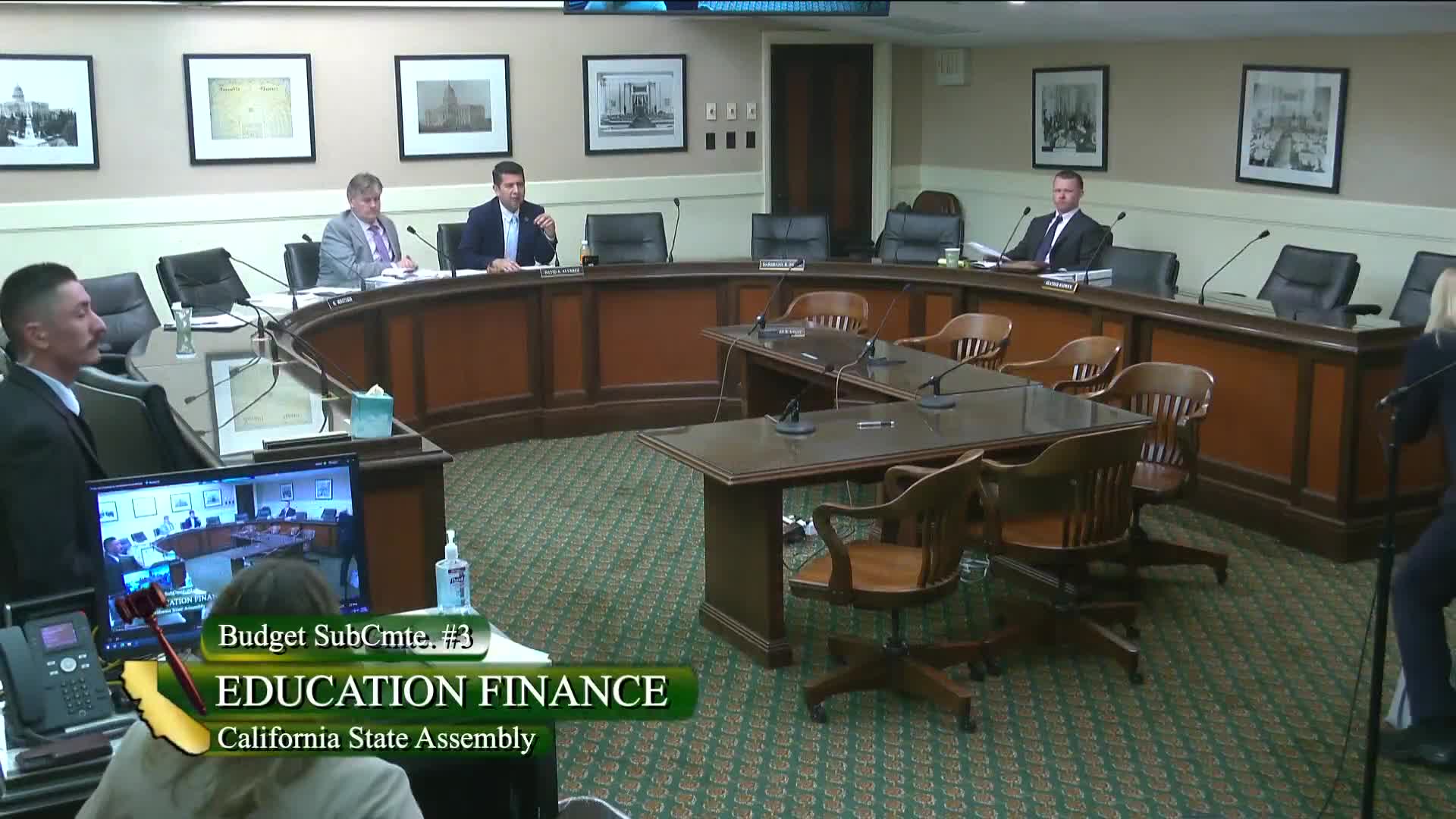
The governor’s May Revision reduced the size of proposed cuts to the University of California and California State University systems compared with the January proposal, but students, campus advocates and Tribal college leaders urged the Assembly subcommittee to do more to shield students and vulnerable institutions.
“While we deeply appreciate the governor’s May Revision to reduce the UC cut to 3 percent, an ongoing cut of any kind will still have a significant impact across our campuses and the communities we serve,” student advocates told the subcommittee. Josiah Bahari, a doctoral student at UC Merced, and Sonya Brooks, the UC Student Regent, both said cuts threaten services for undocumented students, student parents, foster‑youth alumni and others who rely on campus supports. “If it weren’t for public higher education, my American dream would have remained just that — a dream,” Bahari said in public comment.
Financial aid and access: Several speakers urged the Legislature to provide one‑time emergency aid to students who could not complete the Free Application for Federal Student Aid (FAFSA) because of federal data‑privacy concerns or system problems, including some students who have withheld personal data. Student groups and higher‑education advocates said the May Revision preserves core grants (Cal Grant and Middle Class Scholarship) and provided a one‑time increase to avoid award reductions this year, but many called for a targeted, short‑term aid backfill for students still excluded from federal aid.
Tribal college funding: California Indian Nations College (CINC), a public two‑year tribal college on track to secure candidacy accreditation, told the committee it needs immediate one‑time funding to survive until federal support is available. “Without funding in this budget cycle, we will have to close,” said Sean Reagan, vice president of CINC, who noted the college has already used an earlier $5 million state investment for accreditation steps and faces a multi‑year gap before potential federal funds would arrive. Multiple CINC students and staff described the college’s role in serving students from more than 100 tribes and urged at least $5–7 million one‑time to maintain operations.
CSU and UC staffing concerns: Faculty and staff unions, and campus representatives, welcomed the smaller cut but warned about layoffs already underway at several campuses and urged lawmakers to protect merit‑step salary commitments and support low‑enrollment campus turnaround plans. The California Faculty Association and CSU employee representatives asked the Legislature to require CSU to keep compensation commitments and to increase reporting on spending and turnaround strategies for low enrollment campuses.
Other items: Witnesses also urged continued support for the Golden State Teacher Grant program, expanded Cal Grant eligibility for nontraditional transfer routes, and continuation of student supports such as the First Star academies for foster youth at UC campuses — First Star representatives told the committee the program achieves near‑100% high‑school graduation and strong college enrollment rates for participants and requested continued funding across UC campuses.
Why this matters: higher‑education budget choices affect tuition, program continuity and student services — particularly for underrepresented and high‑need students. Tribal colleges and campus‑based student supports operate on thin margins and face delayed federal revenue streams, increasing the importance of any one‑time state backfill while long‑term funding solutions are explored.
What lawmakers asked for next: committee members asked staff to analyze one‑time options for targeted emergency aid to students excluded from federal FAFSA outcomes, estimate the ongoing fiscal impact of any further UC/CSU reductions, and explore a short‑term appropriation to sustain CINC while it completes federal accreditation steps.