Get Full Government Meeting Transcripts, Videos, & Alerts Forever!
Get email alerts on the Proposition 98 topic
No spam. Unsubscribe anytime.
May Revision narrows Proposition 98 gap but rebenches TK funding and increases deferrals, LAO warns
Summary
The May Revision to California’s budget forecasts a 2025–26 Proposition 98 guarantee of about $114.6 billion and would rebench funding to reflect the continued expansion of universal transitional kindergarten (TK), moving an estimated $492 million over several years from community colleges to K–12 while relying on deferrals and one‑time funds to preserve many school proposals.
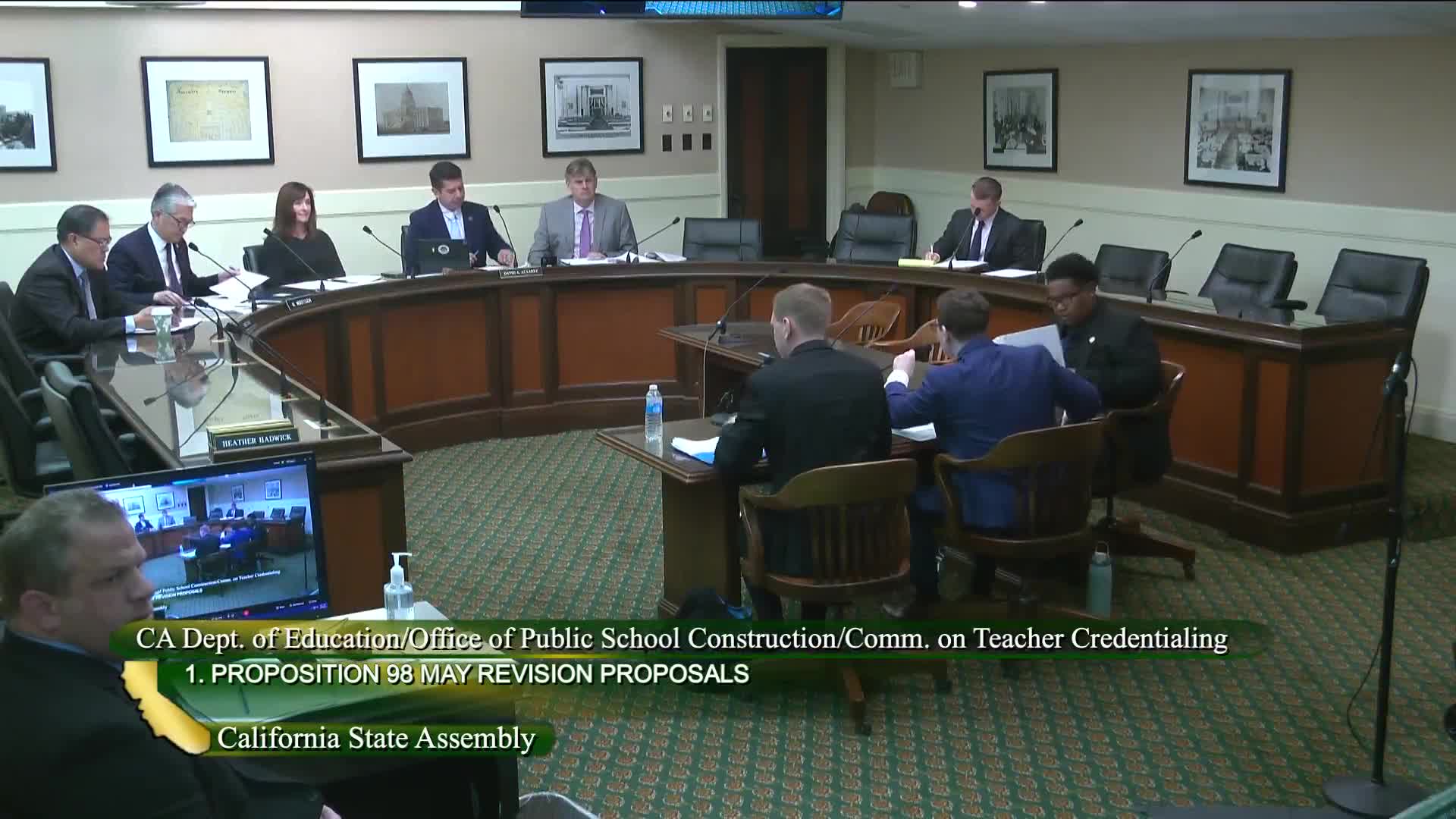
The May Revision to California’s budget forecasts a 2025–26 Proposition 98 guarantee of about $114.6 billion and would rebench funding to reflect the continued expansion of universal transitional kindergarten (TK), Department of Finance officials told the Assembly Budget Subcommittee on Education Finance on May 20.
The proposal moves an estimated $492 million over several years from community colleges to K–12 to align TK program costs with the segment that now delivers TK. It also relies on roughly $2.4 billion in deferrals and uses one‑time balances and smaller reserve actions to pay for many of the administration’s K–12 proposals while maintaining investments such as LCFF COLA and targeted supports, Alex Schoep of the Department of Finance said.
The change matters because, while the May Revision preserves many of the governor’s January school proposals, the LAO said the package relies heavily on one‑time solutions and debt‑like deferrals that could produce a structural shortfall next year. “This plan maintains or expands most school spending from January while using one‑time funds and deferrals that leave the state and districts vulnerable to further revenue declines,” Ken Koppin of the Legislative Analyst’s Office told the committee.
The May Revision highlights and dollar amounts cited by Finance include an ongoing LCFF increase of $2.1 billion (2.3% COLA), $1.7 billion one‑time for student support and professional development block grants, $1.2 billion ongoing to lower TK student‑to‑adult ratios to 10:1, and $525 million ongoing to implement universal before/after/summer programs. For community colleges, Finance proposed a 2.3% COLA of about $217 million and $100 million one‑time for SCFF apportionments in the current year, but many community college proposals from January were reduced or delayed and the colleges face a relatively larger deferral share (the LAO said the college deferral equals roughly 5.3% of district formula funding compared with about 2.2% for K–12).
The LAO recommended an alternative package that would align ongoing spending with the guarantee, avoid deferrals, and preserve COLA and enrollment growth funding by rejecting or delaying certain January proposals and reallocating one‑time items. The office also recommended using the unallocated $1.3 billion in non‑Prop‑98 resources as a buffer to refill the Proposition 98 reserve to reduce volatility rather than spending the amount on non‑education programs this year.
Lawmakers and witnesses raised implementation and equity questions: several community college leaders warned that retroactive rebenching and the reallocation of prior‑year one‑time funding would reduce ongoing capacity and urged a block‑grant backfill; county offices and K–12 advocates said TK is incurring facility and staffing costs that justify steered K–12 funding; and county and school officials asked for clearer guidance and a timeline for the state’s proposed “alternative methodology” for early childhood funding referenced by Finance.
Several other May Revision items drew comment during the Prop 98 panel: a $200 million one‑time literacy professional development proposal, a $100 million one‑time student‑teacher stipend program to be administered by the Kern County Superintendent of Schools (proposed $10,000 per eligible candidate for 500 hours of student teaching), a one‑time $30 million allocation for Special Olympics programming, and continued support for the School Meals for All expansion with $150 million one‑time for kitchen infrastructure and training highlighted by school nutrition advocates in public comment.
The LAO urged the subcommittee to reject or delay some one‑time proposals (including portions of the literacy and coaching proposals) given timing and funding uncertainty; it also recommended targeting discretionary funding increases (for example, to the student support block grant) instead of launching new, ongoing programs that could be hard to sustain if revenues decline.
Members pressed Finance on choices embedded in the Prop 98 split (historically about 89% K–12 and 11% community colleges), with LAO staff calling the split “a budget formula run amok” and recommending lawmakers stop budgeting to a fixed historical percentage and instead prioritize COLA, enrollment changes, and the state’s stated policy goals.
Why this matters: the May Revision preserves many school proposals while pushing much of the budget risk to the future through deferrals and one‑time funding. If revenues continue to soften, districts and colleges could face deeper trade‑offs in 2026–27 and beyond, the LAO warned.
What the committee asked for next: lawmakers asked Finance and the LAO to provide specific options to protect community colleges from retroactive reductions, to explain the expected out‑year impacts of the proposed deferrals, and to provide a clearer timeline for the administration’s alternative early‑childhood funding methodology and for implementation details (for example, how the student teacher stipend would be administered and whether priority would be given to high‑need placements).