Get Full Government Meeting Transcripts, Videos, & Alerts Forever!
Get email alerts on the Zoning Variance topic
No spam. Unsubscribe anytime.
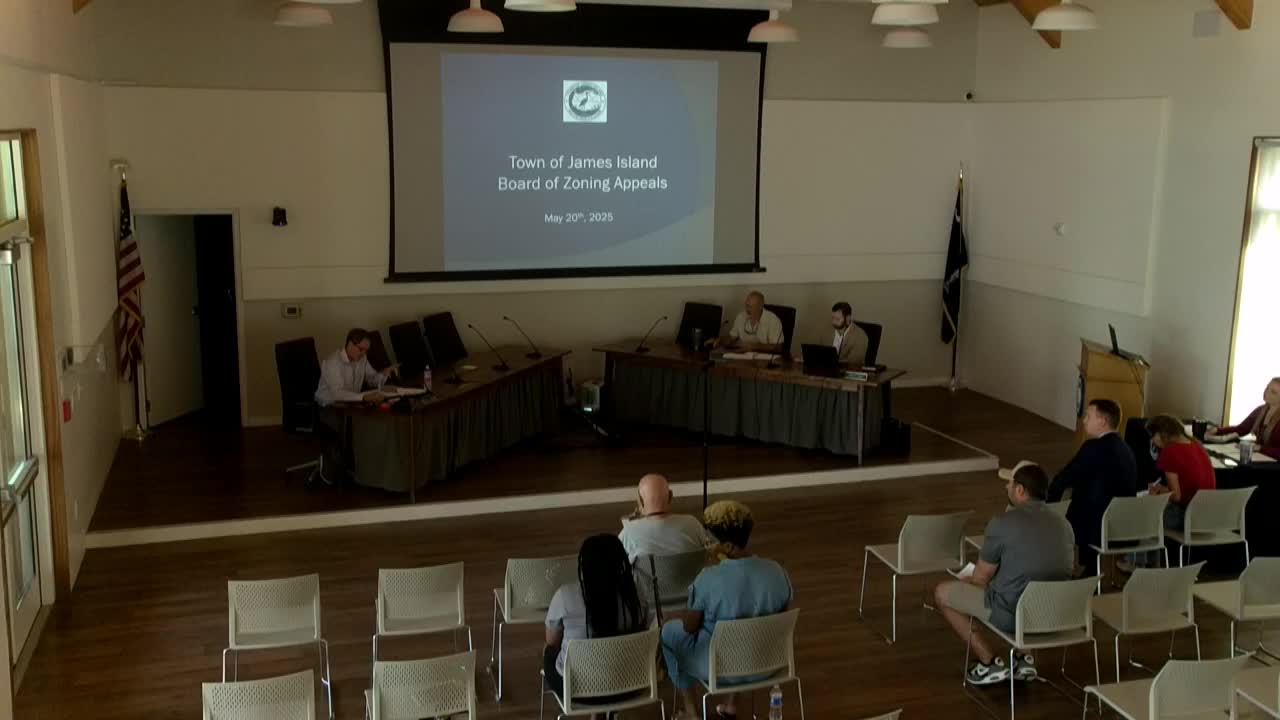
James Island BZA unanimously denies setback variance for 821 Jeb Stuart Road
Summary
The Town of James Island Board of Zoning Appeals on May 20 denied a request by Eric and Bridal Hilger to reduce the required 5-foot side setback to 3 feet for a detached accessory structure at 821 Jeb Stuart Road, finding the application failed to meet zoning variance criteria.
The Town of James Island Board of Zoning Appeals denied a setback variance for 821 Jeb Stuart Road on May 20, voting unanimously to reject a request from applicants Eric and Bridal Hilger to reduce the required 5-foot interior lot line setback for a detached shed to 3 feet.
The decision matters because the requested change would have allowed a 33-by-23-foot steel accessory structure with a 10-foot awning and a 13-foot peak to be placed closer to a large live oak in the rear yard; the board concluded the applicants did not satisfy two required variance findings under the Town of James Island Zoning and Land Development Regulations Ordinance.
Staff told the board the property is in the low-density suburban residential (RSL) zoning district and cited Section 153.207, which requires accessory structures larger than 20 square feet to be set back at least 5 feet from interior lot lines. Planning staff also reviewed the variance approval criteria in Section 153.049 and presented the property's survey, photos of the tree, and a letter of support from an adjacent neighbor. The staff presentation noted the applicants’ written materials were sent to the board on May 14 and May 19 and are part of the record.
Applicant Eric Hilger told the board he wanted to keep the structure near its present location to give a live oak “some space to grow” and because the rear lot narrows. He said the shed would be used for storage and a small hobby space and described the awning and post anchoring that could affect the tree’s root area. Hilger said he had already purchased the building kit and that the previous small shed on the lot was in poor condition; he and his wife bought the property in February 2017.
Board members questioned whether the applicant could shift the building a few feet to meet the 5-foot setback. In discussion, Chair David Savage said the application failed to meet criteria labeled in the staff packet as FC and FF and stressed that the property could still be used as a single-family residence if the variance were denied. Savage said, “the application fails on both, FC and FF,” referring to the ordinance findings the board must make to grant a variance.
Board member Massey Gianatelli agreed, saying the law requires applicants to know applicable rules and that the need for the variance appeared to result from decisions the applicants made when selecting the structure. Board member Joshua Hayes said shifting the shed slightly would allow the applicant to comply and preserve the tree.
No members of the public spoke in support at the hearing and no one spoke in opposition; a neighbor’s letter of support was entered into the record. After discussion, Board member Joshua Hayes moved to approve the variance and another member seconded; the board then voted to deny the application unanimously, with each member voting to deny on the grounds that the applicants failed to satisfy the specified findings of fact.
The board clerk said the final decision would be mailed to the applicants within 10 working days and noted that appeals of BZA decisions are filed to the circuit court under South Carolina Code Section 6-29-820. The board then continued a separate, noncontroversial agenda item — the election of chair and vice chair — to the meeting on June 17, 2025.