Get Full Government Meeting Transcripts, Videos, & Alerts Forever!
Get email alerts on the Solar Energy topic
No spam. Unsubscribe anytime.
Caroline County BZA approves special-use exception for 2 MW Chaberton solar project in Federalsburg
Summary
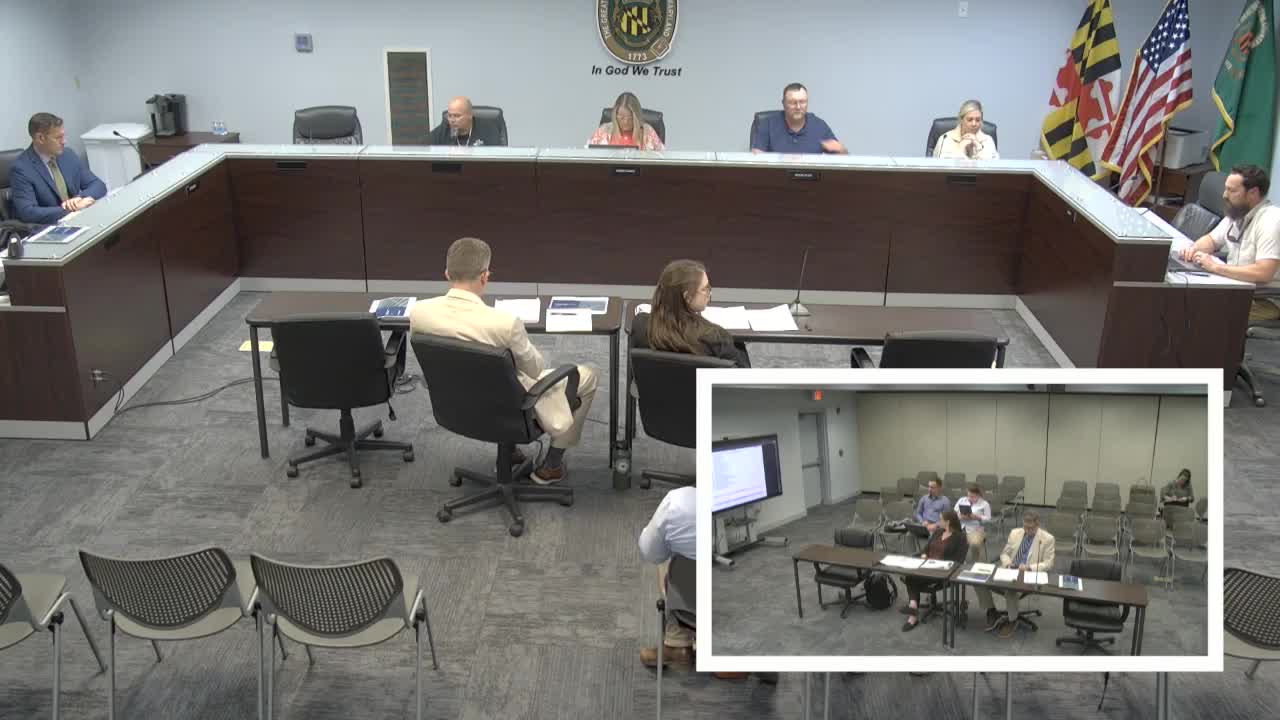
At a May public hearing the Caroline County Board of Zoning Appeals approved application 23-0044, granting a special-use exception for a roughly 2 megawatt, ~23-acre community solar array on Clark Canning House Road in Federalsburg, subject to final site-plan and other conditions.
The Caroline County Board of Zoning Appeals at a May public hearing approved application 23-0044, a special-use exception requested by Chaberton Solar Jabal LLC to construct a 2 megawatt (DC) small-scale commercial community solar energy system on a roughly 22.7–23 acre parcel on Clark Canning House Road near Federalsburg.
The decision, made after a staff presentation and testimony from the applicant, requires the applicant to obtain final site-plan approval from the Planning Commission and to secure required zoning and building permits before construction begins; the board’s decision is void one year from the approval date unless a plat is recorded or a permit is issued and construction has started in accordance with the board’s terms.
Why it matters: the project is presented as a community solar development that the applicant says will produce local electricity subscriptions, estimated customer savings and long-term tax revenue for the county, while the county retains review of site design, stormwater, forest conservation and decommissioning measures.
Applicant representatives said the proposed array will use single-axis tracking panels on about 23 acres, be set back roughly 800 feet from the nearest road, and be screened by 25-foot landscape buffers. “These are single access trackers…they will not exceed 15 feet,” said Paige Jober, identified as senior development manager for the applicant’s developer. The applicant estimated the project’s output at 2 megawatts DC and described anticipated community benefits, including per-subscriber savings and tax payments over the project’s lifetime.
Board staff described the package of exhibits on the record (notice of public hearing, staff report, site plan, decommissioning plan, forest conservation plan, lease/easement and others) and a Technical Advisory Committee (TAC) review that identified about 10 items the applicant must address as part of final site-plan review. “None of which really have any bearing on approval for the special use exception…these are geared more towards the final site plan approval,” staff member Matt Kaczynski said.
During the hearing, applicant witnesses said the project will not include battery energy storage systems, will meet Maryland stormwater management requirements, and will work with Delmarva territory utilities for subscription billing. “Anyone within Delmarva territory can benefit,” the applicant said in response to a question about who may subscribe to the project. The applicant also said the inverters and transformer would operate only during daytime hours and predicted typical sound levels would fall to background at several hundred feet from the equipment; the nearest residence was described as over 1,000 feet away.
Board members asked about construction timing, local subcontracting, emergency response coordination for the fire department and possible impacts on the neighborhood. Applicant representatives said mechanical construction typically includes a peak three-month window and that they will coordinate with local emergency responders and provide informational materials and training before operation. The applicant also noted a decommissioning plan and a forest conservation plan were on file and under review.
The board approved the application with conditions: final site-plan approval by the Planning Commission prior to issuance of any zoning certificate or building permit; required permits and documentation before development; and a one-year void clause unless a plat is recorded or a permit issued and construction begun in accordance with the decision.
Next steps: the applicant must address TAC items and secure final planning commission sign-off and required permits. The county will continue review of the project’s site-plan details, stormwater control, forest conservation and decommissioning security.