Get Full Government Meeting Transcripts, Videos, & Alerts Forever!
Get email alerts on the Climate Resilience topic
No spam. Unsubscribe anytime.
City update: climate resilience plan, solar installations and community pilots outlined
Summary
City staff presented an update on the climate resilience plan, progress on municipal solar projects and several pilot programs including neighborhood resilience funds, cooling work and an e-bike voucher pilot.
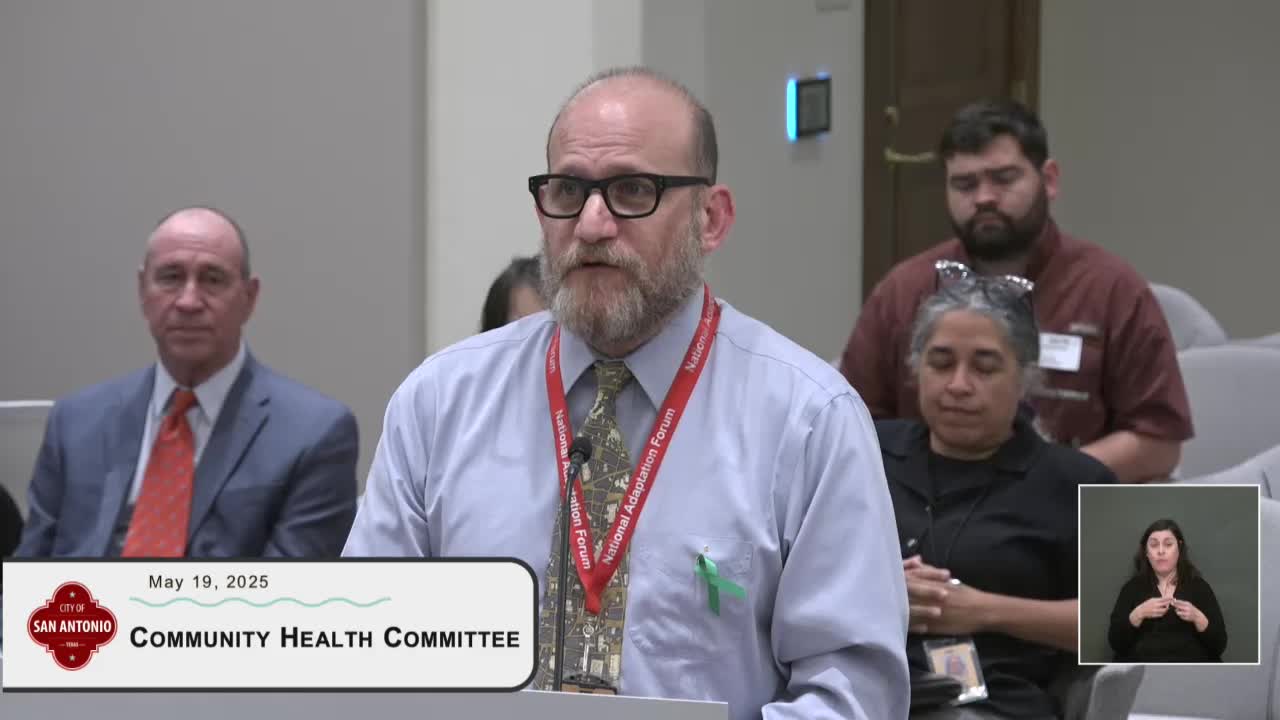
A city climate-resilience briefing to the Community Health Committee on May 19 outlined updates to San Antonio’s 2019 plan, an accelerated timeline for a revised plan and multiple community-level pilots aimed at adaptation and mitigation.
The presenter described a two-track effort: update mitigation and adaptation strategies from the 2019 plan and build an implementation plan that prioritizes strategies by cost, benefit and community leadership. Staff said they will convene advisory subcommittees, hold stakeholder engagement this summer and seek a draft updated plan for circulation next spring.
Staff noted existing work on municipal solar: the council in November 2023 approved roughly 13 megawatts of solar projects, which staff said required about $30 million in installation costs at the time of the briefing and is estimated to save about $1.8 million annually in utility costs. The presenter reported that about 4.1 megawatts had been completed in fiscal 2024–2025, two projects were under construction and a set of additional projects had been authorized to begin work.
Multiple community programs were highlighted. Staff described a Community Action Fund for neighborhood grants (presented figures included $2.3 million in neighborhood grant authority with awards up to $20,000 and a separate $125,000 program); an FY24 resilience allocation of $825,000 to support pilot work in South San/Quintana as a first community; and a pilot e-bike voucher program that offers $1,000 vouchers, for which staff said they received about 1,600 applications and expected the first reimbursements in the week following the meeting.
Other items covered: a cooling program and mini‑split AC installations in targeted neighborhoods, partnerships with CPS Energy for technical and financing support, and membership in an international municipal network to use a data-visualization tool for scenario planning.
Committee members asked about metrics, timelines and funding sustainability. Staff said they would prioritize indicators tied to emissions reductions and community benefits, report a mid‑year account of distributed funds, and continue outreach to identify local partners and alternative funding sources. No new ordinance or appropriation was adopted at the meeting; the briefing was informational.