Get Full Government Meeting Transcripts, Videos, & Alerts Forever!
Get email alerts on the Opioid Settlement Funds topic
No spam. Unsubscribe anytime.
Committee hears update on opioid-settlement funds; city to expand naloxone distribution and outreach
Summary
The San Antonio Community Health Committee received an update on local planning for opioid-settlement funds, including naloxone kit distribution, a city resource portal and partnerships with county and health providers.
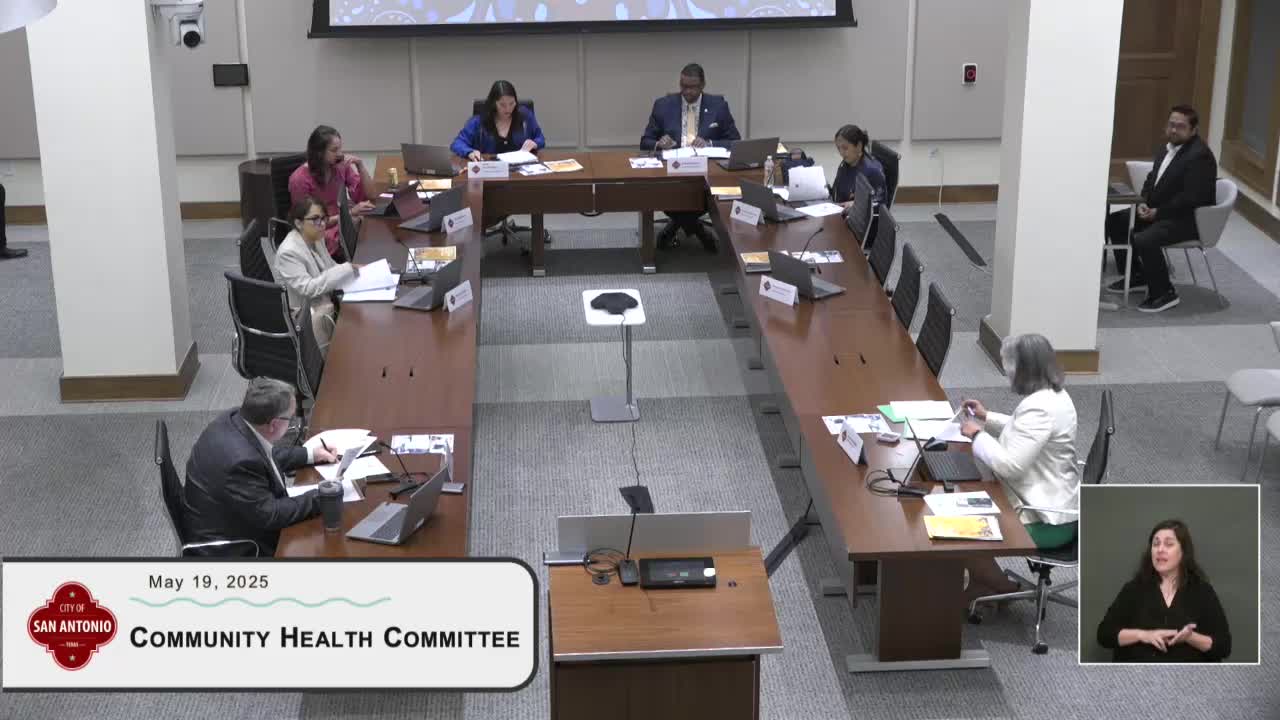
Jessie O'Higgins, presenter, gave the San Antonio Community Health Committee an update May 19 on local plans for opioid-settlement funds and related prevention, harm-reduction and recovery efforts.
O'Higgins told the committee that the state of Texas has secured more than $1.6 billion from opioid litigation and that San Antonio has begun deploying local funds for prevention, treatment and harm-reduction activities. She said city staff are creating policies and budgets to support naloxone distribution, treatment access and recovery services and that a single web portal will list local resources.
The presenter described several concrete steps under way. The city is supplying naloxone (Narcan) kits to the public and to providers, will begin targeted provider outreach with UT Health in September, and has a nonprofit partner and a $100,000 foundation grant to develop plain-language guidance for the community. O'Higgins also said the city is increasing funding to pay for medicines for people experiencing homelessness and is coordinating monthly with Bexar County, which is allocating settlement dollars for housing and related contracts.
Committee members asked how the city will measure outcomes and follow up after a naloxone administration. O'Higgins said each naloxone dose dispensed from public machines includes a QR code that asks the user to provide a location and whether 911 was called; she characterized the code as an early, voluntary way to learn about use and follow-up. She also said naloxone access has changed recently and that in some cases it can be obtained without a prescription at pharmacies.
Committee discussion emphasized stigma and the need to train health-care providers who serve pregnant people. O'Higgins said the city is developing training materials for clinicians and other professionals to address stigma and increase referrals to treatment.
No formal vote or ordinance on the settlement spending took place at the meeting; the session was an informational update and discussion.
The committee heard additional operational details and community coordination plans, and members asked staff to return with further metrics and implementation timelines as the fiscal-year budget and program designs are finalized.