Get Full Government Meeting Transcripts, Videos, & Alerts Forever!
Get email alerts on the School Budget topic
No spam. Unsubscribe anytime.
Cumberland County Schools weigh cuts, pay-scale changes to close $4 million gap
Summary
School leaders presented options including freezing supervisor supplements, reducing instructional cushions and scaling maintenance projects after the county asked for a plan to cover a roughly $4 million shortfall. The board will continue work before presenting to County Commission.
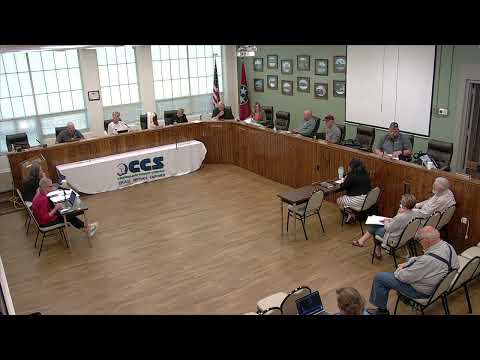
Cumberland County — Cumberland County Schools administrators and board members spent the work session on budget revisions after the county asked the school system to “come back” with a plan to cover about a $4 million gap in its proposed spending.
Dr. Farley, a system staff member who led the presentation, said the district requested $19,000,000 as maintenance of effort from County Commission and sought more than $2,500,000 for singled-out capital projects. “So when we went and presented our budget to the county commission, we were asking for the 19,000,000, that is the maintenance of effort and then we also were asking for specific capital projects to be separated and that was over 2,500,000,” Dr. Farley said.
The discussion centered on three buckets of potential savings: compensation and pay-scale changes, routine operational “cushions” built into instructional lines, and capital/maintenance projects. Board members and staff recapped budget lines showing past and projected shortfalls, options for supervisor pay, and possible reductions in instructional supply allocations and maintenance rotation projects.
Board members reviewed options for supervisors’ pay after an April 24 vote moved supervisors onto the teacher pay scale. The staff packet presented four alternatives: (1) placing supervisors on the teacher scale with their existing supplement percentage, (2) a base-plus-flat-add approach that would yield modest savings, (3) “freezing” supplements and adding the teacher flat add and step raises where applicable, and (4) leaving supervisors on the teacher scale but freezing this year’s supplement. Staff emphasized that none of the options in the packet would reduce any individual’s pay.
“...we are adding into the budget someone with 20 years teaching experience, a masters degree and 10 years admin,” Dr. Farley said when explaining assumptions for replacing a retiring supervisor. Board members pressed staff on whether reducing days worked, reallocating roles or shrinking some administrative posts at larger schools could yield savings sooner.
Administrators also pointed to recurring “cushions” in the instructional budget: the presentation noted a gap between what was budgeted and actual expenditures in prior years (staff cited an approximately 8% miss on instructional totals in 2023–24). Staff proposed tightening that cushion from roughly 8% to 4% to free up an estimated $1.2 million.
Maintenance and capital lines were discussed at length. The packet separated maintenance-of-plant (routine repairs, custodial work) from capital projects (roofing, major renovations, bus replacements). Dr. Farley said the maintenance-of-plant request for the proposal was $4,432,000 and noted last year’s budget and spending showed a sizable gap because some projects rolled forward. Board members asked which projects could be delayed or moved to a one-off request to the County Commission.
Several board members urged prioritizing classrooms and safety over adding new positions or nonessential projects. One board member asked rhetorically, “We could just delete that line, and the owners of the property could maintain their property. Is that a topic of discussion?” reflecting the recurring question of how much county-level maintenance should fall to the school budget versus county government.
On staffing, staff produced an analysis showing savings associated with differing percentage increases for classified employees (a 10% increase vs. 6% or 3%), and an option to reallocate assistant principals among high schools where student counts have declined. The packet also showed the system currently budgets for 360 classroom-teacher positions; staff said they had completed allotment meetings and tightened position counts to match classroom ratios.
Next steps agreed by the board included additional work between that meeting and the next full meeting: (1) staff will refine the pay-scale comparison options and send two proposed salary-scale versions to board members; (2) the board will meet again to consider those scale alternatives before further union negotiations; and (3) staff will continue identifying specific, line-level cuts the board could approve or forward to the County Commission as separate requests.
Votes at a glance: The session opened with a motion to approve the meeting agenda; the motion was seconded and the board approved the agenda by voice vote. No other formal votes or final actions on budget items were taken at the work session.
The board scheduled continued work and a follow-up meeting to refine salary-scale proposals and specific cuts before the district presents a revised plan to County Commission.