Get Full Government Meeting Transcripts, Videos, & Alerts Forever!
Board adopts FY2026 tentative budget of $3.955 billion; flags election and state-mandate risks
Summary
The Maricopa County Board of Supervisors approved a tentative $3,955,121,599 fiscal year 2026 budget and five‑year capital plan, emphasizing public safety and employee compensation while warning of revenue risks from state actions and a dispute with the county recorder that could raise election costs.
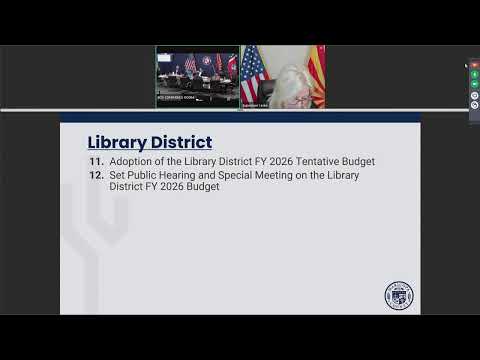
The Maricopa County Board of Supervisors voted unanimously to adopt the county's fiscal year 2026 tentative budget and five‑year capital improvement plan, approving a total appropriation of $3,955,121,599 and setting public hearings on the final budget and truth‑in‑taxation for June 23 and August 18, 2025.
The tentative budget prioritizes public safety, workforce retention and state‑mandated payments while aiming to lower the county's overall property tax rate. Mike McGee, presenting the budget, said the recommended plan “focuses funding on public safety, retaining employees, and satisfying state mandated payments” and that officials used “conservative assumptions” for revenue forecasting.
Why it matters: the plan funds a broad set of county services while keeping reserves to buffer potential state or economic shocks. The board and staff repeatedly warned that several state actions and a contract dispute with the recorder could materially affect the county’s revenue needs and operating costs.
Key budget choices and drivers
- Scale and priorities: The tentative FY2026 appropriation is $3,955,121,599 and the capital program for FY2026 is $452,700,000. The budget increases overall positions by 85 to 15,147 while the staff‑to‑population ratio remains at a low 3.08 per 1,000 residents.
- Public safety and compensation: The county is allocating additional funds to public safety, including near‑final compensation changes for the Maricopa County Sheriff's Office (MCSO). McGee described the sheriff’s compensation update as “a significant investment by the board of supervisors,” while noting final numbers must remain sustainable and comply with the state’s expenditure limitation.
- Conservative revenue assumptions: Budget staff used a conservative 2% growth assumption for state‑shared sales tax in FY2026. Presenters cited slowing sales tax growth (3.9% in FY24 down to 1.9% so far in the current year) and softer domestic migration as reasons to be cautious.
- Mandate…
Already have an account? Log in
Subscribe to keep reading
Unlock the rest of this article — and every article on Citizen Portal.
- Unlimited articles
- AI-powered breakdowns of topics, speakers, decisions, and budgets
- Instant alerts when your location has a new meeting
- Follow topics and more locations
- 1,000 AI Insights / month, plus AI Chat