Get Full Government Meeting Transcripts, Videos, & Alerts Forever!
Get email alerts on the County Budget topic
No spam. Unsubscribe anytime.
Board adopts FY2026 tentative budget of $3.955 billion; flags election and state-mandate risks
Summary
The Maricopa County Board of Supervisors approved a tentative $3,955,121,599 fiscal year 2026 budget and five‑year capital plan, emphasizing public safety and employee compensation while warning of revenue risks from state actions and a dispute with the county recorder that could raise election costs.
The Maricopa County Board of Supervisors voted unanimously to adopt the county's fiscal year 2026 tentative budget and five‑year capital improvement plan, approving a total appropriation of $3,955,121,599 and setting public hearings on the final budget and truth‑in‑taxation for June 23 and August 18, 2025.
The tentative budget prioritizes public safety, workforce retention and state‑mandated payments while aiming to lower the county's overall property tax rate. Mike McGee, presenting the budget, said the recommended plan “focuses funding on public safety, retaining employees, and satisfying state mandated payments” and that officials used “conservative assumptions” for revenue forecasting.
Why it matters: the plan funds a broad set of county services while keeping reserves to buffer potential state or economic shocks. The board and staff repeatedly warned that several state actions and a contract dispute with the recorder could materially affect the county’s revenue needs and operating costs.
Key budget choices and drivers
- Scale and priorities: The tentative FY2026 appropriation is $3,955,121,599 and the capital program for FY2026 is $452,700,000. The budget increases overall positions by 85 to 15,147 while the staff‑to‑population ratio remains at a low 3.08 per 1,000 residents.
- Public safety and compensation: The county is allocating additional funds to public safety, including near‑final compensation changes for the Maricopa County Sheriff's Office (MCSO). McGee described the sheriff’s compensation update as “a significant investment by the board of supervisors,” while noting final numbers must remain sustainable and comply with the state’s expenditure limitation.
- Conservative revenue assumptions: Budget staff used a conservative 2% growth assumption for state‑shared sales tax in FY2026. Presenters cited slowing sales tax growth (3.9% in FY24 down to 1.9% so far in the current year) and softer domestic migration as reasons to be cautious.
- Mandated state payments: About one‑fifth of the operating budget is for state‑mandated payments. Presenters flagged several state impacts: an annual automatic 5% increase tied to the Arnold v. Sarn settlement, ongoing uncertainty in ALTCS (Arizona Long Term Care System) payments, and a $6.7 million juvenile corrections payment that Maricopa County still must make while most other counties do not.
- Jail excise tax: New legislation signed by the governor authorizes renewal of the county’s jail excise/public safety funding tax; that tax will appear on the ballot in 2026. Staff estimated the jail excise tax brings roughly $288–300 million in revenue and accounts for about 7.29% of total county revenue in FY2026. Presenters and supervisors emphasized the large revenue role the tax plays and the difficulty of replacing that funding if voters do not approve an extension.
Elections, recorder shared‑services dispute and budget risk
A substantial portion of the board’s questioning focused on elections operations and a pending shared‑services agreement (SSA) with the county recorder. Assistant County Manager Zach Shira told the board that if the recorder reclaims responsibility for early in‑person voting, the county could face duplicative election costs: initial conservative estimates ranged from $11 million to $13 million in one‑time capital costs, about $1.8 million in ongoing costs, and roughly $900,000 added to the biennial elections reserve (the ELE1 budget). Staff said these figures represent a plausible worst‑case contingency rather than a certain outcome.
Kirsten Prindle, who walked through elections line items, said the FY2026 elections operating budget recommendation totals about $14.2 million, with the elections cycle (ELE1) reserve at $8.6 million for the 2026 primary. The presentation also noted specific equipment and operational items: the county uses Lexmark ballot‑on‑demand printers (maintenance included in this budget), and staff said they plan two tabulators per voting location (550 tabulators was cited as the target number) to support on‑site tabulation for late‑arriving mail ballots.
Presenters described the operational reason for separate queueing after check‑in: one unified check‑in flow avoids bottlenecks, then voters who present late early ballots proceed to a separate tabulation queue to preserve chain of custody and prevent double‑voting.
Other notable budget details
- Retirement and pension payments: The county projects a retirement cost decrease of about $31.8 million as a result of prior pension pay‑downs approved by the board.
- Mandate sensitivity: Staff noted ALTCS and provider rate negotiations remain subject to the state budget process; Prindle said the JLBC baseline included a $5.8 million ALTCS increase while the governor’s proposal had an additional $9 million, and the final number will not be known until the state adopts its budget.
- Staffing changes: Public safety departments drive much of the headcount increases: child and adult probation, detention officer positions at MCSO, and additional court staffing were among the new positions highlighted.
- Capital priorities: The FY2026 capital program includes facilities, public safety substations, a downtown elections facility, Durango Campus electrical upgrades, parks projects and a public safety radio refresh; the FY2026 capital total was presented as $452.7 million with a five‑year CIP of roughly $259.4 million for the flood control program alone.
Board action and follow‑up
Vice Chair Supervisor Brophy McGee moved to approve the tentative FY2026 budget; Supervisor Stewart seconded. The board voted unanimously to adopt the tentative budget and to set the public hearing and special meeting dates for final action: June 23, 2025 for the public hearing and August 18, 2025 for levy/rate adoption.
The board also approved tentative budgets and set hearings for several affiliated districts during the same meeting (see "Votes at a glance" below). Presenters asked the public to watch for final adjustments after the state budget is resolved and recommended maintaining contingency to manage potential state revenue disruptions.
Votes at a glance
- Motion to approve Maricopa County FY2026 tentative budget of $3,955,121,599 and five‑year CIP: moved by Vice Chair Supervisor Brophy McGee; seconded by Supervisor Stewart; outcome: approved unanimously.
- Motion to set public hearing and truth‑in‑taxation hearing for 06/23/2025 and tax levy adoption notice for 08/18/2025: moved by Vice Chair Brophy McGee; seconded by Supervisor Stewart; approved unanimously.
- Flood Control District tentative budget: $105,079,604; moved by Vice Chair Brophy McGee; seconded by Supervisor Gardo; approved unanimously.
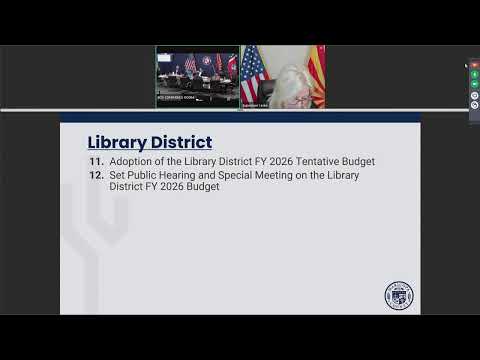
- Library District tentative budget: $48,995,617; moved by Vice Chair Brophy McGee; seconded by Supervisor Stewart; approved unanimously.
- Stadium District tentative budget: $9,750,000; moved by Vice Chair Brophy McGee; seconded by Supervisor Gardo; approved unanimously.
What the board asked staff to do next
Board members requested continued legislative outreach to remove or phase out the juvenile corrections cost shift (the $6.7 million payment), close monitoring of ALTCS/provider rate outcomes in the state budget, and more detailed follow‑up on the recorder SSA and the contingency plans and cost estimates for elections if responsibilities are split. Staff said they are pursuing a phased legislative solution for the juvenile corrections payment and that the final county budget will be updated after state actions are clear.
Ending note
Presenters and supervisors framed the tentative budget as deliberately conservative and focused on maintaining services while improving compensation in public safety and preserving contingency. The board will reconvene on June 23 for the public hearing and will adopt the final budget and property tax levy in August after required public notices and the state budget outcome are known.