Get Full Government Meeting Transcripts, Videos, & Alerts Forever!
Conference committee approves omnibus cannabis conference report after hours of public testimony
Summary
A Minnesota conference committee approved a conference report for Senate File 2370, the omnibus cannabis bill, after public testimony on testing, patient access, hemp licensing, local retail rules, potency limits and expungement. Committee chairs directed staff to finalize the report and make technical conforming changes.
A Minnesota legislative conference committee on May 16 approved a conference report on Senate File 2370, the omnibus cannabis bill, after more than two hours of public testimony and committee discussion.
The committee voted to instruct nonpartisan staff to prepare the final conference committee report and to make technical and conforming changes “to reflect the intent of this conference committee,” a motion moved by Representative Steven Stevenson and approved by voice vote. The committee did not amend the report on the floor during the hearing.
The bill, described by witnesses and staff as a package of implementation fixes, contains provisions aimed at smoothing the licensing rollout, easing barriers for testing laboratories, clarifying social-equity eligibility, expanding some patient protections, creating lower-potency hemp wholesaler and delivery pathways, updating transportation rules and directing the Office of Cannabis Management (OCM) to propose a supply-chain streamlining plan to the Legislature.
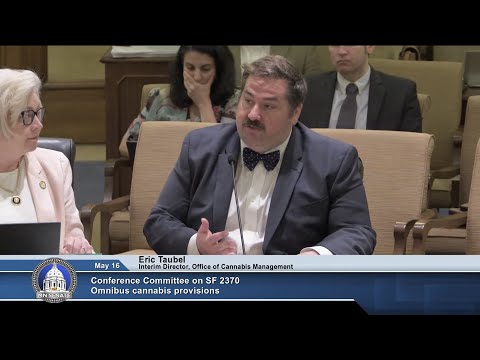
Eric Taubel, interim director of the Minnesota Office of Cannabis Management, told the committee the report reflects several OCM recommendations and would help launch the regulated market. “The office remains focused on implementing chapter 342 to foster an equitable cannabis industry that prioritizes public health and safety, consumer confidence, and market integrity,” Taubel said. He highlighted four areas the office supports: licensing rollout (including a licensing variance for testing facilities), application-process improvements, clarifications to social-equity qualification standards and provisions to protect continuity for medical patients.
Taubel told conferees the bill would permit testing facilities to start accreditation while they begin operations, a change intended to reduce a common rollout choke point. “Every market that has launched has had some amount of slowdown related to the lack of testing capacity,” he said, and the bill’s changes are intended “to ease the burden of entry for new testing facilities into the market.”
Testing capacity was a repeated theme in testimony. Taubel said the OCM had seven preliminary-approved labs and five qualified applicants in the…
Already have an account? Log in
Subscribe to keep reading
Unlock the rest of this article — and every article on Citizen Portal.
- Unlimited articles
- AI-powered breakdowns of topics, speakers, decisions, and budgets
- Instant alerts when your location has a new meeting
- Follow topics and more locations
- 1,000 AI Insights / month, plus AI Chat