
Council hears early planning options for 76-acre sports complex; cost estimates top $20 million
Get AI-powered insights, summaries, and transcripts
Subscribe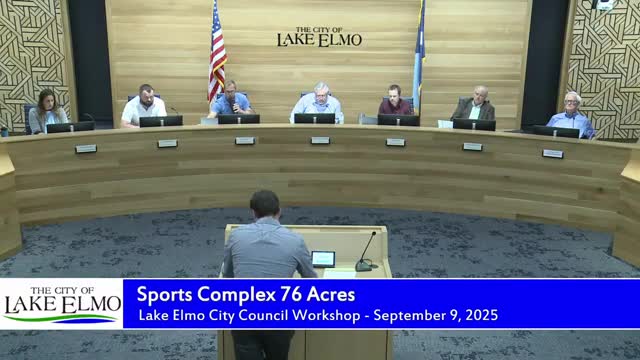
Summary
City staff outlined a phased plan for a 76-acre sports complex the city recently purchased, recommending a community-engagement and financial-feasibility study before major capital work.
City staff briefed the Lake Elmo City Council on early planning for a recently purchased 76-acre parcel south of Sunfish Lake Park that the city envisions as a regional sports complex.
Why it matters: The parcel could host multiple baseball/softball fields and multiuse soccer fields, parking, concessions and restrooms. Staff said a buildout comparable to other suburban complexes could cost in the tens of millions; staff and consultants cited budgets in the $20–25 million range for an extensive buildout with artificial turf, full grading, utilities and parking.
What staff presented: Director Stopa summarized research trips and conversations with other municipalities and sports associations. “Today we’re talking about the sports complex, the land, that was recently purchased. The city, 76 acres,” he told the council. Staff proposed a phased approach: community engagement and a financial feasibility study to examine field count, turf-versus-grass tradeoffs, maintenance costs and revenue opportunities such as user fees, leases, naming rights and partnerships.
Associations and design preferences: Representatives from Lake Elmo Baseball and the Minnesota Blizzard (a travel program) said their ideal layout would include 4–5 fields, two larger “stadium-style” fields with lighting and artificial turf to reduce rainouts and lengthen usable seasons. Staff noted artificial turf has high upfront and replacement costs (one presenter cited roughly $1 million per soccer-size turf field) but lowers routine maintenance and supports tournaments. Grass-only development still requires substantial site work — grading, stormwater, parking — and staff estimated even a scaled grass build could run several million dollars.
Funding and timing: Staff flagged multiple funding mechanisms: park dedication funds (the packet noted a $3 million park-dedication balance at 2024), partnerships with sports associations, sponsorships and possibly a referendum if capital needs exceed available reserves. Staff recommended moving community engagement and the financial analysis into the 2026 work program rather than attempting to meet a 2026 referendum timetable. Several councilmembers said they favored a cautious, phased process with consultant-led financial modeling and resident surveys before committing to large capital outlays.
Operational questions: The council discussed operations and maintenance models. Staffing, seasonal operations, potential leases to associations, and the need for early planning on stormwater and grading were highlighted. Director Stopa said the site will require substantial earthwork and stormwater infrastructure and that those site-development costs are often a major portion of initial capital outlays.
Next steps: Staff recommended engaging a consultant to produce a community-engagement and financial-feasibility report and to coordinate with sports associations about potential cost-sharing or long-term leases. Council did not set a referendum timetable; members asked staff to plan for 2026 engagement and to return with consultant proposals and a clearer phasing plan.
Ending: No capital appropriation or binding decision was made. Councilmembers emphasized the need for broad community engagement, detailed cost modeling and phased design before any large-scale construction decisions.