Get Full Government Meeting Transcripts, Videos, & Alerts Forever!
Get email alerts on the Stormwater topic
No spam. Unsubscribe anytime.
Commission asks staff to strengthen stormwater code, end municipal self‑certification and step up coordination on karst groundwater risks
Summary
After months of technical review and public concern about Mill Creek-area development, the Board directed staff to pursue code changes that would tighten stormwater protections in sensitive karst areas, phase out municipal self‑certification and seek formal coordination with state and regional regulators.
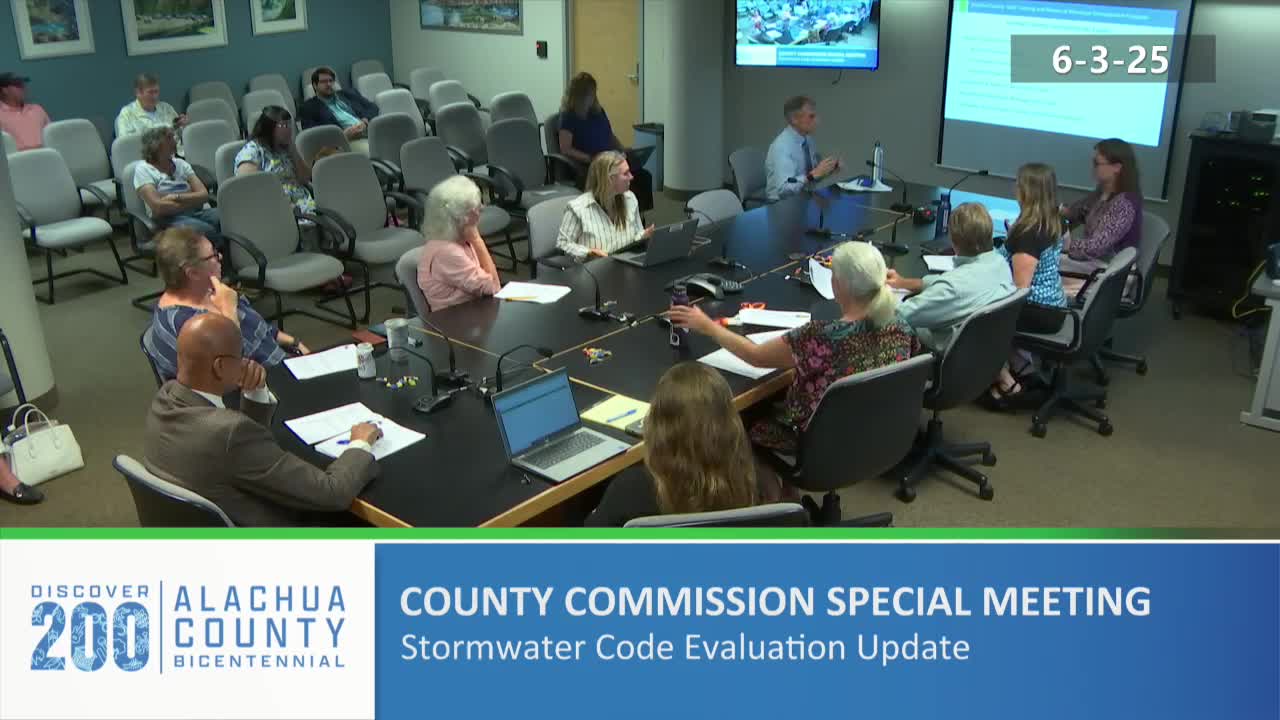
Alachua County commissioners voted June 3 to pursue multiple changes to the county’s stormwater program following a staff presentation that highlighted gaps in groundwater protection for projects in sensitive karst terrain.
Stacy Greco, EPD’s water resources program manager, opened the presentation and introduced new water resources engineer Mary Zoka. "We will focus on these two points: bringing back the recommendation to strengthen our stormwater code and, then specifically looking at eliminating the current self certification process," Greco said.
EPD staff told the Board that Alachua County’s existing countywide codes — including the wetland code, natural resources code and irrigation design code — provide substantial protection in many cases but leave particular vulnerabilities where development drains directly into karst features and the unconfined aquifer. Mary Zoka said county requirements currently allow municipalities to submit a self‑certification affidavit and that the county typically sees those documents 30 days after final municipal approval, a timing she called too late to influence project design.
Staff reviewed local outcomes and national best practices. They reported that Alachua County scored well in a low‑impact development (LID) code audit conducted by The Nature Conservancy and University of Florida tools, but that LID measures frequently arrive late in the design process as mitigation rather than being used earlier for avoidance and site‑specific design. Staff also noted that state stormwater rule updates (adopted in 2024, coming into effect in 2025) improved standards but do not include explicit groundwater protection for sensitive karst areas.
Commissioners and speakers debated the practical limits of county authority. County staff explained the difference between the county’s conduct/code authority (stormwater, water‑quality code) and municipal land‑use authority; staff emphasized that while the county can enforce its stormwater rules, it lacks direct land‑use enforcement over municipal approvals. The Board asked staff to pursue both voluntary early coordination and, where appropriate, code changes.
Public concern was strong. Dozens of citizens commented, including Soria Lindberg and Kristen Rubin, urging stronger notice and more protective rules for features such as Mill Sink and nearby cave systems. Brandon Balanas (a Hawthorne resident) argued that stronger rules could raise development costs and reduce investment; elected officials and staff rejected a binary view, saying environmental protection and sustainable economic development can coexist.
Action: the Board approved a package of four steps: (1) explore revisions to the county stormwater quality code and require earlier submittal/review of documents now sent only after final municipal approval; (2) end or revise the municipal self‑certification process and consider reviewing a subset of municipal applications earlier in the process (especially in the western sensitive karst area); (3) send an updated chair letter to the City of Alachua and continue direct technical engagement on Mill Creek-area permits; and (4) pursue further code updates and implementation steps — including a consistency checklist, piloting LID inventory, exploring required soil amendments when suppliers exist, and engaging IFAS/University of Florida and regional partners for technical assistance. The motion passed on a voice vote.
Staff emphasized next steps: meet with the Suwannee River Water Management District to assess how district permitting and the Basin Management Action Plan (BMAP) can better address groundwater concerns in karst areas; pilot earlier county review of municipal projects in sensitive areas; and return with draft code language and resource implications. Greco said the county is also planning an outreach campaign tied to the county’s fertilizer ordinance taking effect in July.
The Board also discussed enforcement tools available under the county’s conduct code — daily fines, injunctions and liens — and that bonds are used to secure performance of infrastructure when stormwater facilities are county assets. Commissioners asked staff to quantify resource needs to implement new review expectations; several said they expect to consider requests for additional EPD staff in the upcoming budget.
What comes next: staff will pursue the four‑part package, meet with the Suwannee River Water Management District and the City of Alachua, obtain technical consultant support for karst groundwater protection, and return with proposed code amendments and an implementation plan, including workload and budget implications.