Get Full Government Meeting Transcripts, Videos, & Alerts Forever!
Get email alerts on the Development Review topic
No spam. Unsubscribe anytime.
Alachua County centralizes tracking of municipal development notices; staff to map municipal notice rules
Summary
County staff established a central tracking process for municipal development notices and will return with a summary of municipal notice requirements after commissioners asked for clearer coordination and visibility into municipal planning actions.
Alachua County commissioners directed staff on June 3 to map how municipalities notify the county about development proposals and return with a recommended process for earlier coordination.
Growth Management Director Jeff Hayes told the Board the county has formalized a central review role, assigning a staff member to monitor municipal agendas, legal ads and neighborhood workshop notices and to log those items in CitizenServe. "We do have a staff person in growth management who is being tasked with actually reviewing agendas for municipalities, reviewing newspapers, media reports and to sort of be a central person so that things aren't getting lost in the shuffle," Hayes said.
The action followed a staff presentation explaining that counties are routinely alerted to large-scale comprehensive plan amendments (those over about 50 acres or text amendments) but often do not receive notice about smaller municipal steps such as small‑scale amendments, plan board hearings or local site-plan revisions. Steve Hostetter, director of the county's Environmental Protection Department (EPD), said that while the county enforces certain countywide codes — including the countywide wetland code, irrigation design code and natural resources protections — municipalities use different land‑development processes and may not provide the county with every notice.
Commissioners asked for operational changes to make county review more effective. Commissioner Cornell moved that staff summarize the county's notice requirements and each municipality's notice rules, and return the information to the Board. The motion also directs staff to identify gaps and opportunities to improve public engagement; it passed on a unanimous voice vote.
Staff outlined immediate procedural changes already in effect: a named staff member (Ken McMurray) will log incoming notices in CitizenServe, associate them with parcel records, and create a permit-type tracking entry so county reviewers can search municipal submittals alongside unincorporated projects. Hayes said the log will include links to submitted documents and a record of staff comments.
Commissioners and commenters raised related concerns: visibility for residents who do not receive mailed notice, expansion of mailed notification distances, use of TV channel 12 for scroll notices, and whether county staff should be copied on all comments sent to municipal staff. Some commissioners warned against automatically elevating routine staff-to-staff coordination to the Board, preferring staff-level problem solving but asking for escalation when issues are unresolved.
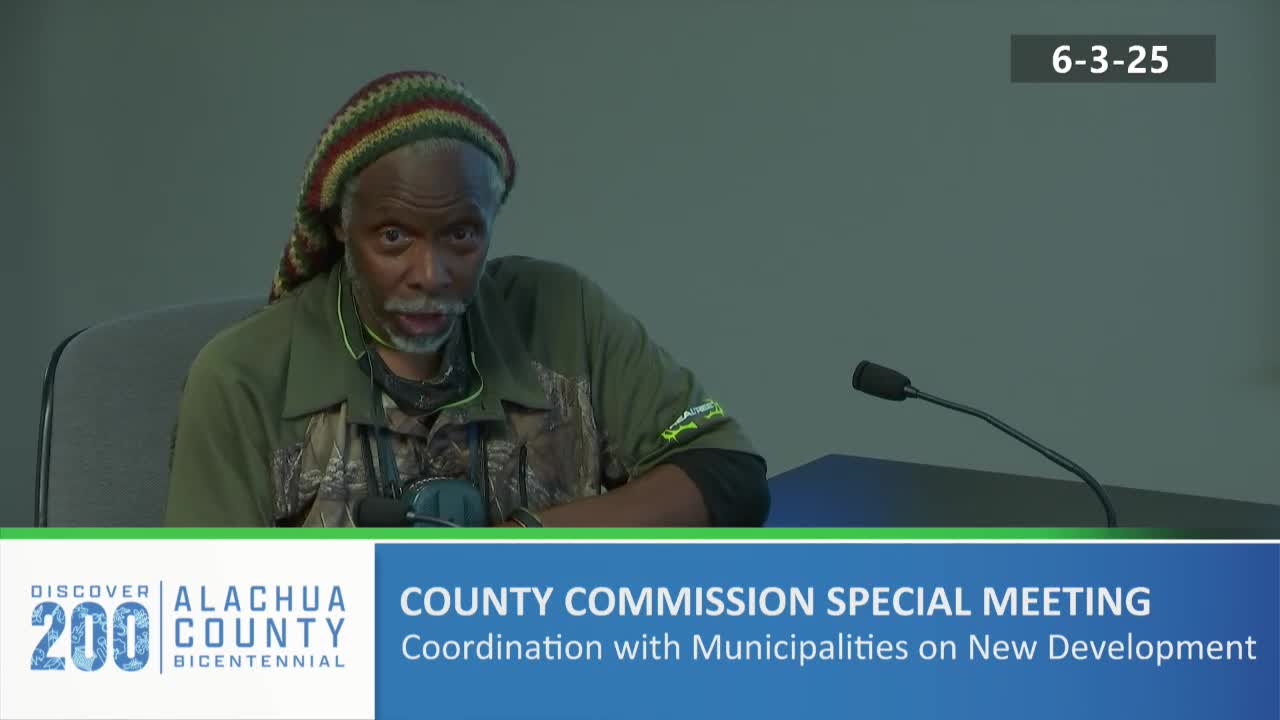
Public commenters urged stronger intergovernmental coordination. High Springs resident Brian Bisscher suggested an intergovernmental council for regional planning; Soria Lindberg and Kristen Rubin said county notice and cross‑jurisdictional alerts are crucial for protecting water resources and public participation.
What comes next: staff will return to the Board with a summary of Alachua County's notice rules, a comparison chart of municipal notice requirements, and recommendations for how CitizenServe tracking can be used to improve early notification and create a searchable public repository.