Get Full Government Meeting Transcripts, Videos, & Alerts Forever!
Get email alerts on the Land Use Miramar Redevelopment topic
No spam. Unsubscribe anytime.
Sarasota commissioners approve Miramar redevelopment after lengthy public hearing; several other measures pass
Summary
After more than five hours of debate and public testimony, the City Commission approved a comprehensive-plan amendment to allow an 18-story redevelopment at the historic Miramar site. Commissioners also approved several other routine and land-use votes that had been on the agenda.
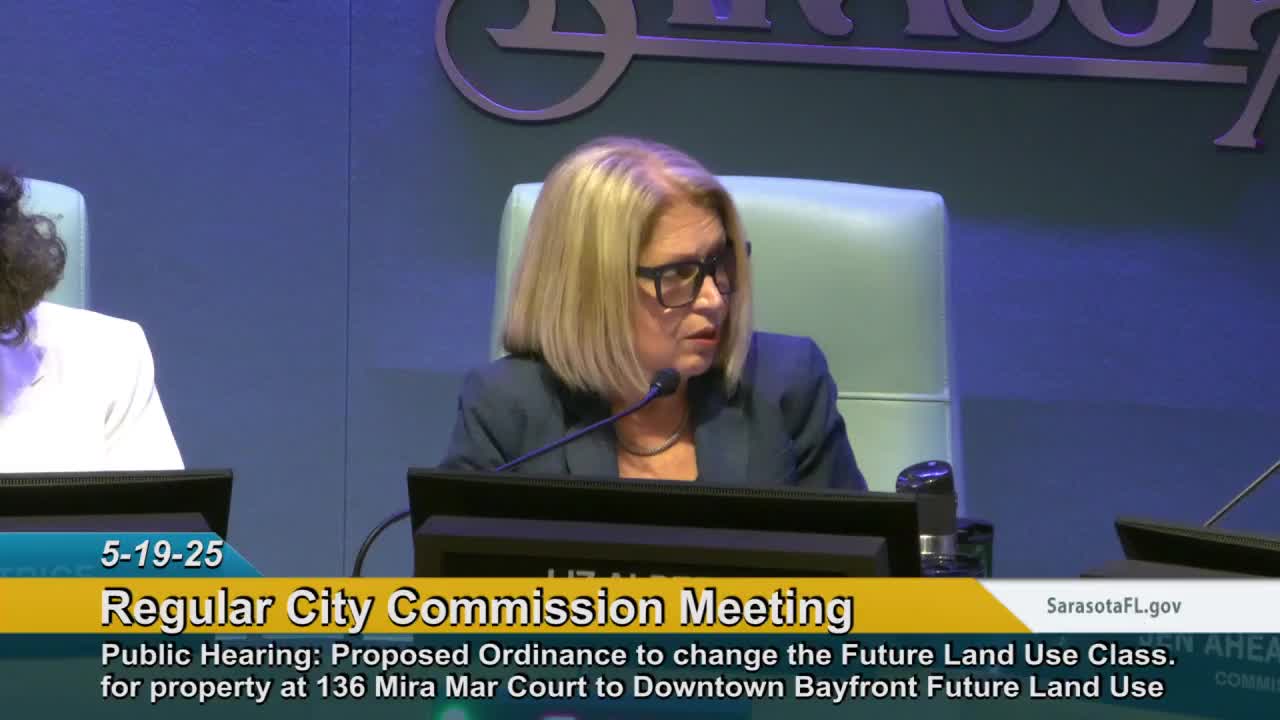
Sarasota — After an extended legislative public hearing and more than five hours of testimony, discussion and cross-examination, the Sarasota City Commission voted unanimously on May 19 to amend the city’s comprehensive plan to allow the Miramar site at 65 South Palm Avenue to be reclassified from Downtown Core to Downtown Bayfront, enabling taller buildings on the parcel. The vote was 5-0.
The Miramar item dominated the meeting and drew a long line of speakers, technical presentations and two opposing expert teams before commissioners debated whether the public benefit claimed by the applicant — chiefly funding and carrying out rehabilitation of the historic Miramar apartment buildings — outweighed concerns about compatibility and precedent.
Why it mattered
The applicant, Miramar Acquisition Company (represented by Seward Development), asked the commission to change the future land-use designation so the owner can build two residential towers with a maximum height of 18 stories and fund a projected $29 million rehabilitation of the two historic Miramar structures. City staff recommended denial, saying the proposed height increase was inconsistent with several components of the adopted Sarasota City Plan and could establish an undesirable precedent by extending the Downtown Bayfront classification inland from the bayfront.
What commissioners heard
City long-range planning manager David Smith and planning director Steve Coover presented the staff analysis and emphasized compatibility and precedent concerns. Smith told commissioners the planning staff found "several components of the comprehensive plan that do not further the public benefit" and recommended denial.
The applicant’s team described a preservation-led approach that the developers say makes rehabilitation financially feasible. Architect Rick Gonzales, who led the preservation analysis, walked commissioners through precedents where restoration required complex and costly structural work. Developer Patrick DePinto of Seward Development said the project was a "legacy" effort and argued the added floors were the economic engine to pay for the restoration. Owner representative Matt Leake and preservation architect Gonzales told commissioners the architects had scanned the buildings and planned a rehabilitation approach that retained the historic facades and character where possible.
Opponents included the Mark Sarasota Condominium Association and a hired planner and attorney who argued the proposal would introduce an 80% increase in allowable height on the site and was incompatible with surrounding blocks. Attorney Ralph Brooks represented the Mark and argued that, because this is a legislative action, the commission had wide discretion and should deny the amendment; the association’s planner, Max Forgy (AICP), offered nine findings he said justified denial, especially citing incompatibility and the 80% height increase.
One of the central tensions was procedural: because rezoning to the Downtown Bayfront zoning (the implementing zone for the proposed land-use change) would effectively be required if commissioners approved the plan amendment, many speakers urged commissioners to consider the rezoning implications now. Because the hearing was legislative rather than quasi-judicial, opponents were nonetheless able to present expert testimony and the commission allowed extended presentation time.
Quotes
- "The 18 18 stories will allow the the light air and view corridors," developer’s land-use attorney Brenda Patton said in support of the project’s design intent. - "Saving the Miramar is not a luxury. It is an investment that pays dividends for generations," said Sal Morabito, a downtown business owner who supported the application. - "The city staff recommends denial," David Smith said during the staff presentation, summarizing the planning analysis.
Vote and conditions
Commissioner Aaron Ulrich moved to approve the ordinance amending the comprehensive plan; Vice Mayor Trice seconded. The motion passed 5-0. The approved ordinance includes multiple proffers from the applicant intended to limit impacts, including caps on nonresidential square footage, limits on the number of residential units tied to the traffic analysis, and conditions designed to ensure the rehabilitation of the historic Miramar is completed before occupancy of the new residential units. Commissioners and staff said additional, precise contract language and conditions would be finalized for the rezoning and site-plan approvals that follow.
Votes at a glance (selected formal actions taken May 19, 2025)
- Ordinance 25-55-65 (Miramar comp-plan amendment): approved 5-0. Motion: move to approve ordinance 25-55-65 (mover: Commissioner Ulrich; second: Vice Mayor Trice). Outcome: approved. Key condition: proffers and site-plan sequencing to ensure historic Miramar rehabilitation precedes occupancy of new residential units. - Resolution 25R3328 (City code compliance special magistrate hourly rate): approved unanimously (action taken in consent/earlier session). Outcome: approved. - Item 9-1 (First amendment to cooperative agreement with Virtasoft LLC — electronic payment services; adopt convenience-fee model for utility payments): approved unanimously. Outcome: approved; commissioners and staff discussed a 2.95% card convenience fee and a minimum $1.95 card transaction fallback; ACH will remain a free option. - Item 9-2 (Second amendment to purchase and sale agreement between City and Newtown Gateway LLC — Marian Anderson site at 2046 Dr. Martin Luther King Jr. Way): approved unanimously. Outcome: approved; amendment extends timelines, allows staged closings and clarifies responsibilities during site rehabilitation. - Item 10-2 (Vacation of Fourth–Fifth Street alley segment and re-routing): approved 5-0. Outcome: approved; applicant will dedicate a new alley alignment and relocate utilities and provide public-realm improvements as proffered. - Item 11-1 (Rezone to MU2 and administrative site plan for 5325 Royal Palm Avenue — five-story hotel): approved 5-0. Outcome: approved; the planning board had recommended approval. The project will retain or replace trees where feasible and include on-site stormwater mitigation as proposed. - Item 12-1 (Appointment of an interim city manager — direction to finalize an agreement with a proposed interim): approved unanimously; commissioners directed staff and city attorney to finalize an interim-manager agreement and bring it back at the special meeting the next day.
What’s next
Approvals of plan amendments or rezonings will be followed by the required rezoning and site-plan processes (where applicable) with the city’s development review committee and administrative review, and second readings where ordinances require it. Commissioners specifically asked staff and the applicant to finalize proffer language and sequencing (historic rehabilitation, required inspections/COs, and limitation on new unit occupancy until rehabilitation is complete) before moving to second reading.
Context and takeaways
The Miramar decision was the meeting’s most consequential item and drew extended public participation; commissioners said they considered the historic preservation case presented by the developer carefully alongside staff’s compatibility and precedent concerns. The final ordinance is structured so that the additional height and rezoning are conditioned on the developer’s commitments to the Miramar rehabilitation and to limits on new development intensity. Commissioners also approved a string of other routine and land-use items, including a new electronic payments arrangement for utilities and the interim city-manager authorization. The decisions set up follow-up administrative and ordinance hearings to finalize terms and implement the projects.
Ending
The commission recessed and continued follow-up votes and administrative work, instructing city staff and the city attorney to finalize the precise proffer and contract language required by several of the approvals and to present finalized documents at the commission’s next meeting and at a special meeting scheduled for the following day.