Get Full Government Meeting Transcripts, Videos, & Alerts Forever!
Get email alerts on the Pharmacy Technician Roles And Ratio topic
No spam. Unsubscribe anytime.
Board hears hospital case for broader pharmacy‑technician roles and PIC‑led ratios
Summary
SACRAMENTO, Calif. — The Board of Pharmacy Licensing Committee on June 12, 2025 reviewed how hospital systems are using pharmacy technicians to support clinical pharmacists and considered regulatory changes to allow more flexible pharmacist‑to‑technician ratios in inpatient settings.
SACRAMENTO, Calif. — The Board of Pharmacy Licensing Committee on June 12, 2025 reviewed how hospital systems are using pharmacy technicians to support clinical pharmacists and considered regulatory changes to allow more flexible pharmacist‑to‑technician ratios in inpatient settings.
Committee members heard hour‑long presentations from leaders at Stanford HealthCare, Cedars‑Sinai Medical Center, UC San Diego Health and Kaiser Permanente describing technician roles ranging from sterile compounding and automated‑dispensing management to medication‑history collection, prior‑authorization work and diversion surveillance. The session framed the regulators’ core question: how to balance operational efficiency and patient safety as technology and technician training change the hospital pharmacy workforce.
The presentations supplied operational detail and workload metrics the committee cited when weighing options. At Stanford HealthCare, presenter Dandry Desai, executive director of pharmacy, said his system verifies “around 10,000 orders” per day and dispenses roughly “22,000 doses per day” in its inpatient setting, plus about 5,000 daily ambulatory dispenses. Stanford inpatient pharmacy technician manager Evelyn Talbert described technicians running automated‑pack and “pill picker” equipment, performing med histories and prior‑authorization work, and using TechCheckTech programs to check meds going into automated dispensing cabinets.
Cedars‑Sinai chief pharmacy officer Rita Shane told the committee that the health system has used a formal technician career ladder since 1989 and now deploys technicians across purchase/procurement, analytics, medication histories, transitions‑of‑care follow‑up and sterile compounding auditing. “Technicians are the backbone of what we do,” Shane said, urging structured training, competency testing and ongoing quality assurance when expanding technician duties.
UC San Diego and Kaiser speakers made similar points. Nancy Yam (UC San Diego) described technicians’ roles in sterile compounding, automated‑dispensing maintenance and best‑possible medication history work. Kaiser’s Doug O’Brien emphasized automation and barcode/RFID safeguards, noting that barcode medication administration and pharmacy barcoding have “decreased the reported medication error rate … by 50 percent.” O’Brien also described centralized drug‑supply analytics and diversion‑monitoring tools that technicians can help run.
Committee members and presenters repeatedly framed two implementation themes: (1) technicians’ duties are expanding beyond traditional dispensing into clinical‑support and operational analytics roles, and (2) safety depends on training, documented competency, supervision and technology. Several presenters said that organizations use vendor training, super‑users and formal site‑level competency programs rather than a single national automation certificate.
Committee discussion turned to the existing pharmacist‑to‑technician ratio in California’s institutional (inpatient) regulations, currently set at one pharmacist to two technicians. President Seung Oh noted proposed legislative language under consideration for noninstitutional settings that would allow increases up to one pharmacist to four technicians if the pharmacist‑in‑charge (PIC) sets and documents the ratio for a specific pharmacy. Oh asked members whether the PIC‑driven model, coupled with documented training, policies and quality assurance, would be an appropriate template to consider for inpatient settings.
Members expressed broad support for adding flexibility while protecting public safety. Several members and presenters suggested distinguishing tasks that directly affect medication preparation and immediate patient administration (for which closer pharmacist oversight and checks remain essential) from other operational or analytic roles (for which greater PIC discretion could be appropriate). The committee discussed model language and next steps; President Oh said the committee would bring feedback to the full board the following week and consider drafting regulatory language.
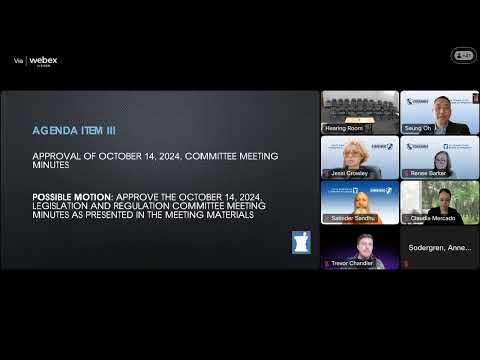
Votes at a glance: the committee approved the draft minutes of the Oct. 17, 2024 Licensing Committee meeting (motion by Vice Chair Chandler; second by Satinder Sandu). Recorded votes were Yes: Trevor Sandler, Renee Barker, Jesse Crowley, Claudia Mercado, Satinder Sandu and Seung Oh. Outcome: approved.
What’s next: committee members asked staff to prepare regulatory options that would (a) allow PIC‑set ratios within stated boundaries, (b) require written policies on training, competency and quality assurance when higher ratios are used, and (c) clearly identify which technician tasks require direct pharmacist verification. The Licensing Committee will revisit draft language at a future meeting and present recommendations to the full Board of Pharmacy.
The committee also accepted public comment from industry and frontline technicians. Commenters urged caution and robust safeguards — including training, observation and quality‑assurance checks — if ratios are made more flexible.
The committee took no final regulatory vote on ratios at the June 12 meeting; members asked staff to draft options and return the matter to the board for further deliberation.