Get Full Government Meeting Transcripts, Videos, & Alerts Forever!
Get email alerts on the Transportation Funding topic
No spam. Unsubscribe anytime.
Fairfax officials give overview of how county pays for large transportation projects
Summary
County transportation staff told the Board of Supervisors’ Transportation Committee on June 3 that major projects require assembling multiple funding sources — local, regional, state and federal — and outlined which programs the county typically taps and what risks and restrictions each carries.
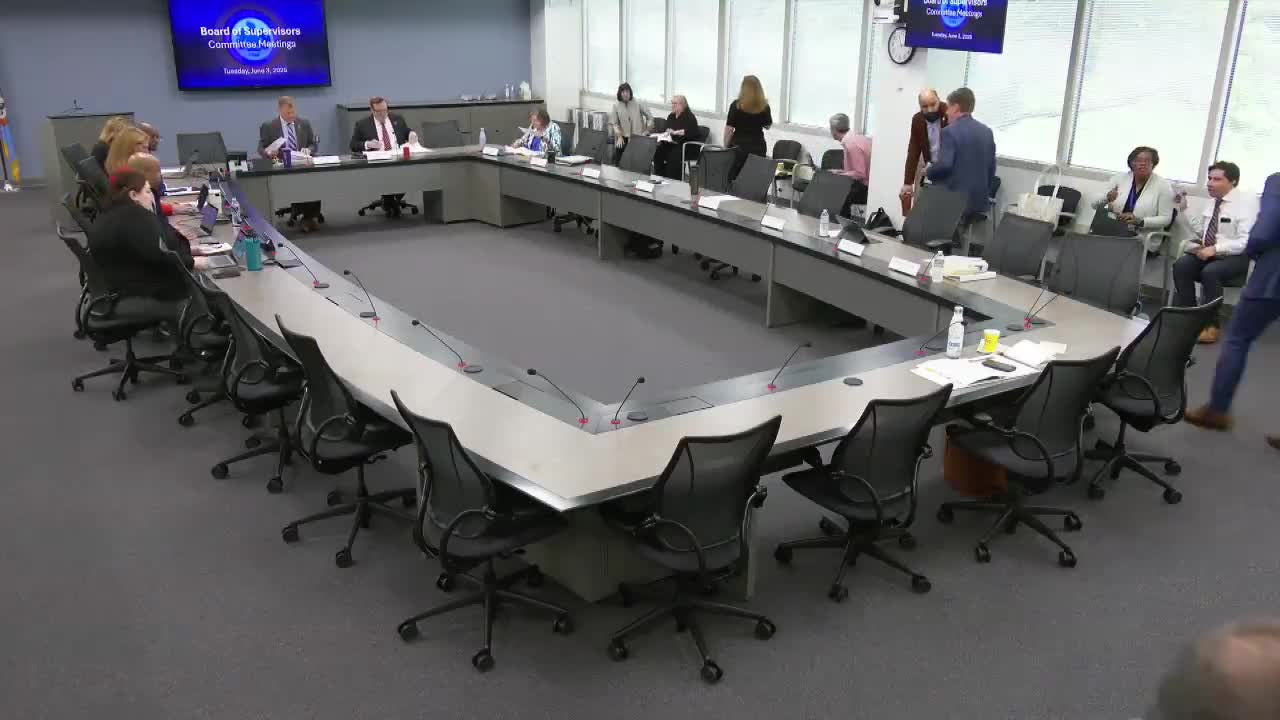
Fairfax County transportation staff told the Board of Supervisors’ Transportation Committee on June 3 that the county must piece together local, regional, state and federal dollars to pay for large projects such as road widenings and bus rapid transit.
The overview, presented by Greg Stevenson, director of the Fairfax County Department of Transportation, and Noel Dominguez, chief of the department’s coordination and funding division, summarized federal grants (CIG, CMAQ, RSTP, Transportation Alternatives, discretionary programs such as RAISE/INFRA), state programs (SmartScale, revenue sharing, MERIT, TRIP), regional sources (NVTA, NVTC/Commuter Choice) and local tools (NVTA 30% local allocations, the commercial/industrial tax option, general obligation bonds, special tax districts and developer proffers).
Stevenson said the county often must “attach the most restrictive funding to the project” to preserve flexible local dollars for other uses. He illustrated the approach with a $100 million road-widening example in which an initial $45 million local commitment, $10 million regional and $10 million state contribution left a $30 million gap. After hypothetical federal and additional regional awards, he showed how the county could reduce the local share and redeploy the freed-up local funds to other projects.
County staff emphasized that each funding source carries its own rules and timing. Dominguez described federal discretionary grants as “each [having] completely different criteria” and noted application complexity ranges from brief CMAQ/RSTP forms to multi‑hundred‑page Capital Investment Grant (CIG) submissions. He also reminded the committee that some grants provide funds several years after award, creating a multi‑year “puzzle” to align project readiness with funding availability.
The presentation included concrete local funding details discussed by staff: NVTA returns 30% of regionally collected revenues to localities, while the county provides roughly 43% of NVTA revenue over time; county transfers to WMATA required by a 2018 state bill total about $27.12 million regionally, producing an annual Fairfax share staff estimated at about $13 million; and the commercial-industrial tax rate can be set up to 12.5¢ per $100 of assessed value and has been enacted at the maximum in Fairfax.
Committee members pressed staff on contingency planning for uncertain federal funding, cost escalation on projects and the county’s use of consultants. Chairman McKay cautioned that “this is a very risky time” for relying on federal dollars and asked how the county monitors federal program changes; Stevenson and Dominguez said they maintain regular contact with federal partners, use contracted federal lobbyists for updates and work to develop contingency plans if federal support weakens. Deputy County Executive Jennifer Miller asked staff to prepare a “plan B” analysis that shows what would stop, what would continue and what the county would need to cover if a particular funding source were lost.
Committee members also requested follow-up information including a breakdown of revenues associated with each local funding option over time, the county’s carryover and committed transportation balances, example project schedules showing how delays and scope changes affect cost, and any changes in VDOT’s funding or cost expectations. Staff agreed to return with those materials and to consider case examples that explain why some projects’ costs rise faster than others.
The committee did not take any formal votes during the presentation. Staff indicated they would continue monitoring federal developments, pursue grant opportunities, and return to the committee with the requested contingency analyses and revenue breakdowns.
Less critical details: staff noted some discretionary federal awards (for example, recent transit-related and planning grants) arrive on inconsistent schedules; transportation alternatives and revenue-sharing cycles are biannual; and NVTA six‑year programming typically schedules funds several years out but can accelerate funding for ready projects.