Get Full Government Meeting Transcripts, Videos, & Alerts Forever!
Get email alerts on the Housing Preservation topic
No spam. Unsubscribe anytime.
UMD researcher briefs Rockville council on strategies to preserve affordable housing
Summary
The University of Maryland graduate researcher presented findings and three recommendations for preserving both subsidized and naturally occurring affordable housing in Rockville: create a centralized subsidized‑housing database, reestablish rehabilitation loan financing, and strengthen a county‑level preservation network.
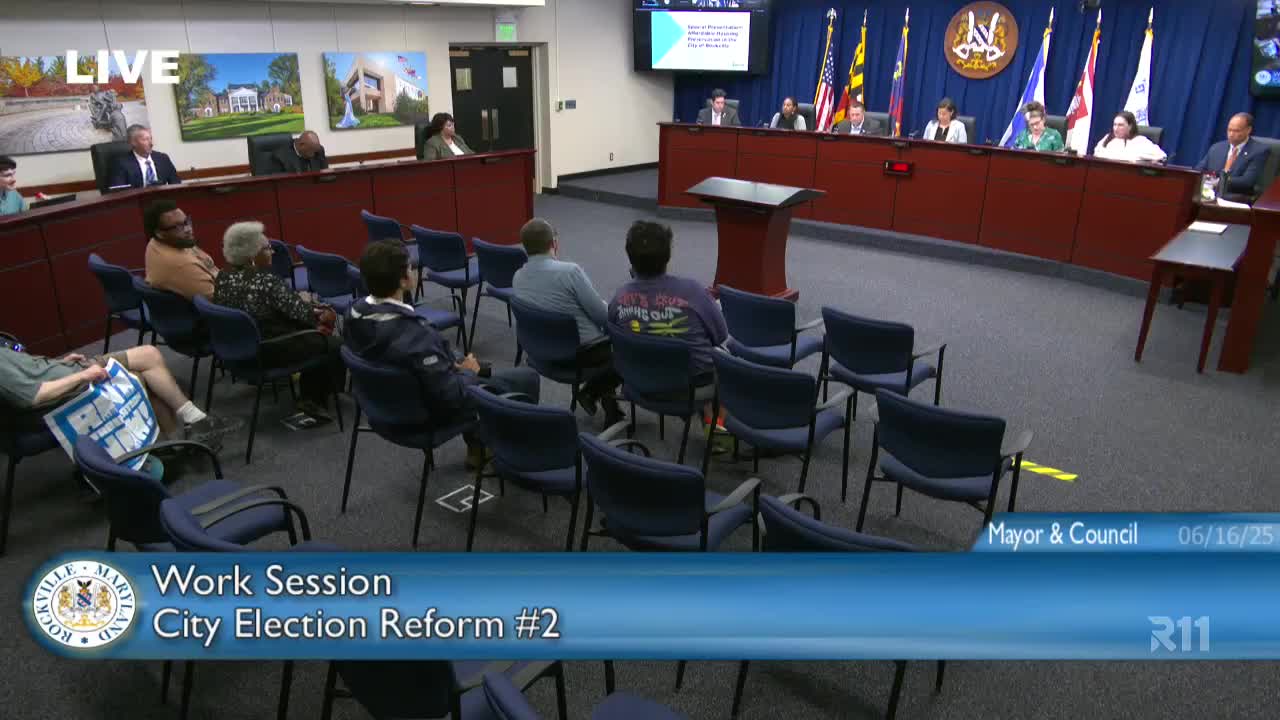
The Rockville Mayor and Council received a presentation June 16 on best practices for preserving affordable housing, delivered by Thomas Garda, a graduate researcher at the University of Maryland School of Public Policy.
Garda framed "preservation" to mean both extending legal affordability (rental covenants and subsidies) and physical preservation of aging housing stock through rehabilitation. His research drew on stakeholder interviews, a review of national cases and a simple risk analysis of properties with affordable units in Rockville.
Key findings and recommendations
- Centralized preservation database: Garda recommended the city (or a county partnership) build a property‑level database to identify subsidized and naturally occurring affordable units, with flags for contract expiration years and proximity to transit. "Property‑by‑property data is critical to identify what is most at risk," Garda said.
- Rehab loan program: Stakeholders told Garda that financing favors new construction; limited local funding for rehabilitation can make it economically easier to demolish and replace older affordable buildings than to rehabilitate them. Garda recommended reviving a county rehab‑loan program or creating a local equivalent to subsidize rehabilitation costs.
- Stakeholder preservation network: Garda urged Rockville to build or join a preservation network (for example, the Montgomery Housing Alliance) so developers, nonprofits and local government can share data and target preservation financing efficiently.
Garda also presented a simple risk scoring table for MPDU (moderately priced dwelling unit) buildings in Rockville and noted that five MPDU properties — totaling 226 MPDU units in his dataset — have affordability covenants coming due within the next 10 years.
Council and staff reaction
Jane Lyons Rader, Housing Programs Manager, thanked Garda and asked staff to follow his recommendations; City Manager Mihailak said the city will incorporate the presentation into ongoing housing work sessions. Several councilmembers raised related questions: whether flood‑map updates and future property tax reassessments have been considered (these can raise rehabilitation costs) and how distressed‑building lists would be integrated.
Next steps
City staff confirmed they will incorporate Garda's recommendations into the housing work program and will provide follow‑up analyses to the council. The presentation is intended to inform later policy choices on preservation financing and program design.
Ending
Garda's recommendations give the city three pragmatic tools — data, rehab financing and a coordinated preservation network — that staff said they will consider as they prepare detailed strategies for the council to review.