Get Full Government Meeting Transcripts, Videos, & Alerts Forever!
Get email alerts on the Housing Rent Stabilization topic
No spam. Unsubscribe anytime.
Hundreds of Rockville renters urge council to adopt rent stabilization as city studies transparency reforms
Summary
Dozens of tenants, tenant-organizers and youth testified at the June 16 Rockville Mayor and Council meeting to demand a binding rent‑stabilization policy. Councilmembers asked staff for more data and signaled follow-up work sessions on landlord‑tenant code updates that would expand transparency and reporting requirements.
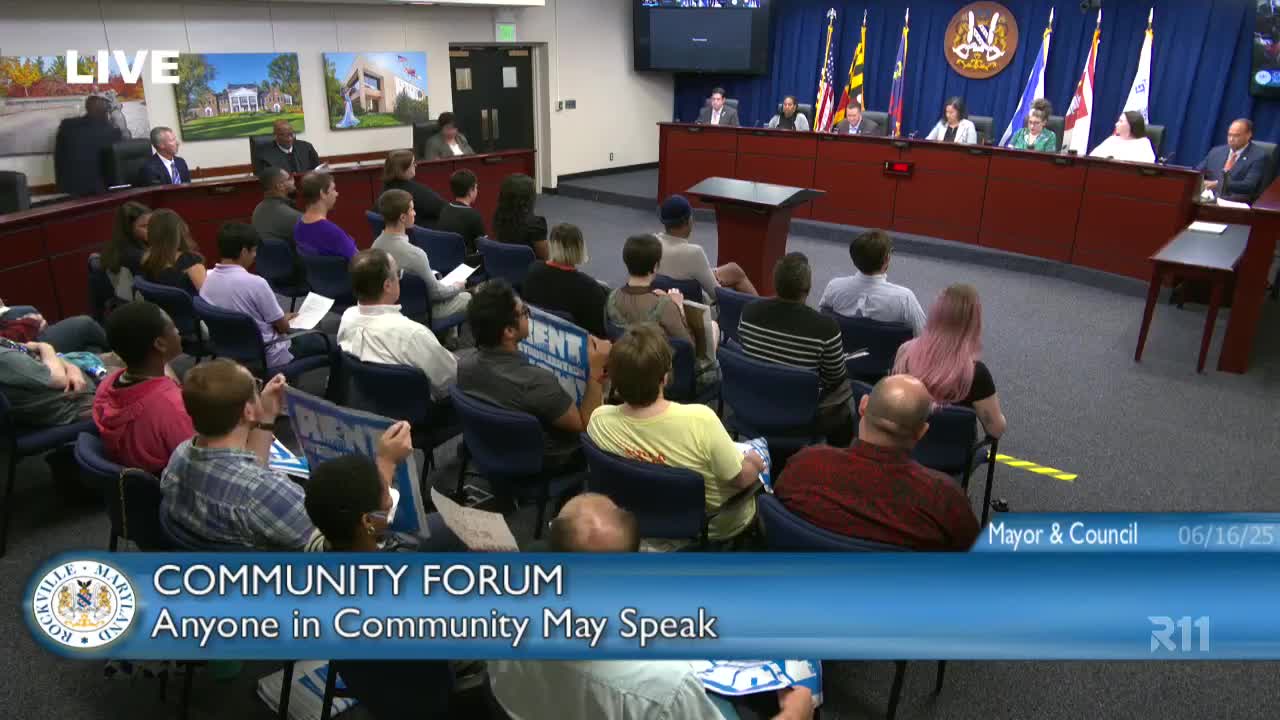
Hundreds of residents packed the Rockville Mayor and Council meeting on June 16, pressing elected officials to adopt binding rent‑stabilization protections and greater rental‑market transparency.
The most direct appeals came during the public‑comment period, when renters, tenant organizers and high‑school students described sharp rent increases, housing instability and the need for enforceable limits on annual rent hikes.
"Without protections, the coming year's rent hikes will push many out of our city," Sunrise Rockville leader Rosie Clemens Cope told the council. "A rent increase isn't just a number. It's a neighbor who can't afford their medication anymore."
The testimony reflected a wide coalition: tenant associations, federal employees, researchers, teachers and youth commissioners. Many speakers cited Montgomery County's 2023 rent‑stabilization measure — which caps increases in many buildings — and urged Rockville to adopt a local policy at least as strong. "I'm here tonight to ask the city of Rockville to pass its own rent stabilization legislation of at least equal strength to the county measure," longtime resident Bradley Ormland said.
Why it matters
At least half of Rockville residents rent their homes, several speakers and staff noted, so policy changes affecting rent‑setting could affect a large share of the population. Tenants and tenant advocates also linked rent hikes to broader problems: family disruption, loss of school stability for children, and health harms among people facing displacement.
What the council and staff said
Councilmember Zola Shaw, who has previously supported tenant protections, said she plans to introduce a "rent stabilization framework" for council discussion and described key elements the community has requested: a cap tied to inflation or a fixed percentage, a ban on many "junk" fees, targeted exemptions for new construction and small landlords, and a petition process for landlords seeking relief in exceptional cases. "I plan to introduce a rent‑stabilization framework, which is a discussion that we could have in the future," Shaw said during old/new business.
City staff and the city manager stressed that the city must balance enforceability with administration demands. Jane Lyons Rader, the city's housing programs manager, and other staff outlined a parallel process to update Chapter 18 of the City Code (the landlord‑tenant chapter) to improve transparency, data collection and tenant protections. The code update aims to clarify lease‑related disclosures, require building‑level reporting on rents and fees, and provide public access to aggregate rent trends.
During a detailed work session on Chapter 18, staff recommended several changes: require landlords to submit standard lease language as part of rental licensing, collect unit‑level rent and vacancy data at license time, remove the current nonprofit exemption for reporting, and publish an interactive public map showing average rental rates and code compliance status. "We think a color‑coded, tiered display based on multi‑year averages provides tenants useful context without exposing raw transaction‑level figures that other landlords might misuse," Lyons Rader said.
Dissent and nuance
Some councilmembers urged caution. Councilmember Adam Van Grama and others said staff must ensure the city has the operational capacity to collect unit‑level data and that any fines or penalties be proportionate. Councilmember John Valeri and others said they did not support removing staff oversight entirely from personnel and policy matters — a separate debate taking place in Chapter 15 code amendments — but did not oppose the landlord‑tenant transparency work session itself.
Next steps
Staff said it will return in the fall with a draft Chapter 18 code update that includes detailed reporting forms and proposed public displays, and will continue targeted tenant outreach this summer, including door‑to‑door canvassing. Councilmember Shaw and Councilmember David Miles said they will seek a formal work session to discuss rent stabilization options; the city manager said staff would coordinate with councilmembers on scheduling.
Voices quoted
- "A rent increase isn't just a number. It's a neighbor who can't afford their medication anymore," Rosie Clemens Cope, Sunrise Rockville organizer, public commenter. - "I move to reappoint Barry Stadt to serve a full 3 year term until 07/01/2028 to the Landlord Tenant Affairs Commission," Councilmember Zola Shaw (on an unrelated reappointment vote earlier in the evening). - "We think a color‑coded, tiered display based on multi‑year averages provides tenants useful context," Jane Lyons Rader, Housing Programs Manager, City of Rockville (work session).
Ending
Councilmembers and staff left the meeting with several clear assignments: staff will continue tenant outreach and refine Chapter 18 draft language; councilmembers who favor a rent‑stabilization study will seek a formal work session; and the city will return later this year with concrete draft code changes and public‑facing data proposals for council review.